Introduction
In today's digital-first economy, data has become one of the most valuable assets a business can own. Every customer interaction, online purchase, website visit, social media engagement, and operational process generates valuable information. However, collecting data alone is not enough. The real competitive advantage comes from analyzing that data and using it to make informed business decisions.
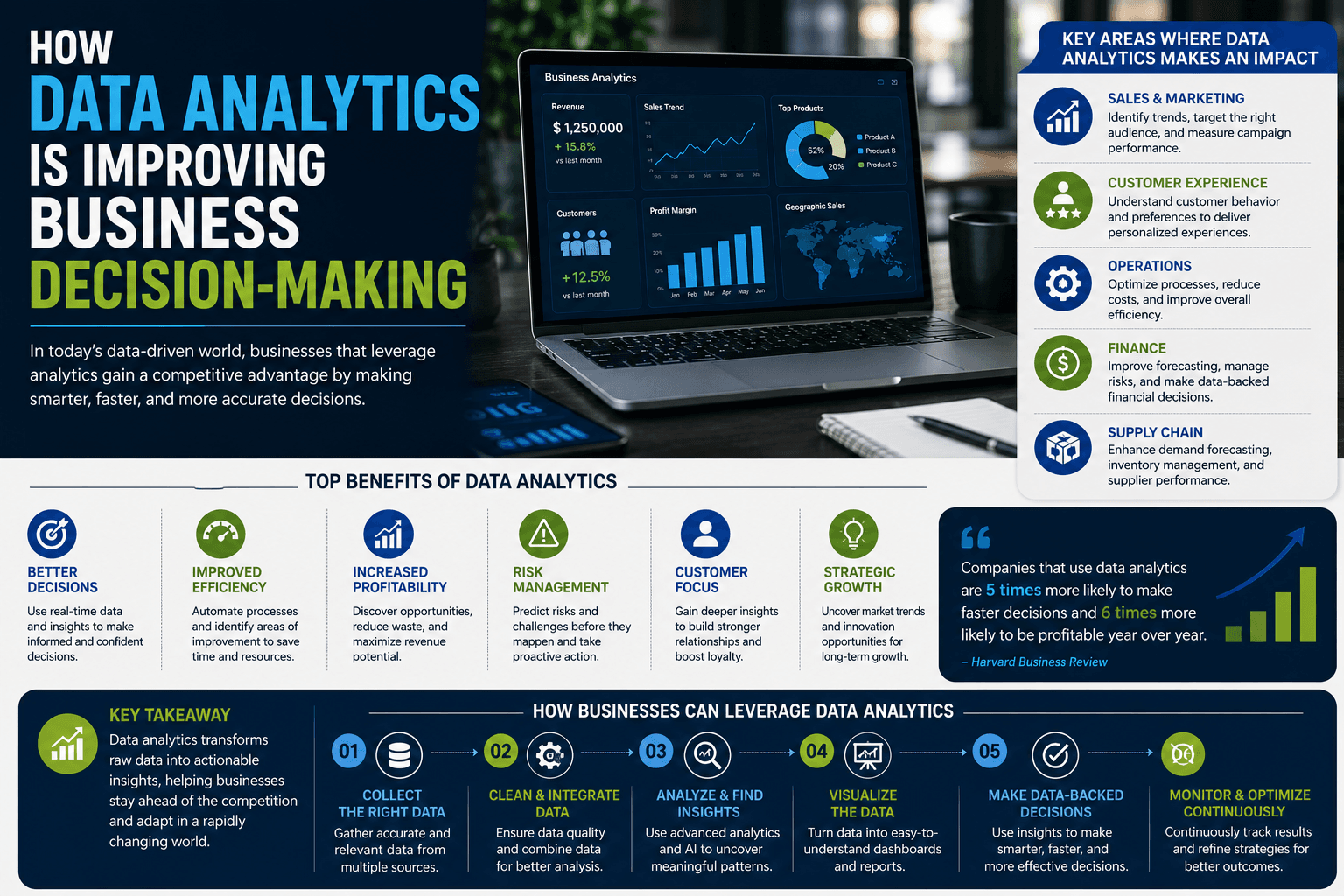
Data analytics has transformed the way organizations operate by replacing assumptions with evidence-based strategies. Businesses of all sizes now rely on analytics to understand customers, improve operations, reduce risks, optimize marketing campaigns, and identify new growth opportunities. Companies that embrace data-driven decision-making are often more agile, more profitable, and better prepared for market changes than those that rely solely on intuition.
As technology continues to evolve, data analytics is becoming an essential part of modern business strategy rather than an optional investment.
What Is Data Analytics?
Data analytics is the process of collecting, organizing, and analyzing data to discover meaningful insights that support better decision-making. Businesses use various analytical techniques to identify trends, measure performance, predict future outcomes, and solve complex problems.
Modern analytics platforms combine artificial intelligence, machine learning, automation, and visualization tools to help organizations process massive amounts of information quickly and accurately. Interactive dashboards and real-time reports allow decision-makers to monitor business performance without waiting for monthly or quarterly reports.
Instead of guessing what customers want or which strategy might work, businesses can rely on measurable facts supported by data.
Why Data-Driven Decision-Making Matters
Markets are becoming increasingly competitive and customer expectations continue to rise. Organizations must react quickly to changing demand, economic conditions, and technological innovation.
Data-driven decision-making offers several advantages:
Reduces uncertainty and guesswork
Supports faster decision-making
Improves strategic planning
Identifies new business opportunities
Measures business performance accurately
Enables continuous improvement
Leaders who base decisions on reliable information can respond more effectively to challenges while minimizing costly mistakes.
Understanding Customers Through Data
One of the greatest strengths of data analytics is its ability to provide deep insights into customer behavior.
Businesses can analyze:
Purchase history
Browsing activity
Customer feedback
Product preferences
Geographic location
Engagement across digital channels
These insights allow organizations to create highly personalized experiences. Rather than offering the same products or promotions to everyone, businesses can deliver recommendations tailored to individual customer needs.
Personalization increases customer satisfaction, improves engagement, and encourages repeat purchases. It also helps companies build stronger long-term relationships with their audiences.
Improving Operational Efficiency
Efficient operations are essential for maintaining profitability, and data analytics plays a major role in identifying areas for improvement.
Organizations use analytics to monitor workflows, production systems, and business processes in real time. Managers can quickly identify bottlenecks, eliminate unnecessary costs, and improve resource allocation.
Examples include:
Optimizing manufacturing processes
Improving warehouse management
Reducing delivery times
Streamlining supply chain operations
Managing inventory more effectively
Even small operational improvements can result in significant cost savings over time.
Smarter Financial Planning
Financial decisions require accuracy, and data analytics provides valuable insights that help businesses manage budgets, forecast revenue, and reduce financial risk.
Financial teams use analytics to:
Forecast future sales
Monitor cash flow
Analyze spending patterns
Detect fraudulent activities
Evaluate investment opportunities
Predictive models also help organizations prepare for different economic scenarios, allowing leaders to make proactive financial decisions instead of reacting after problems arise.
Better financial planning improves stability and supports long-term business growth.
Data Analytics in Marketing
Marketing has evolved significantly with the rise of data analytics.
Instead of relying on broad advertising campaigns, businesses now use customer insights to create targeted marketing strategies that deliver better results.
Analytics helps marketers:
Segment audiences
Track campaign performance
Measure return on investment (ROI)
Identify high-performing channels
Optimize advertising budgets
Businesses can monitor campaign performance in real time and adjust their strategies immediately if results fall below expectations.
This data-driven approach reduces wasted marketing spend while increasing conversions and customer engagement.
Predictive Analytics for Future Growth
One of the most powerful capabilities of modern analytics is predictive analysis.
Predictive analytics uses historical data, statistical models, and artificial intelligence to estimate future outcomes.
Businesses use predictive analytics to:
Forecast product demand
Predict customer churn
Estimate future sales
Anticipate market trends
Plan inventory levels
Reduce supply chain disruptions
Rather than reacting to changes after they occur, organizations can prepare in advance and make strategic decisions with greater confidence.
Companies that successfully use predictive analytics often gain a significant competitive advantage.
Supporting Better Human Resource Decisions
Human resource departments are increasingly relying on analytics to improve workforce management.
HR professionals use data to:
Improve recruitment strategies
Measure employee performance
Identify training needs
Predict employee turnover
Analyze workforce productivity
By understanding workforce trends, organizations can make better hiring decisions and create stronger employee development programs.
Analytics also supports diversity initiatives, workforce planning, and talent retention efforts.
Real-Time Business Intelligence
Modern businesses operate in environments where conditions can change rapidly.
Real-time analytics enables organizations to monitor critical performance indicators as events occur.
Business leaders can instantly view:
Sales performance
Customer activity
Inventory levels
Website traffic
Marketing results
Financial performance
This allows companies to respond immediately to changing market conditions, customer demand, or operational issues.
Real-time decision-making has become particularly valuable for industries such as retail, logistics, healthcare, finance, and e-commerce.
Artificial Intelligence and Advanced Analytics
Artificial intelligence is taking data analytics to an entirely new level.
AI-powered analytics systems automatically identify hidden patterns, detect anomalies, generate forecasts, and recommend actions without requiring extensive manual analysis.
Benefits of AI-driven analytics include:
Faster processing of large datasets
More accurate predictions
Automated reporting
Intelligent business recommendations
Continuous learning and improvement
As AI technologies continue to advance, businesses will gain access to even more sophisticated decision-support tools.
Organizations that combine AI with strong data strategies will be better positioned to innovate and compete in the future.
Challenges Businesses Should Consider
Although data analytics offers enormous benefits, successful implementation requires careful planning.
Common challenges include:
Protecting sensitive customer data
Maintaining data quality
Integrating multiple data sources
Managing implementation costs
Addressing skill shortages
Complying with privacy regulations
Businesses should establish clear data governance policies, invest in employee training, and adopt reliable analytics platforms to maximize long-term value.
High-quality data remains the foundation of effective analytics.
The Future of Data Analytics
The future of data analytics will be shaped by artificial intelligence, automation, cloud computing, and real-time data processing.
Organizations are expected to rely more heavily on self-service analytics platforms that allow employees across departments to access valuable insights without requiring advanced technical expertise.
Emerging technologies such as generative AI, automated decision support, and advanced predictive modeling will further improve the speed and accuracy of business decisions.
Companies that continue investing in data literacy and analytics capabilities will be better prepared for future market opportunities.
Conclusion
Data analytics has fundamentally changed how businesses make decisions. Instead of relying on intuition or outdated reports, organizations can now access real-time insights that improve customer experiences, optimize operations, strengthen financial planning, and reduce business risks.
Whether improving marketing performance, managing supply chains, forecasting demand, or supporting strategic planning, data analytics provides the intelligence needed to make confident business decisions.
As digital transformation continues across every industry, organizations that embrace data-driven decision-making will be better positioned to innovate, adapt, and achieve sustainable growth. In today's competitive marketplace, data is no longer simply information—it is a strategic asset that drives smarter decisions and long-term business success.
Frequently Asked Questions
What is data analytics in business?
Data analytics is the process of examining business data to uncover insights that improve decision-making, operational efficiency, and overall performance.
Why is data analytics important?
It helps businesses make informed decisions, understand customer behavior, reduce risks, optimize operations, and identify growth opportunities.
How does predictive analytics benefit businesses?
Predictive analytics forecasts future trends, customer behavior, and demand, allowing organizations to plan proactively and improve business outcomes.
Which industries benefit most from data analytics?
Retail, healthcare, finance, manufacturing, logistics, e-commerce, education, telecommunications, and technology all use data analytics to improve performance and competitiveness.How Data Analytics Is Transforming Business Decision-Making