
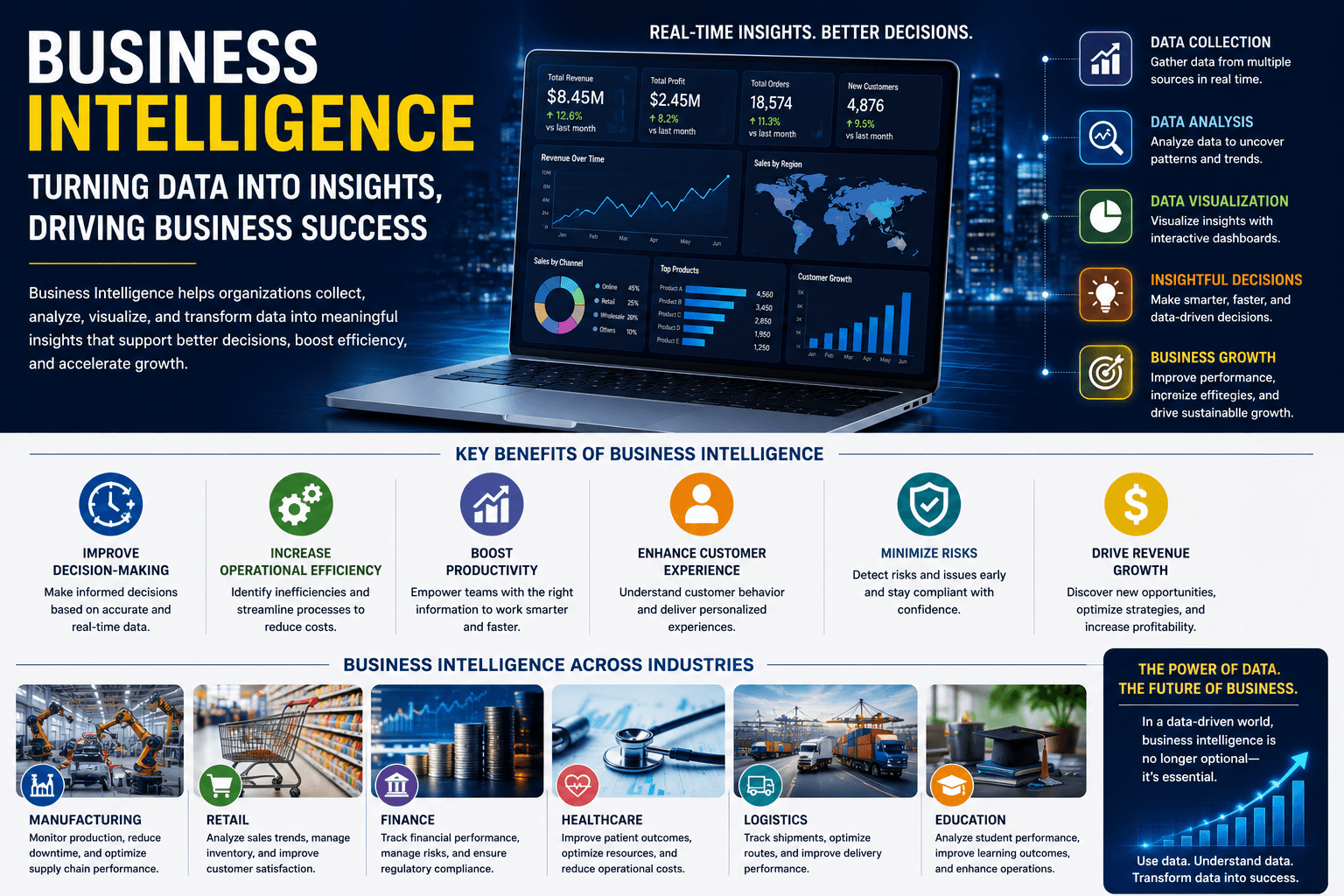

Business intelligence (BI) has become one of the most valuable technologies for organizations seeking sustainable growth in today's competitive global economy. As businesses generate enormous volumes of data every day, the ability to transform information into actionable insights has become a major competitive advantage. In 2026, companies across every industry are investing in business intelligence solutions to improve decision-making, increase efficiency, and identify new growth opportunities.
Business intelligence combines data collection, analytics, reporting, visualization, and artificial intelligence to help organizations understand performance and make informed strategic decisions. Instead of relying on intuition alone, executives can now access real-time dashboards that provide detailed insights into sales, operations, customer behavior, marketing performance, and financial results.
The rapid growth of digital transformation has significantly increased the importance of business intelligence. Organizations collect information from websites, mobile applications, customer relationship management systems, enterprise software, social media platforms, and supply chain operations. Business intelligence platforms integrate these multiple data sources into a single environment where leaders can analyze trends and monitor key performance indicators more effectively.
One of the greatest advantages of business intelligence is improved decision-making. Executives no longer need to wait for monthly reports before identifying business challenges. Modern BI dashboards provide real-time visibility into company performance, allowing managers to respond quickly to changing market conditions, customer demands, and operational issues. Faster access to reliable information supports more confident and strategic business decisions.
Artificial intelligence is enhancing business intelligence capabilities through predictive analytics and machine learning. AI-powered BI platforms identify hidden patterns, forecast future demand, detect operational risks, and recommend data-driven actions. Predictive analytics helps businesses anticipate customer behavior, optimize inventory levels, improve sales forecasting, and reduce unnecessary operational expenses.
Sales and marketing departments are among the biggest beneficiaries of business intelligence. Companies analyze customer purchasing behavior, demographic information, website traffic, and campaign performance to create highly targeted marketing strategies. Businesses can identify their most profitable customer segments, improve advertising return on investment, and personalize customer experiences using data-driven insights.
Financial management has also improved significantly through business intelligence solutions. Finance teams use BI software to monitor cash flow, revenue trends, expenses, profitability, and investment performance. Automated financial reporting reduces manual work while improving accuracy and enabling faster strategic planning. Business leaders gain a clearer understanding of financial performance through interactive dashboards and customizable reports.
Supply chain management has become increasingly data-driven with business intelligence technologies. Organizations monitor inventory levels, supplier performance, transportation costs, warehouse efficiency, and customer demand using real-time analytics. This visibility allows companies to optimize logistics operations, reduce delays, improve forecasting, and strengthen supply chain resilience during periods of market uncertainty.
Customer experience has become another major focus of business intelligence. Companies analyze customer feedback, online reviews, purchasing habits, and support interactions to better understand customer expectations. These insights help organizations improve products, enhance service quality, reduce customer churn, and build stronger long-term relationships with clients.
Human resources departments are also embracing business intelligence. HR analytics provide valuable insights into employee performance, recruitment efficiency, workforce planning, training effectiveness, and employee retention. Organizations use these insights to improve hiring decisions, strengthen workplace culture, and increase overall productivity.
Cloud computing has accelerated the adoption of business intelligence by making advanced analytics accessible to organizations of all sizes. Cloud-based BI platforms eliminate the need for expensive infrastructure while providing secure access to business data from anywhere in the world. Small and medium-sized businesses now have access to powerful analytical tools that were once available only to large enterprises.
Cybersecurity remains a critical consideration as organizations rely more heavily on data. Business intelligence platforms incorporate advanced security measures including encryption, user authentication, access controls, and compliance monitoring to protect sensitive business information. Companies continue investing in secure data governance practices to maintain customer trust and meet regulatory requirements.
Data visualization has become one of the most valuable features of modern business intelligence. Interactive charts, graphs, heat maps, and dashboards enable executives to understand complex information quickly. Visual reporting improves communication across departments while helping decision-makers identify opportunities and challenges more effectively.
The rise of self-service business intelligence is empowering employees throughout organizations. Rather than relying exclusively on IT departments, managers and business professionals can generate reports, analyze data, and create dashboards independently. This flexibility improves operational efficiency while encouraging data-driven decision-making across all business functions.
As competition continues increasing across global markets, companies are recognizing that data is one of their most valuable business assets. Organizations capable of collecting, analyzing, and acting upon information more effectively often outperform competitors by identifying market trends earlier, improving operational efficiency, and responding more quickly to customer needs.
Looking ahead, business intelligence will become even more integrated with artificial intelligence, automation, cloud computing, and predictive analytics. Businesses will increasingly rely on intelligent systems capable of providing proactive recommendations, identifying hidden opportunities, and supporting long-term strategic planning. These innovations will continue transforming how organizations operate in an increasingly digital economy.
Companies that invest in business intelligence today are building stronger foundations for future success. Data-driven organizations are better equipped to manage uncertainty, improve customer satisfaction, increase profitability, and maintain competitive advantages within rapidly changing industries.
Conclusion
Business intelligence has evolved into an essential strategic tool for modern organizations. By combining advanced analytics, artificial intelligence, cloud computing, and real-time reporting, businesses can make faster and more informed decisions while improving operational performance. As digital transformation continues accelerating, organizations that prioritize business intelligence will be better positioned to drive innovation, strengthen competitiveness, and achieve sustainable long-term growth.