How Predictive Analytics Is Improving Business Decision-Making
R
In today's data-driven economy, businesses generate massive amounts of information every second. Customer transactions, website interactions, supply chain activities, financial records, and operational data all provide valuable insights. However, simply collecting data is no longer enough. The organizations that succeed in 2026 are those that can transform raw information into accurate predictions that support faster and smarter decision-making.
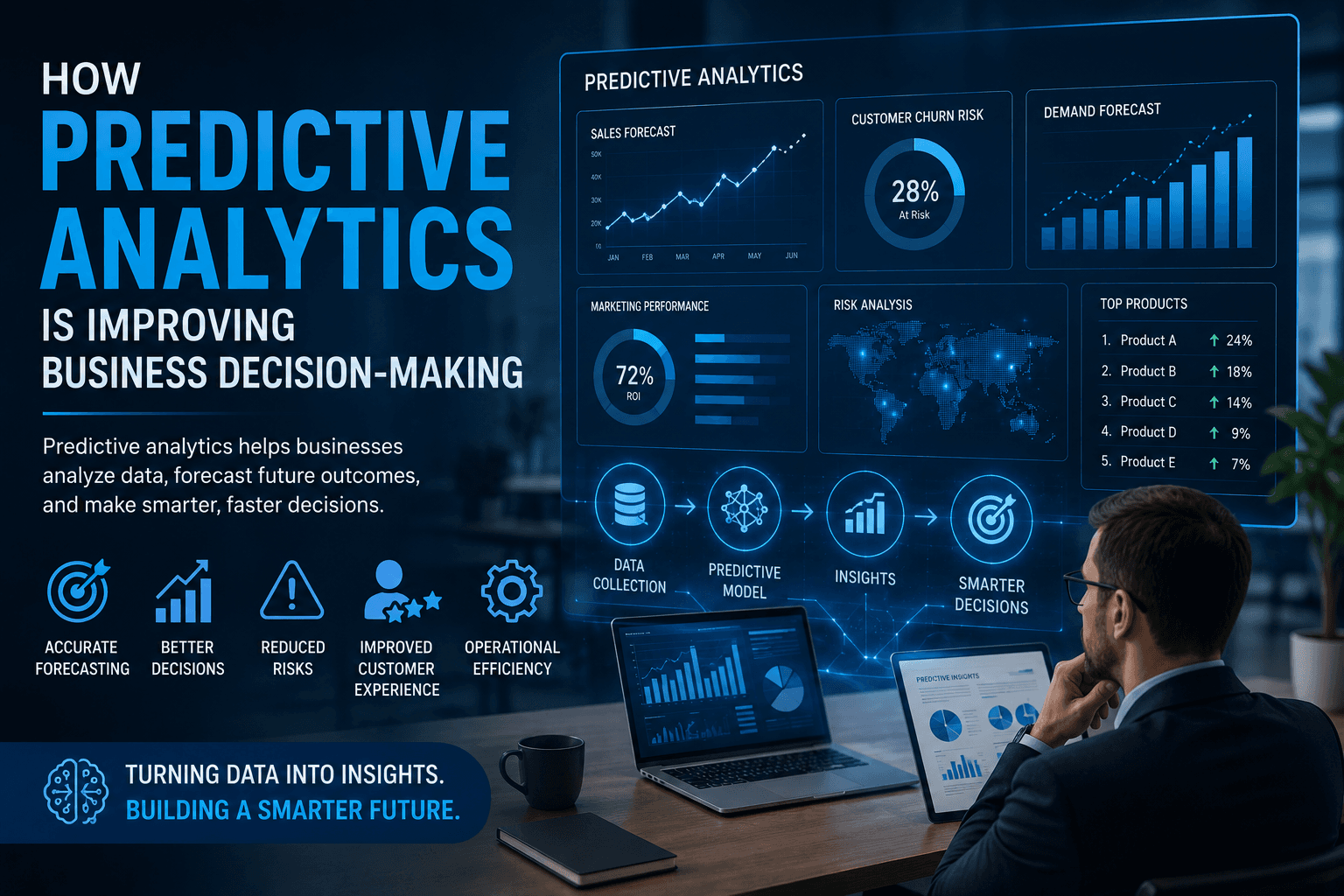
Predictive analytics has emerged as one of the most valuable technologies helping businesses anticipate future outcomes rather than simply analyzing past performance. By combining artificial intelligence (AI), machine learning, statistical modeling, and big data, predictive analytics enables organizations to identify patterns, forecast trends, reduce risks, and uncover new growth opportunities.
What Is Predictive Analytics?
Predictive analytics uses historical data, current information, and advanced algorithms to estimate future events and behaviors. Instead of asking what happened, businesses can answer questions such as:
Which customers are most likely to make another purchase?
Which products will experience higher demand next month?
When is equipment likely to require maintenance?
Which marketing campaign will generate the highest return?
What business risks should leaders prepare for?
These insights allow companies to make proactive decisions with greater confidence.
Why Businesses Are Investing in Predictive Analytics
Organizations face increasing competition, changing consumer behavior, and rapidly evolving market conditions. Predictive analytics helps businesses respond more effectively by improving planning and reducing uncertainty.
Companies invest in predictive analytics to:
Improve forecasting accuracy
Reduce operational costs
Enhance customer experiences
Optimize inventory
Increase sales performance
Support strategic planning
Minimize business risks
As AI technology becomes more accessible, predictive analytics is no longer limited to large enterprises. Small and medium-sized businesses are also adopting these solutions.
Improving Customer Insights
Understanding customer behavior is essential for long-term success.
Predictive analytics helps businesses identify purchasing patterns, customer preferences, and future buying intentions.
Organizations can use these insights to:
Personalize marketing campaigns
Recommend products
Improve customer retention
Reduce customer churn
Create targeted promotions
Personalized experiences strengthen customer relationships while increasing revenue opportunities.
Smarter Financial Planning
Finance departments increasingly rely on predictive analytics to improve decision-making.
Advanced forecasting models help organizations:
Predict cash flow
Estimate future revenue
Identify unusual financial activity
Improve budgeting
Evaluate investment opportunities
These capabilities enable financial leaders to make more informed strategic decisions.
Supply Chain Optimization
Predictive analytics improves supply chain efficiency by forecasting demand and identifying potential disruptions before they occur.
Businesses can:
Optimize inventory levels
Reduce stock shortages
Improve warehouse management
Plan transportation more effectively
Minimize waste
Accurate forecasting supports better customer service while reducing unnecessary operational costs.
Better Risk Management
Every business faces risks ranging from market volatility to cybersecurity threats.
Predictive models help organizations identify potential risks early, allowing leaders to develop mitigation strategies before problems escalate.
Risk analysis supports stronger business continuity planning and operational resilience.
Marketing Performance
Marketing teams use predictive analytics to maximize campaign performance.
AI-powered models analyze customer behavior to determine:
The best time to send emails
Which audiences are most likely to convert
Which advertisements generate the highest engagement
How customers interact across multiple channels
These insights improve marketing efficiency while reducing advertising costs.
Human Resources and Workforce Planning
Predictive analytics is also improving workforce management.
Human resource teams use predictive models to:
Forecast hiring needs
Identify employee turnover risks
Improve recruitment strategies
Support workforce planning
Enhance employee engagement
These insights help organizations build stronger and more productive teams.
Artificial Intelligence Enhances Accuracy
Machine learning models become more accurate over time as they analyze additional data and identify emerging trends.
This allows businesses to adapt quickly to changing market conditions while improving forecasting reliability.
Challenges Organizations Should Address
Although predictive analytics offers significant advantages, successful implementation requires high-quality data and responsible governance.
Businesses should focus on:
Data accuracy
Privacy protection
Cybersecurity
Ethical AI practices
Skilled analytics teams
Continuous model improvement
Strong governance ensures predictions remain reliable and trustworthy.
The Future of Predictive Analytics
Predictive analytics will continue expanding across industries as AI technology becomes more sophisticated.
Organizations will increasingly combine predictive analytics with automation, real-time dashboards, digital twins, and generative AI to support faster business decisions.
Businesses that develop strong data capabilities today will be better prepared to compete in tomorrow's digital economy.
Conclusion
Predictive analytics is transforming business decision-making by helping organizations anticipate future trends, reduce uncertainty, improve operational efficiency, and create better customer experiences. From marketing and finance to supply chain management and workforce planning, predictive insights enable businesses to make proactive, data-driven decisions.
As artificial intelligence and advanced analytics continue to evolve, predictive analytics will remain a key competitive advantage for organizations seeking sustainable growth, innovation, and long-term success in an increasingly data-driven world.
| Category | Details |
|---|---|
| Topic | AI |
| Author | Rose |
| Published | 30/06/2026 |
| Read Time | Not set |
R