Starting an online business in 2026 has become more accessible than ever. You no longer need a large office, expensive equipment, or a huge team to begin. With a laptop, internet connection, useful skills, and the right strategy, entrepreneurs can build businesses from almost anywhere.
Artificial intelligence, social media, e-commerce, digital products, and remote services are creating new opportunities for people who want to start with a limited budget.
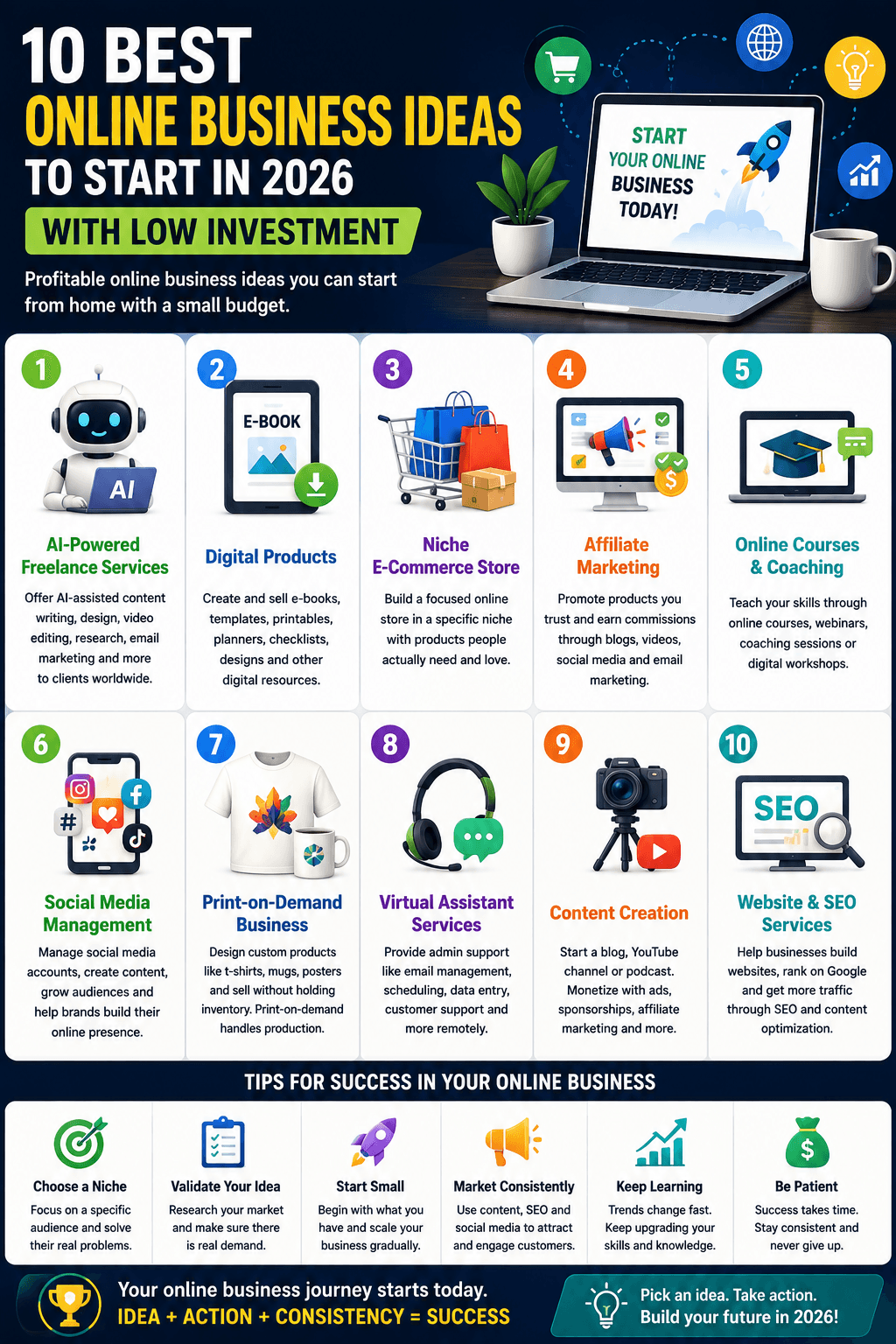
Here are 10 of the best online business ideas to consider in 2026 with relatively low startup costs.
1. AI-Powered Freelance Services
AI has created new opportunities for freelancers who know how to use technology effectively.
You can offer services such as:
AI-assisted content writing
Social media management
Graphic design
Video editing
Research
Email marketing
Presentation creation
AI workflow setup
The important thing is to sell a useful service, rather than simply selling access to an AI tool.
For example, instead of saying "I use AI to write articles," offer "SEO blog content for small businesses."
2. Digital Products
Digital products are attractive because you can create them once and sell them repeatedly.
Examples include:
E-books
Templates
Planners
Checklists
Design assets
Business documents
Educational guides
Online resources
You can sell digital products through your own website or suitable online marketplaces.
The best products usually solve a specific problem for a specific audience.
3. Niche E-Commerce Store
You don't necessarily need a massive online store to succeed in e-commerce.
Instead, focus on a specific niche.
Examples include:
Personalized gifts
Fitness accessories
Hobby products
Pet products
Home organization products
Specialized stationery
Eco-conscious products
A niche makes it easier to understand your target customers and create focused marketing campaigns.
4. Affiliate Marketing
Affiliate marketing allows you to earn commissions by recommending products or services from other companies.
You can build an audience through:
Blogs
Pinterest
YouTube
Social media
Newsletters
Niche websites
For example, a website about productivity could publish useful articles about productivity software and include relevant affiliate links.
The key to long-term success is creating helpful content instead of publishing content solely to promote affiliate products.
5. Online Courses and Coaching
If you have expertise in a particular area, you can turn that knowledge into an online business.
Potential subjects include:
Digital marketing
Graphic design
Coding
Language learning
Business skills
Photography
Personal productivity
Software tutorials
You can offer recorded courses, live classes, one-on-one coaching, or group programs.
6. Social Media Management
Many small businesses struggle to maintain an active social media presence.
If you understand platforms such as Instagram, Facebook, TikTok, LinkedIn, or Pinterest, you can offer social media management services.
Your services could include:
Content planning
Caption writing
Graphic creation
Scheduling
Community management
Performance reporting
Short-form video planning
AI tools can help speed up research and content production while you focus on strategy and client communication.
7. Print-on-Demand Business
Print-on-demand allows entrepreneurs to sell customized products without purchasing large quantities of inventory upfront.
Products can include:
T-shirts
Mugs
Posters
Phone cases
Tote bags
Notebooks
Home décor
When a customer places an order, the product is produced and shipped through the print-on-demand provider.
Your main responsibilities are creating designs, choosing a niche, building a brand, and marketing the products.
8. Virtual Assistant Services
Businesses and entrepreneurs often need help with administrative tasks.
A virtual assistant can provide services such as:
Email management
Calendar management
Data organization
Customer support
Research
Appointment scheduling
Document preparation
Social media assistance
This can be a relatively simple online business to start if you already have strong organizational and communication skills.
9. Content Creation
Content creation can become a business when you build a focused audience.
You could create content around:
Technology
AI
Business
Finance
Travel
Education
Food
Fitness
Entertainment
Potential revenue sources include advertising, sponsorships, affiliate marketing, memberships, digital products, and services.
You don't need millions of followers. A smaller audience that strongly trusts your expertise can also have significant commercial value.
10. Website and SEO Services
Businesses need websites that can attract visitors and convert them into customers.
If you learn website development, SEO, or both, you can offer services to small businesses.
Possible services include:
Website creation
SEO optimization
Keyword research
Content strategy
Local SEO
Technical SEO
Website maintenance
Conversion optimization
AI can help with research and repetitive tasks, but strong strategy and technical knowledge remain valuable.
How to Choose the Right Online Business
Choosing the right idea depends on your skills, budget, and goals.
Ask yourself:
What skills do I already have?
Starting with an existing skill can reduce the time needed to get your first customer.
How much money can I invest?
Some businesses can be started with very little money, while e-commerce or software businesses may require more investment.
How quickly do I need revenue?
Service businesses can sometimes generate revenue sooner because you can sell your skills directly to clients.
Digital products and content businesses may take longer to build an audience.
Who is my target customer?
A clear target audience makes it easier to develop products and marketing messages.
Low Investment Doesn't Mean No Investment
One common misconception is that an online business costs nothing.
Even a low-cost business may require spending on:
Domain registration
Website hosting
Software
Marketing
Design
Payment processing
Business education
However, many entrepreneurs can start small and reinvest their initial revenue into the business.
How AI Can Help New Entrepreneurs
AI can reduce the time required for many business tasks.
Entrepreneurs can use AI for:
Brainstorming business ideas
Market research
Content planning
Customer support
Data analysis
Marketing drafts
Product research
Workflow automation
However, AI should support your business rather than replace your judgment.
Always review important information and make sure your final products and services provide genuine value.
Tips for Starting an Online Business in 2026
Start With One Idea
Don't try to launch five businesses simultaneously.
Choose one model and test it.
Solve a Real Problem
Customers are more likely to pay for a product or service that saves time, reduces costs, improves results, or solves a genuine problem.
Start Small
You don't need a perfect website or huge product catalog on day one.
Create a simple version, get feedback, and improve.
Build an Audience
Use useful content to attract people who are interested in your niche.
Email lists, social media, search traffic, and communities can all help.
Track Your Results
Monitor important metrics such as:
Visitors
Leads
Customers
Conversion rate
Revenue
Customer acquisition cost
Use the data to decide what to improve.
Conclusion
2026 offers many opportunities for entrepreneurs who want to start an online business with a relatively small initial investment.
AI-powered services, digital products, niche e-commerce, affiliate marketing, online education, social media management, print-on-demand, virtual assistance, content creation, and SEO services are all worth exploring.
But there is no guaranteed shortcut to online income.
The strongest approach is to choose a specific problem, serve a clear audience, start small, use technology wisely, and consistently improve your offer.
With the right strategy and persistence, a low-cost online business can become a sustainable source of income over time.
FAQs
1. What is the best online business to start in 2026?
There is no single best option. Freelancing, AI services, digital products, affiliate marketing, online education, niche e-commerce, and SEO services can all be potential opportunities.
2. Which online business requires the least investment?
Service-based businesses such as freelancing, virtual assistance, consulting, and social media management can often be started with relatively low upfront costs.
3. Can I start an online business without a website?
Yes. You can initially use social media, freelance platforms, marketplaces, or other online channels. However, having your own website can help establish a long-term brand presence.
4. Can AI help me start an online business?
Yes. AI can assist with research, content creation, marketing, customer service, product development, and automation.
5. Is affiliate marketing still worth it in 2026?
Affiliate marketing can still be a viable model, but success generally requires useful content, a targeted audience, and trusted recommendations.
6. What is a good online business for beginners?
Freelancing, virtual assistance, social media management, and digital products can be approachable starting points depending on your skills.
7. How much money do I need to start an online business?
The amount varies by business model. Some service businesses can start with basic equipment and software, while e-commerce and other models may require more capital.
8. How long does it take to make money online?
There is no guaranteed timeline. Some service businesses may find customers relatively quickly, while content-based and product businesses can take longer to build.
9. Should I use AI-generated content for my business?
AI can help with content production, but you should review, edit, fact-check, and personalize the content before publishing or selling it.
10. What is the most important thing when starting an online business?
Focus on solving a real customer problem. A useful product or service and a clearly defined audience are more important than simply following the latest online business trend.