
Video marketing has always been one of the most effective ways to attract customers, but creating high-quality videos traditionally required significant time, money, and creative resources. In 2026, artificial intelligence is changing that reality.
AI-powered video creation tools now enable businesses to produce professional marketing videos in minutes instead of days. From product promotions to social media campaigns, AI-generated video marketing is becoming the new standard for companies looking to grow their brands quickly and efficiently.
What Is AI-Generated Video Marketing?
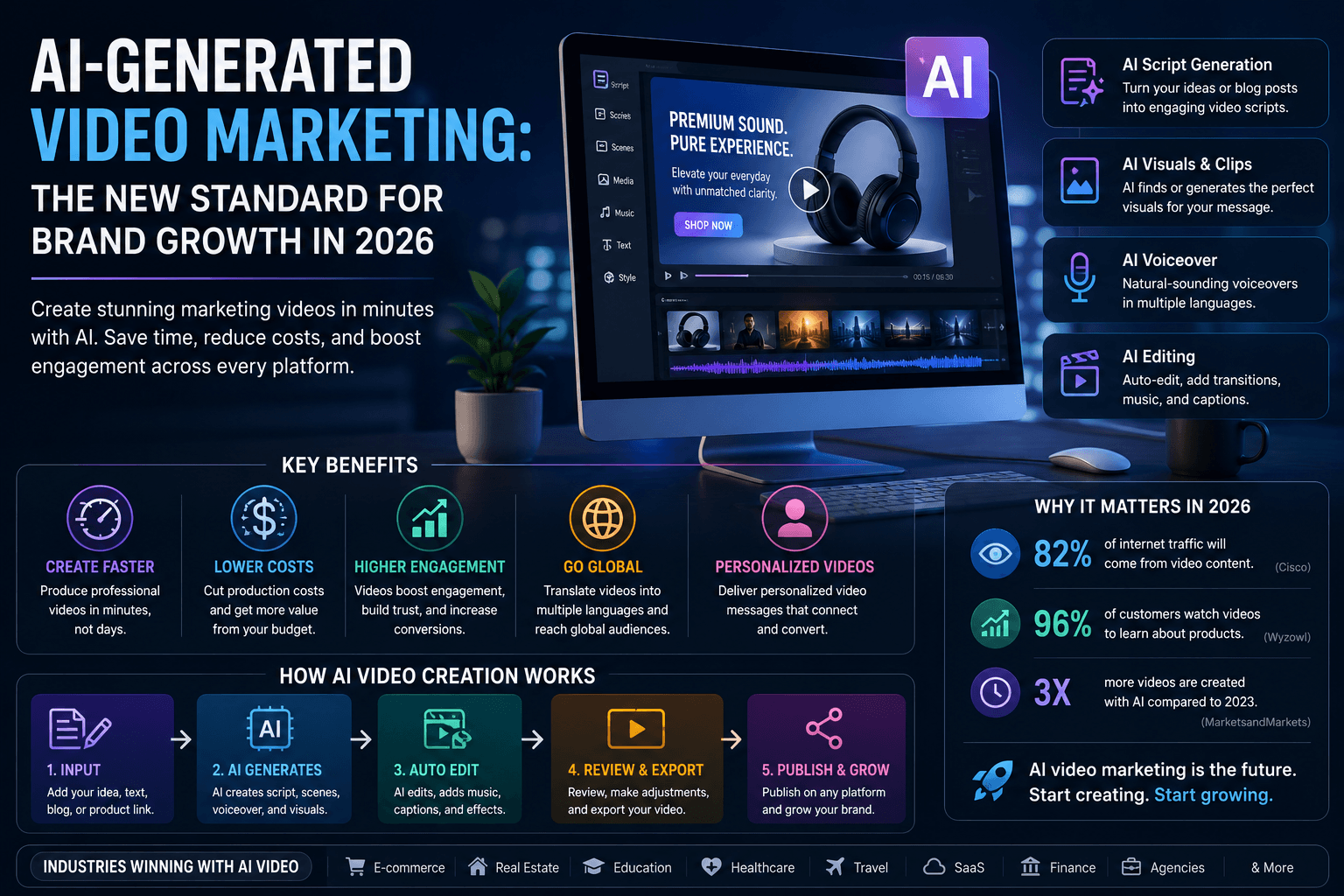
AI-generated video marketing uses artificial intelligence to create videos from simple text prompts, blog articles, product descriptions, or images. AI can automatically generate scripts, voiceovers, animations, subtitles, music, and editing, reducing the need for expensive production teams.
Businesses can now create engaging videos without advanced editing skills.
Why Businesses Are Adopting AI Video
Consumers increasingly prefer watching videos over reading long text. AI makes it possible for businesses of every size to meet this demand without increasing marketing costs.
Key reasons include:
Faster content creation
Lower production costs
Higher engagement rates
Easier content localization
Consistent brand messaging
Benefits of AI Video Marketing
1. Create Videos in Minutes
AI can transform a blog post or product page into a polished marketing video within minutes.
2. Reduce Marketing Costs
Businesses no longer need expensive cameras, studios, or large production teams for many marketing campaigns.
3. Improve Social Media Engagement
Short AI-generated videos perform well across platforms like LinkedIn, Instagram, Facebook, TikTok, and YouTube.
4. Reach Global Audiences
AI can automatically translate videos into multiple languages with subtitles and natural-sounding voiceovers.
5. Personalize Customer Experiences
Businesses can generate personalized video messages for customers based on their interests, purchase history, or location.
Industries Benefiting the Most
AI-generated video marketing is helping:
E-commerce stores
Real estate agencies
Educational platforms
Healthcare providers
Travel companies
SaaS businesses
Digital marketing agencies
Financial services
Best Practices
To maximize results, businesses should:
Start with high-quality source content.
Keep videos concise and engaging.
Add captions for accessibility.
Maintain consistent branding.
Review AI-generated content before publishing.
Human creativity still plays an important role in ensuring authenticity.
Challenges to Consider
Businesses should also be aware of:
Copyright compliance
Deepfake misuse
Brand consistency
Fact-checking AI-generated content
Ethical use of AI
Responsible implementation builds trust with audiences.
The Future of AI Video Marketing
Experts believe AI-generated video will become a central part of digital marketing strategies. Businesses will increasingly use AI to create personalized advertisements, product demonstrations, customer onboarding videos, and educational content at scale.
Organizations that adopt AI video early will gain a competitive advantage by producing more content, reaching larger audiences, and reducing marketing costs.
Final Thoughts
AI-generated video marketing is no longer a futuristic concept—it is becoming an essential business tool. Companies that combine AI efficiency with human creativity can create engaging video content faster, smarter, and more affordably than ever before.
As video continues to dominate digital marketing, AI will play a key role in helping brands stand out and connect with customers.
FAQs: AI-Generated Video Marketing: The New Standard for Brand Growth in 2026
1. What is AI-generated video marketing?
AI-generated video marketing is the use of artificial intelligence tools to create, edit, personalize, and distribute video content for marketing purposes. AI can assist with tasks such as scriptwriting, storyboarding, voice generation, visual creation, captions, translations, video editing, and content repurposing. This allows businesses to produce marketing videos faster and potentially at a lower cost than traditional production methods. In 2026, AI-generated video is increasingly being used for advertisements, social media campaigns, product demonstrations, educational content, personalized customer experiences, and brand storytelling.
2. Why is AI-generated video becoming important for brand growth in 2026?
Video has become one of the most effective ways for brands to capture attention and communicate information online, while AI is making video production more accessible. Businesses can use AI to transform ideas, written content, product information, or marketing campaigns into video concepts much faster than conventional production workflows. Smaller companies can also experiment with professional-looking content without maintaining large production teams. The biggest advantage is often speed: marketers can test multiple concepts, formats, messages, and audiences quickly and use performance data to improve future campaigns.
3. How can AI-generated videos help businesses reduce marketing costs?
AI can reduce some of the time and labor involved in video production by automating repetitive tasks. For example, marketers can use AI for initial scripts, captions, voiceovers, translations, editing assistance, scene generation, and resizing content for different platforms. This can reduce the need to outsource every small video project or organize a full production process for simple campaigns. However, AI does not make every video completely free or automatically high quality. Businesses may still need professional creative direction, human editing, licensed assets, actors, specialized production, and quality control depending on the campaign.
4. Can small businesses use AI video marketing without a large production team?
Yes. AI video platforms have lowered some of the technical barriers associated with video production, making it possible for small businesses and individual marketers to create content with relatively limited resources. A small team can develop product videos, social media clips, tutorials, promotional videos, and educational content using AI-assisted workflows. The key is to maintain a consistent brand identity, message, and visual style. Small businesses should focus on producing useful and authentic content rather than simply generating a large volume of videos because audiences can quickly lose interest in repetitive or generic AI content.
5. What types of AI-generated videos work best for marketing?
The most effective format depends on the audience and marketing objective. Short-form educational videos can help brands build awareness, while product demonstrations can explain how a product works. AI-generated explainer videos can simplify complex services, and personalized videos can be used for customer engagement. Businesses can also use AI to create social media advertisements, onboarding videos, training materials, customer-support content, and multilingual campaigns. Rather than selecting a format because it is popular, marketers should match the video style to the specific stage of the customer journey and the action they want viewers to take.
6. Can AI personalize video marketing for different customers?
AI can help marketers create variations of video content for different audiences by adapting elements such as language, messaging, product recommendations, narration, and calls to action. For example, an international company could create versions of the same campaign in multiple languages, while an e-commerce brand could tailor promotional content to different customer segments. Personalization can make marketing messages more relevant, but companies should use customer data responsibly. Businesses need appropriate privacy practices, transparency, and safeguards when AI systems use personal or behavioral information to customize marketing experiences.
7. Will AI-generated video replace traditional video production?
AI-generated video is unlikely to completely replace traditional video production because different types of content require different production approaches. AI can be highly effective for rapid content creation, concept development, educational videos, and certain advertising formats. However, major brand campaigns, cinematic advertisements, documentaries, live events, and emotionally complex storytelling may still benefit from professional directors, cinematographers, actors, designers, and production teams. The future is more likely to involve collaboration between human creatives and AI systems, where AI handles selected production tasks while people provide strategy, creativity, judgment, and brand direction.
8. What are the biggest risks of using AI-generated videos for brands?
One major risk is producing content that feels artificial, repetitive, misleading, or disconnected from the brand's identity. AI-generated videos can also contain factual errors, unrealistic visuals, incorrect pronunciations, copyright concerns, or inconsistent representations of products and people. There are additional concerns surrounding deepfakes, unauthorized likenesses, synthetic voices, and misleading advertising. Brands should therefore establish review processes before publishing AI-generated content. Human oversight is particularly important for claims involving products, finances, health, public figures, or other areas where inaccurate or deceptive content could damage trust.
9. How can brands make AI-generated videos feel authentic?
Authenticity comes primarily from the quality of the idea and the connection between the content and the brand's audience, not simply from the technology used to create the video. Brands can make AI-assisted videos more authentic by using their own stories, original insights, real customer experiences, distinctive brand language, and genuine product demonstrations. Human editing and creative direction can also remove unnatural elements and improve pacing. Businesses should avoid producing generic videos that could belong to any competitor. The goal should be to use AI as a creative accelerator while preserving the personality and perspective that make the brand recognizable.
10. What is the future of AI-generated video marketing beyond 2026?
AI-generated video marketing is likely to become increasingly integrated into everyday marketing workflows. Businesses may be able to generate campaign variations, localized videos, personalized advertisements, product explainers, and social media content from a single marketing brief. AI could also make real-time content adaptation easier by allowing marketers to modify messages based on audience behavior and campaign performance. Despite these advances, human creativity, strategy, ethical judgment, and brand storytelling will remain important. The companies most likely to benefit will be those that combine AI's speed and scalability with strong creative standards, authentic storytelling, responsible data practices, and rigorous quality control.