TFThe Future of Smart Homes in 2026: AI, Automation & Connected Living
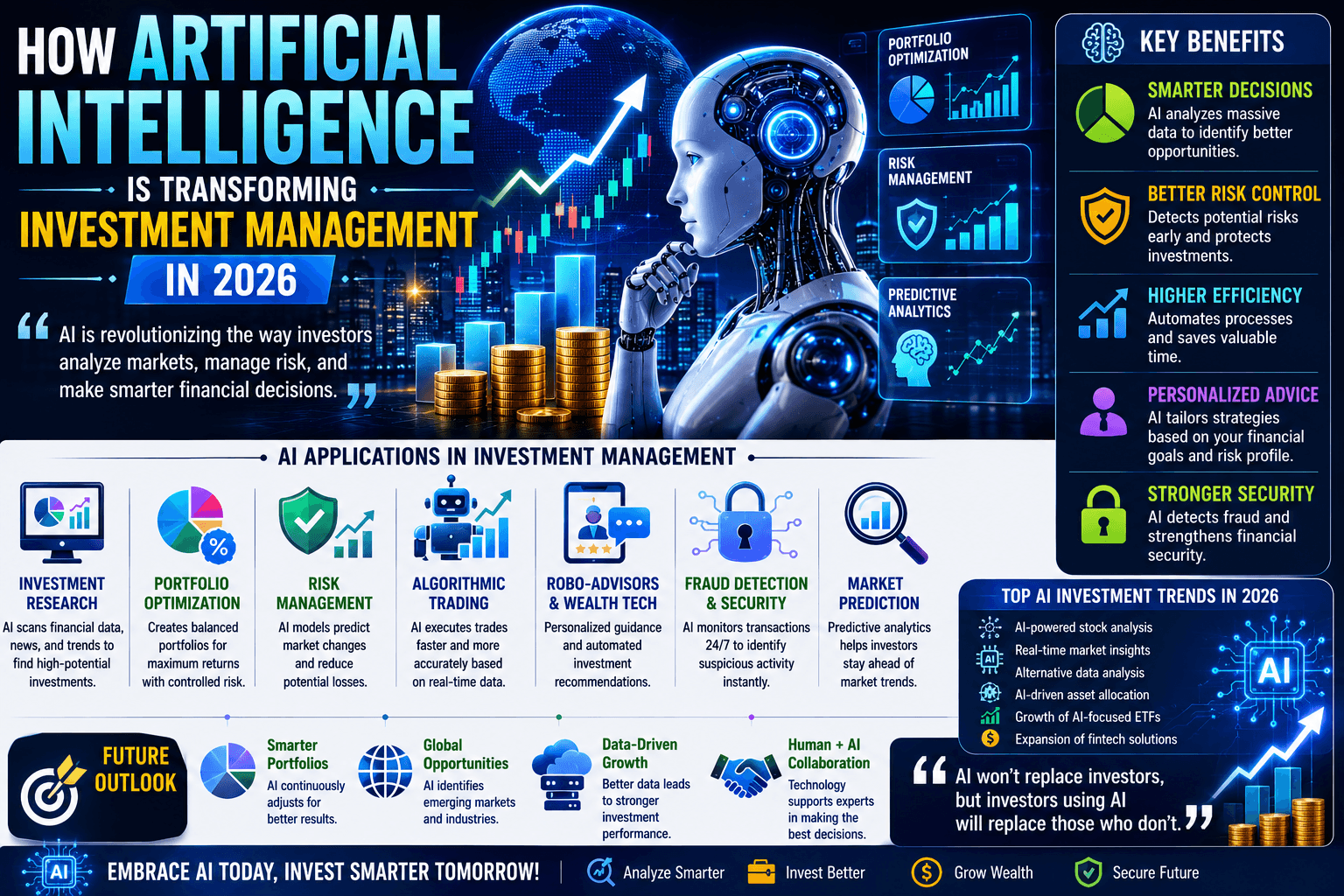
Artificial intelligence (AI) is rapidly changing the way financial markets operate. From portfolio management and stock analysis to fraud detection and risk assessment, AI has become one of the most influential technologies shaping the future of investment management.
In 2026, financial institutions, hedge funds, private equity firms, wealth managers, and retail investors increasingly rely on AI-powered tools to process massive amounts of market data and support investment decisions.
Rather than replacing human expertise, artificial intelligence is enhancing financial decision-making by providing deeper insights, improving efficiency, and helping investors respond more effectively to changing market conditions.
The Rise of AI in Finance
Artificial intelligence has evolved from an emerging technology into a core component of modern financial services.
Banks, investment firms, insurance companies, and fintech businesses use AI to improve productivity, automate routine tasks, and identify opportunities that traditional analysis might overlook.
With access to real-time market data, AI systems can evaluate millions of data points in seconds, allowing investors to make faster and more informed decisions.
As computing power continues improving, AI is expected to play an even greater role across global financial markets.
AI Improves Investment Research
Traditional investment research often requires significant time and manual analysis.
Artificial intelligence accelerates this process by analyzing:
Financial statements
Market news
Economic indicators
Corporate earnings
Industry trends
Historical performance
AI-powered systems can identify relationships and patterns that may not be immediately visible through manual research alone.
This enables analysts to focus more on strategic decision-making.
Portfolio Optimization Through Artificial Intelligence
Portfolio management has become increasingly data-driven.
AI helps investors build diversified portfolios by evaluating:
Risk tolerance
Market volatility
Asset allocation
Sector performance
Historical returns
Correlation between investments
Rather than relying solely on historical assumptions, AI continuously updates recommendations based on changing market conditions.
This dynamic approach helps improve portfolio resilience.
Better Risk Management
Managing investment risk remains one of the most important responsibilities for investors.
AI assists by monitoring:
Market volatility
Credit risk
Liquidity conditions
Macroeconomic developments
Sector performance
Early identification of changing market conditions allows investors to respond more effectively while maintaining long-term investment objectives.
Algorithmic Trading Continues Expanding
Large financial institutions increasingly use algorithmic trading systems supported by artificial intelligence.
These systems analyze market data and execute transactions according to predefined strategies.
Benefits include:
Faster execution
Reduced emotional decision-making
Greater efficiency
Continuous market monitoring
Although AI improves execution speed, successful investing still requires careful strategy and oversight.
Personalized Wealth Management
Artificial intelligence is making investment advice more accessible.
Modern investment platforms can provide personalized portfolio recommendations based on factors such as:
Financial goals
Investment horizon
Risk tolerance
Income level
Diversification preferences
These AI-powered solutions allow investors to receive tailored guidance while maintaining greater control over their financial decisions.
Fraud Detection and Security
Cybersecurity has become increasingly important in digital finance.
Artificial intelligence helps financial institutions detect unusual transaction patterns, identify potential fraud, and strengthen security systems.
Machine learning models continuously improve by analyzing new threats, helping protect investors and financial institutions.
AI Supports Institutional Investors
Large investment organizations increasingly integrate AI into daily operations.
These include:
Asset management firms
Hedge funds
Pension funds
Private equity firms
Insurance companies
AI assists with market analysis, due diligence, company valuation, and investment research.
Institutional adoption demonstrates growing confidence in AI-powered financial technology.
Artificial Intelligence and Private Equity
Private equity firms also benefit from AI.
Artificial intelligence helps evaluate acquisition opportunities by analyzing:
Company financial performance
Market trends
Competitive positioning
Customer behavior
Operational efficiency
This allows investors to make more informed acquisition decisions while improving portfolio company performance after investment.
AI and Stock Market Analysis
Artificial intelligence can process enormous volumes of financial information much faster than traditional methods.
AI evaluates:
Earnings reports
Trading volumes
Economic data
Market sentiment
News developments
While AI cannot predict future prices with certainty, it provides valuable insights that support more informed investment decisions.
Challenges of AI in Finance
Despite significant advantages, artificial intelligence also presents challenges.
These include:
Data privacy concerns
Algorithm bias
Regulatory compliance
Cybersecurity risks
Model transparency
Financial institutions continue developing governance frameworks to ensure responsible AI adoption.
Future Investment Opportunities
Artificial intelligence is creating investment opportunities across multiple industries.
High-growth sectors include:
AI software
Cloud computing
Semiconductor manufacturing
Cybersecurity
Robotics
Financial technology
Data analytics
Enterprise software
Investors increasingly view these industries as important drivers of long-term economic growth.
The Future of Investment Management
AI is expected to become even more integrated into financial markets over the coming years.
Future developments may include:
Smarter portfolio optimization
Enhanced predictive analytics
Automated compliance systems
Improved financial planning
Advanced market forecasting
Personalized investment strategies
Rather than replacing financial professionals, AI will continue supporting better decision-making through advanced analytics.
Conclusion
Artificial intelligence is transforming investment management by making financial analysis faster, more accurate, and increasingly data-driven. From portfolio optimization and risk management to fraud detection and personalized wealth management, AI is reshaping nearly every aspect of the investment process.
While technology cannot eliminate market uncertainty, it provides investors with powerful tools to improve decision-making and adapt to changing financial conditions.
As AI continues evolving alongside global financial markets, investors who understand its capabilities and limitations will be better positioned to take advantage of the next generation of investment opportunities.