

Introduction
The financial landscape is evolving rapidly as businesses navigate economic uncertainty, technological innovation, and changing customer expectations. In 2026, organizations that understand emerging financial trends will be better positioned to improve profitability, manage risks, and seize new growth opportunities.
Whether you're a startup founder, small business owner, or corporate executive, staying informed about these financial developments can help you make smarter strategic decisions.
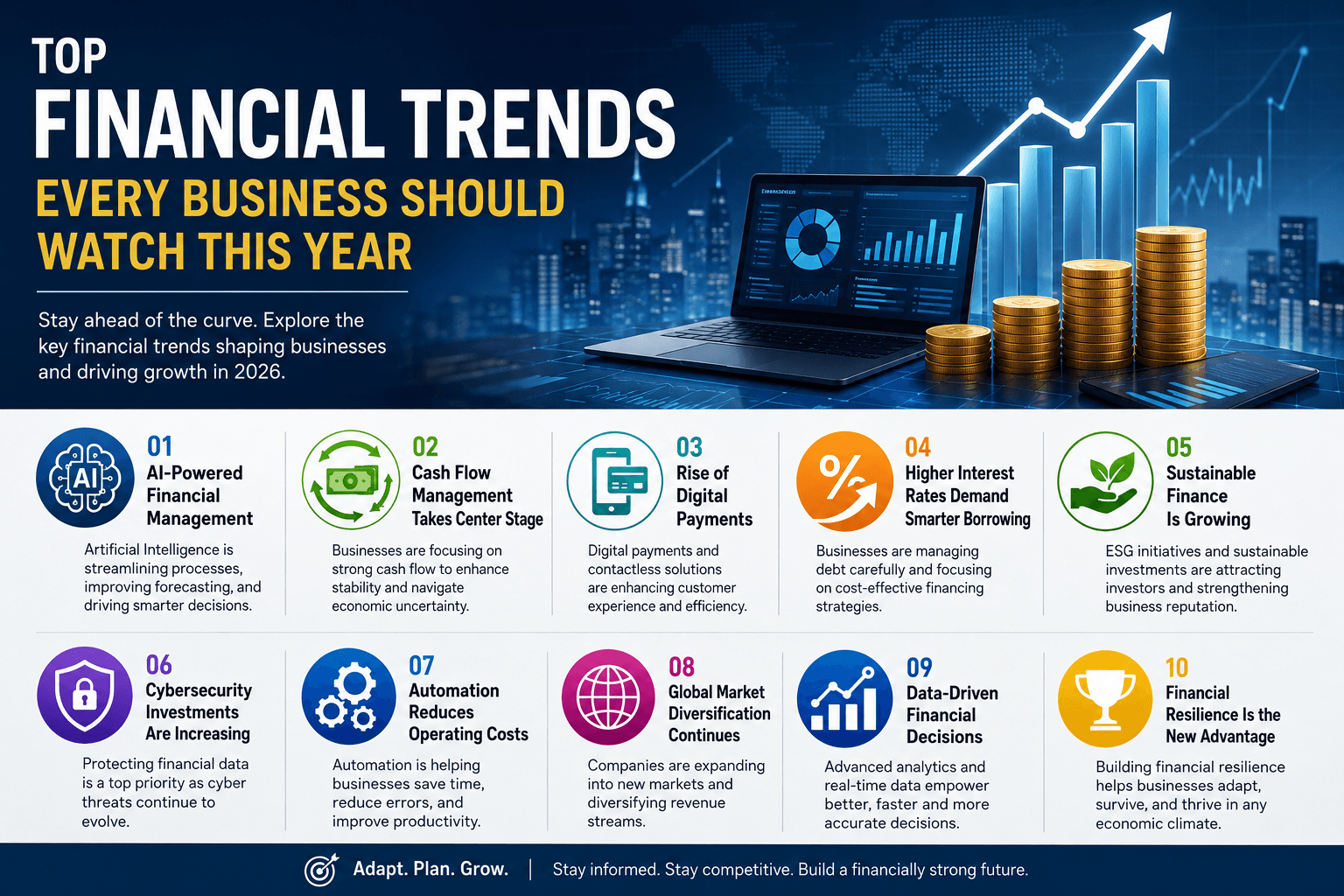
1. Artificial Intelligence Is Transforming Financial Management
Artificial intelligence has become an essential tool for modern finance teams. Businesses are using AI to automate bookkeeping, detect fraud, forecast cash flow, and generate real-time financial insights.
Benefits include:
Faster reporting
Improved accuracy
Better budgeting
Reduced operational costs
Smarter decision-making
Companies investing in AI-powered financial software are gaining a competitive advantage through increased efficiency and data-driven planning.
2. Cash Flow Management Is a Top Priority
Economic uncertainty has made cash flow more important than ever.
Businesses are strengthening their financial resilience by:
Monitoring cash flow daily
Reducing unnecessary expenses
Building emergency reserves
Improving invoice collection
Negotiating better payment terms
Healthy cash flow allows companies to continue investing even during challenging market conditions.
3. Digital Payments Continue to Expand
Consumers increasingly expect fast, secure, and convenient payment options.
Businesses are adopting:
Digital wallets
Contactless payments
Instant bank transfers
QR code payments
Subscription billing systems
Offering multiple payment methods improves customer satisfaction while increasing sales opportunities.
4. Rising Interest Rates Require Smarter Borrowing
Higher interest rates continue influencing business financing decisions.
Companies are:
Paying down high-interest debt
Refinancing existing loans
Delaying non-essential borrowing
Improving financial planning
Prioritizing profitable investments
Careful debt management has become a key financial strategy in today's economy.
5. Sustainable Finance Is Growing
Environmental, social, and governance (ESG) initiatives are becoming increasingly important to investors and customers.
Businesses are investing in:
Energy-efficient operations
Green technologies
Sustainable supply chains
Carbon reduction programs
Responsible governance practices
Strong sustainability performance can improve investor confidence and enhance brand reputation.
6. Cybersecurity Investments Are Increasing
Financial cybercrime continues to rise worldwide.
Businesses are allocating larger budgets toward:
Multi-factor authentication
Data encryption
Fraud detection systems
Employee cybersecurity training
Cloud security solutions
Protecting financial information has become essential for maintaining customer trust.
7. Automation Is Reducing Operating Costs
Automation technologies continue reshaping financial operations.
Businesses are automating:
Payroll processing
Expense management
Invoice generation
Tax compliance
Financial reporting
Automation reduces human error while allowing finance teams to focus on strategic planning.
8. Global Market Diversification
Many businesses are reducing dependence on a single market.
Companies are expanding into new regions through:
Cross-border e-commerce
International partnerships
Global supply chain diversification
Digital marketplaces
Diversification helps reduce economic risk while creating new revenue opportunities.
9. Data-Driven Financial Decision Making
Modern businesses rely heavily on financial analytics.
Real-time dashboards provide insights into:
Revenue growth
Customer profitability
Operating expenses
Investment performance
Market trends
Data-driven decision-making enables businesses to respond quickly to changing market conditions.
10. Financial Resilience Is the New Competitive Advantage
Rather than focusing solely on rapid growth, businesses are emphasizing long-term financial stability.
Successful companies are:
Maintaining healthy liquidity
Diversifying revenue streams
Building strong balance sheets
Investing strategically
Preparing for economic uncertainty
Financial resilience allows organizations to withstand market volatility while continuing to innovate.
Conclusion
Financial trends continue evolving as technology advances and global markets adapt to new economic realities. Businesses that embrace digital transformation, strengthen cash flow management, invest in automation, and prioritize financial resilience will be better equipped for sustainable growth.
Staying ahead of these trends is no longer optional—it's a critical part of building a successful, future-ready business. Organizations that continuously monitor financial developments and adapt their strategies will be best positioned to thrive in an increasingly competitive global economy.
Frequently Asked Questions (FAQs)
1. What are financial trends in business?
Financial trends are changes in economic conditions, investment strategies, technologies, and financial practices that influence how businesses manage money, investments, and growth.
2. Why should businesses monitor financial trends?
Monitoring financial trends helps businesses make informed decisions, reduce risks, improve profitability, and stay competitive in a rapidly changing marketplace.
3. Which financial trends are shaping businesses this year?
Major trends include AI-driven finance, digital payments, embedded finance, sustainable investing, automation, fintech innovation, data analytics, and stronger cybersecurity.
4. How is artificial intelligence transforming financial management?
AI automates financial reporting, detects fraud, forecasts cash flow, analyses financial data, and improves decision-making through predictive analytics.
5. What is embedded finance?
Embedded finance integrates financial services such as payments, lending, insurance, and banking directly into non-financial digital platforms, improving customer convenience.
6. Why are digital payments becoming more important?
Digital payments offer faster transactions, improved security, lower processing costs, and better customer experiences while supporting cashless business operations.
7. How does financial automation benefit businesses?
Automation reduces manual work, minimises errors, speeds up financial processes, improves compliance, and allows finance teams to focus on strategic planning.
8. What role does cloud technology play in finance?
Cloud-based financial systems provide secure access to financial data, improve collaboration, support real-time reporting, and reduce infrastructure costs.
9. Why is cash flow management essential?
Effective cash flow management ensures businesses can meet financial obligations, invest in growth opportunities, and maintain financial stability during economic uncertainty.
10. How can businesses prepare for economic uncertainty?
Businesses should diversify revenue streams, maintain financial reserves, monitor market conditions, reduce unnecessary expenses, and develop contingency plans.
11. What is sustainable finance?
Sustainable finance involves investments and financial decisions that consider environmental, social, and governance (ESG) factors alongside financial performance.
12. How does fintech improve financial services?
Fintech provides faster payments, digital lending, automated accounting, AI-powered financial analysis, and innovative banking solutions that improve efficiency.
13. Why is cybersecurity important in financial management?
Strong cybersecurity protects financial data, prevents fraud, safeguards customer information, and reduces the risk of costly cyberattacks.
14. How does data analytics improve financial decision-making?
Data analytics provides insights into customer behaviour, spending patterns, revenue trends, and operational performance, enabling smarter business decisions.
15. What are the benefits of digital banking for businesses?
Digital banking offers real-time account management, faster payments, simplified transactions, improved financial visibility, and greater operational efficiency.
16. How do rising interest rates affect businesses?
Higher interest rates can increase borrowing costs, impact investment decisions, reduce consumer spending, and encourage businesses to strengthen financial planning.
17. What is financial resilience?
Financial resilience is a business's ability to withstand economic challenges while maintaining stable operations, healthy cash flow, and long-term growth.
18. Why should businesses diversify their revenue streams?
Diversification reduces dependence on a single income source, improves financial stability, and creates additional growth opportunities.
19. How can businesses improve financial forecasting?
Businesses should use historical data, AI-powered forecasting tools, market analysis, and regular financial reviews to create more accurate financial projections.
20. What role does ESG play in financial strategy?
Environmental, Social, and Governance (ESG) practices help businesses attract investors, strengthen brand reputation, manage risks, and support sustainable growth.
21. How does automation improve financial accuracy?
Automation reduces human errors, standardises financial processes, improves reporting accuracy, and increases overall operational efficiency.
22. Why are businesses investing more in financial technology?
Financial technology improves productivity, enhances customer experiences, reduces operational costs, and enables businesses to adapt quickly to changing market conditions.
23. How can businesses reduce financial risk?
Businesses can reduce financial risk by maintaining strong cash reserves, diversifying investments, implementing cybersecurity measures, monitoring market trends, and conducting regular financial audits.
24. What are the advantages of real-time financial reporting?
Real-time reporting provides up-to-date financial insights, enabling faster decision-making, improved budgeting, and more effective performance monitoring.
25. How does digital transformation support financial growth?
Digital transformation streamlines financial operations, improves efficiency, enhances customer experiences, and supports data-driven strategic planning.
26. What financial metrics should businesses monitor?
Key metrics include revenue growth, profit margins, cash flow, operating expenses, return on investment (ROI), customer acquisition costs, and debt levels.
27. How can small businesses benefit from modern financial trends?
Small businesses can use digital payments, cloud accounting, automation, AI tools, and fintech solutions to improve efficiency, reduce costs, and compete more effectively.
28. What is the future of business finance?
The future of business finance will be driven by artificial intelligence, automation, digital banking, blockchain, sustainable finance, predictive analytics, and increasingly personalised financial services.
29. Why is staying updated on financial trends important?
Keeping up with financial trends enables businesses to adapt to changing market conditions, embrace innovation, make informed financial decisions, reduce risks, and achieve sustainable long-term growth.