Why Context-Aware AI Is the Next Evolution of Business Automation
L
Artificial intelligence has already transformed how businesses automate repetitive tasks, analyze data, and improve operational efficiency. However, many traditional AI systems still operate based on predefined rules or isolated data, limiting their ability to understand the broader business environment.
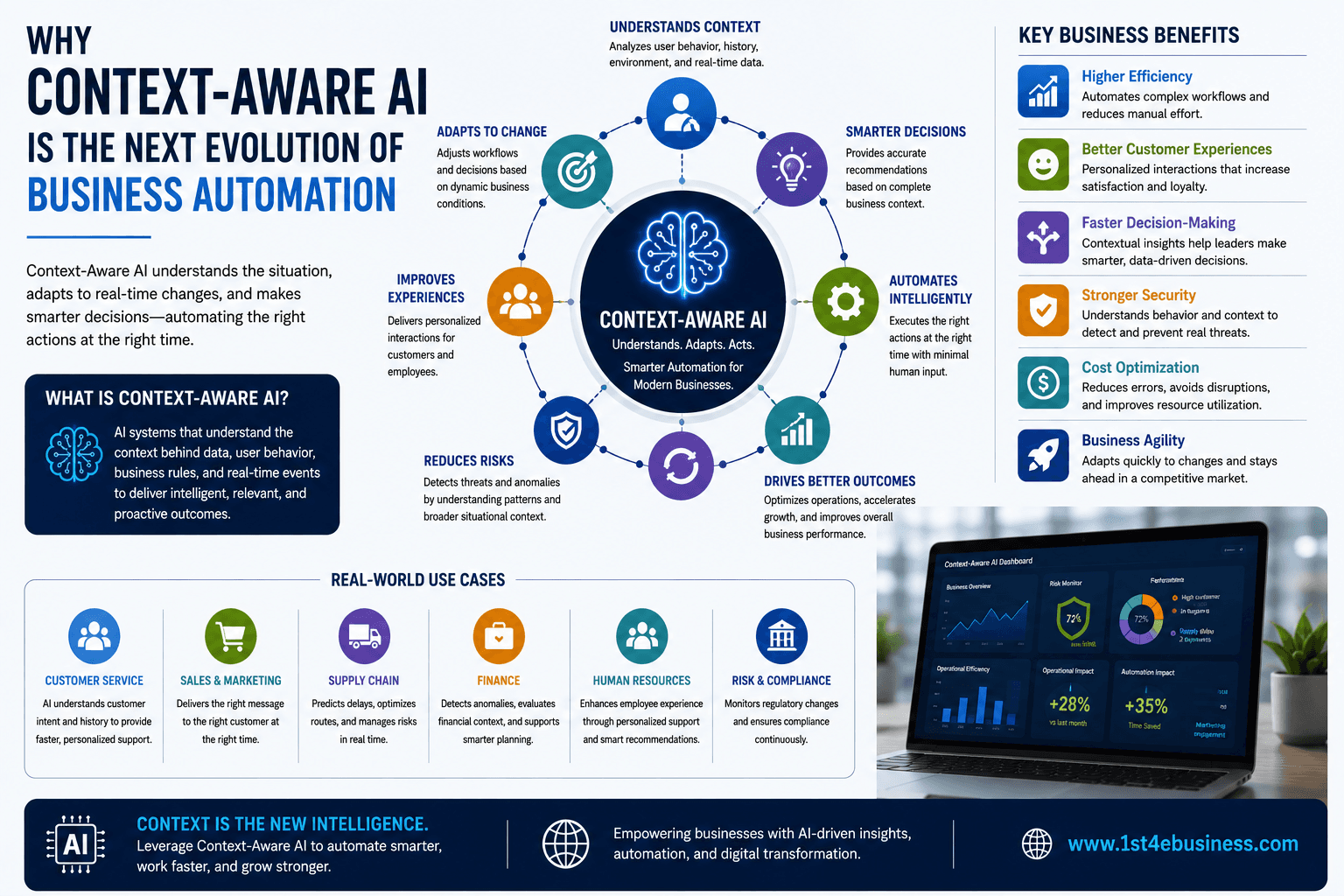
In 2026, businesses are entering a new era with **Context-Aware AI**—intelligent systems that understand the surrounding business context before making decisions or taking action. Rather than responding only to commands, Context-Aware AI considers user behavior, business objectives, historical data, real-time conditions, and environmental factors to deliver more accurate, personalized, and proactive outcomes.
As organizations seek smarter automation and better customer experiences, Context-Aware AI is becoming a critical competitive advantage.
## What Is Context-Aware AI?
Context-Aware AI refers to artificial intelligence systems that analyze multiple sources of information to understand the complete situation surrounding a task or decision.
Instead of relying only on a single data point, these systems evaluate factors such as:
* User preferences
* Previous interactions
* Business rules
* Customer history
* Location and timing
* Market conditions
* Operational priorities
* Real-time events
This enables AI to make more informed and relevant decisions.
## Smarter Business Automation
Traditional automation performs predefined tasks exactly as programmed.
Context-Aware AI goes much further by adapting workflows based on changing business conditions.
For example, instead of automatically approving every purchase request below a fixed amount, the AI can also consider budget availability, supplier performance, historical spending, project urgency, and business priorities before making a recommendation.
This results in more intelligent automation with fewer manual interventions.
## Personalizing Customer Experiences
Customer expectations continue to rise.
Context-Aware AI analyzes browsing behavior, purchase history, support interactions, and customer preferences to deliver personalized recommendations, targeted offers, and proactive assistance.
Businesses can provide experiences that feel more natural and relevant, improving customer satisfaction and loyalty.
## Improving Enterprise Decision-Making
Executives often make decisions using reports from multiple departments.
Context-Aware AI combines information from finance, sales, operations, human resources, supply chains, and customer service to provide a unified understanding of business performance.
Instead of presenting isolated metrics, AI recommends actions based on the overall business context.
This enables faster, more strategic decision-making.
## Enhancing Workplace Productivity
Employees spend significant time searching for information, switching between applications, and performing repetitive administrative tasks.
Context-Aware AI assistants understand employee roles, ongoing projects, schedules, and organizational priorities.
They can summarize meetings, retrieve relevant documents, prioritize tasks, schedule appointments, and provide intelligent recommendations that improve productivity.
## Strengthening Cybersecurity
Cybersecurity systems also benefit from contextual intelligence.
Rather than triggering alerts based on individual events alone, Context-Aware AI evaluates user behavior, device history, access patterns, network activity, and threat intelligence together.
This reduces false positives while improving the detection of genuine security threats.
## Optimizing Supply Chain Operations
Global supply chains generate enormous amounts of operational data.
Context-Aware AI analyzes inventory levels, weather conditions, transportation delays, supplier performance, geopolitical developments, and customer demand simultaneously.
Businesses receive proactive recommendations that minimize disruptions and improve operational resilience.
## Responsible AI Governance
As AI becomes more autonomous, organizations must ensure decisions remain transparent, ethical, and compliant.
Businesses implementing Context-Aware AI should prioritize:
* High-quality data
* Privacy protection
* Human oversight
* Explainable AI
* Bias monitoring
* Regulatory compliance
Responsible governance builds trust while maximizing the benefits of intelligent automation.
## The Future of Business Intelligence
Future AI systems will become even more context-aware by integrating data from IoT devices, digital twins, enterprise software, wearable technology, and external market intelligence.
These intelligent platforms will continuously learn from changing environments, anticipate business needs, and support autonomous decision-making across every department.
Organizations that adopt Context-Aware AI today will be better prepared for the next generation of intelligent business operations.
## Conclusion
Context-Aware AI represents a major evolution in business automation. By understanding the broader context behind every decision, organizations can automate complex processes, improve customer experiences, strengthen cybersecurity, and make more informed strategic decisions.
As digital transformation accelerates, Context-Aware AI will become a core capability for businesses seeking greater efficiency, agility, and long-term competitive advantage.
| Category | Details |
|---|---|
| Topic | AI |
| Author | Lora |
| Published | 02/07/2026 |
| Read Time | Not set |
L