
Introduction
Artificial intelligence has evolved rapidly over the past few years, but one major limitation has remained: memory. Traditional AI systems are excellent at answering questions and generating content, yet they often forget previous interactions once a conversation ends. This forces users to repeat information, explain preferences again, and restart workflows from scratch. As businesses increasingly depend on AI for everyday operations, this limitation reduces efficiency and creates friction in enterprise environments.
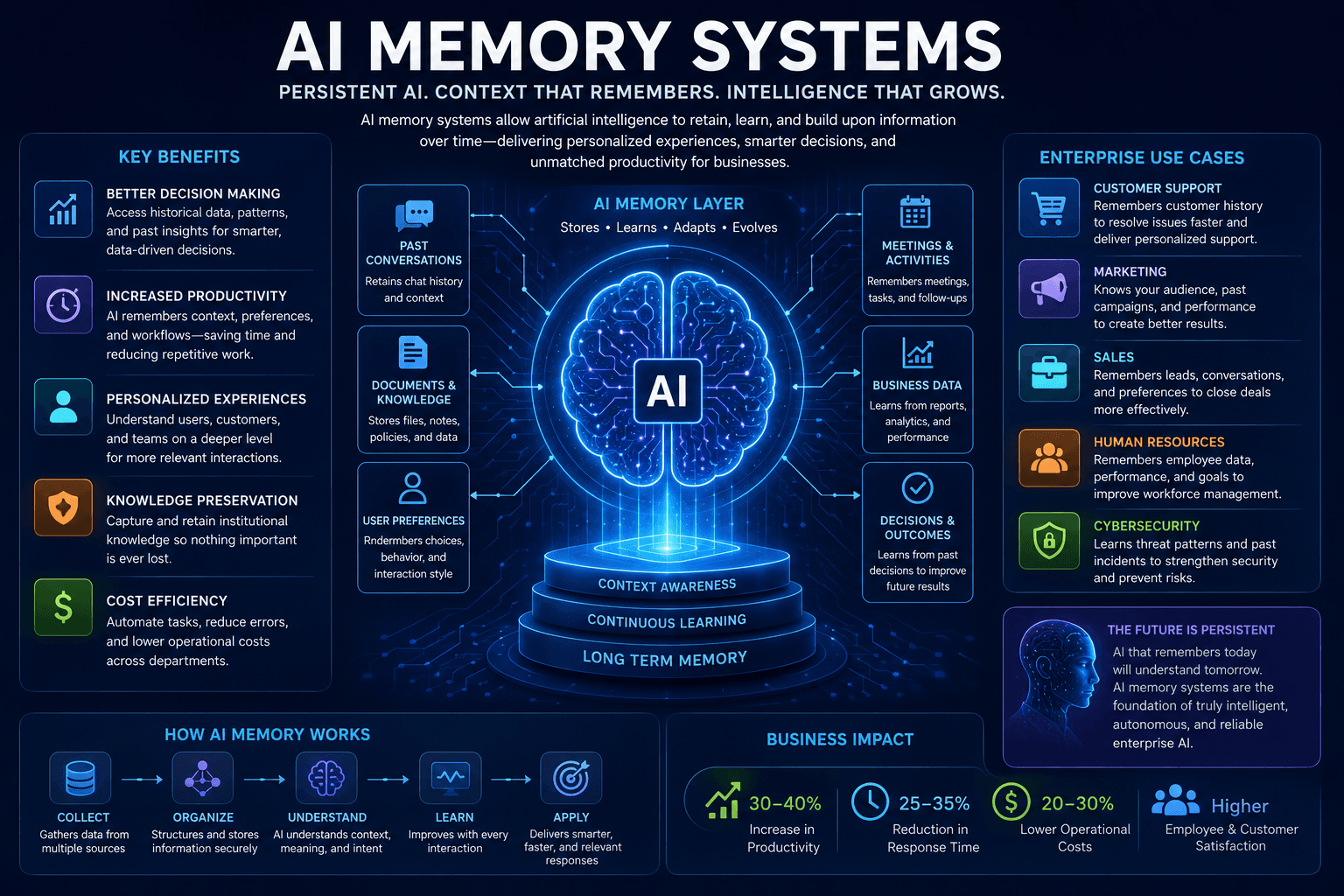
The next breakthrough in artificial intelligence is AI memory systems, often referred to as persistent AI. Instead of treating every interaction as a new conversation, persistent AI remembers previous discussions, understands long-term context, learns user preferences, and continuously builds organizational knowledge. This allows AI to function more like an experienced employee than a simple chatbot.
For enterprises, AI memory systems represent a significant leap forward. Imagine an AI assistant that remembers every project, understands your company's policies, recognizes customer preferences, recalls previous meetings, and automatically adapts its recommendations based on past outcomes. Such capabilities can dramatically improve productivity, reduce repetitive work, and support better decision-making.
As organizations prepare for the next generation of digital transformation, AI memory systems are expected to become a foundational technology across industries. Businesses that adopt persistent AI early will be better positioned to create intelligent workflows, enhance customer experiences, and gain a competitive advantage in an increasingly AI-driven economy.
What Are AI Memory Systems?
AI memory systems allow artificial intelligence to retain and retrieve information across multiple interactions rather than treating each conversation as an isolated event. By storing relevant context, preferences, documents, and past decisions, persistent AI can provide more personalized, accurate, and efficient responses.
Unlike traditional AI tools that lose context after a session ends, AI memory systems continuously build knowledge over time. They can remember customer histories, project updates, business policies, and individual work styles, making interactions smoother and more productive.
For example, instead of asking for the same project details every week, a persistent AI assistant already knows the project's objectives, deadlines, stakeholders, and previous discussions. This reduces repetitive communication and enables faster task completion.
How AI Memory Differs from Traditional AI
Conventional AI focuses on answering immediate questions based on the current conversation. Once the session ends, most of that context disappears. Persistent AI, however, creates a long-term knowledge base that grows with every interaction.
This means AI can remember:
User preferences
Company procedures
Customer communication history
Business goals
Frequently used documents
Team responsibilities
Previous project decisions
Meeting summaries
As a result, businesses spend less time repeating information and more time executing meaningful work.
Why Businesses Need Persistent AI
Modern organizations generate enormous amounts of information every day. Emails, documents, meetings, customer conversations, financial reports, and operational data often become scattered across multiple systems. Employees waste valuable time searching for information or recreating work that already exists.
AI memory systems solve this challenge by creating a centralized intelligence layer that remembers organizational knowledge. Employees can instantly retrieve information through natural language instead of manually searching through files or databases.
Persistent AI also improves collaboration by ensuring every team member has access to consistent, up-to-date information. This reduces miscommunication, improves decision-making, and accelerates project delivery.
Key Features of AI Memory Systems
Modern AI memory platforms combine several advanced capabilities.
Long-Term Context Retention
AI remembers conversations, projects, and business activities over extended periods.
Personalized Recommendations
The system adapts responses based on user preferences and previous interactions.
Enterprise Knowledge Management
AI organizes documents, policies, and historical data into searchable knowledge.
Continuous Learning
Persistent AI improves recommendations by learning from successful outcomes and user feedback.
Cross-Platform Integration
AI connects with email, CRM software, cloud storage, calendars, project management tools, and communication platforms to maintain complete organizational awareness.
Benefits of AI Memory Systems
Organizations adopting AI memory systems gain several competitive advantages.
Increased Productivity
Employees spend less time searching for information and more time completing valuable work.
Better Customer Experiences
Persistent AI remembers customer preferences, previous purchases, and support history, enabling highly personalized interactions.
Smarter Decision-Making
By analyzing historical business data alongside current information, AI provides more informed recommendations.
Improved Collaboration
Shared AI memory keeps departments aligned and ensures everyone works with consistent information.
Reduced Knowledge Loss
When experienced employees leave an organization, valuable knowledge often disappears with them. AI memory systems preserve institutional knowledge for future teams.
Industries Benefiting from AI Memory Systems
AI memory systems have applications across nearly every industry.
Healthcare providers use persistent AI to maintain patient histories and improve treatment coordination.
Financial institutions rely on AI memory for compliance, fraud detection, and customer relationship management.
Retail businesses personalize shopping experiences based on customer preferences.
Manufacturing companies preserve operational knowledge to improve maintenance and production efficiency.
Legal firms organize case histories and research for faster legal analysis.
Educational institutions create personalized learning experiences for students.
Here are additional SEO-rich headings you can add to expand the article to 1,350–1,500 words while improving topical authority and SEO.
AI Memory Systems vs Traditional Databases
Although AI memory systems store information, they are very different from traditional databases. A database simply saves structured data and requires users to search manually. AI memory systems understand context, relationships, and intent. Instead of searching for exact records, users can ask natural language questions such as, "What decisions did our marketing team make during last month's campaign?" The AI can retrieve, summarize, and explain the relevant information instantly. This conversational approach makes enterprise knowledge more accessible and significantly reduces the time employees spend searching for data.
How AI Memory Systems Improve Customer Relationships
Customer experience has become one of the most important competitive advantages for businesses. AI memory systems allow organizations to remember customer preferences, previous conversations, purchase history, support requests, and communication styles. Instead of treating every interaction as a new conversation, AI provides highly personalized recommendations and faster problem resolution. This leads to stronger customer loyalty, higher satisfaction rates, and increased lifetime customer value while creating a more consistent experience across every communication channel.
AI Memory and Knowledge Management
Many organizations struggle with knowledge scattered across emails, cloud storage, internal documents, and messaging platforms. AI memory systems act as intelligent knowledge managers by organizing information into a centralized, searchable resource. Employees can quickly retrieve policies, project documentation, meeting notes, training materials, and technical documentation using simple natural language queries. This improves collaboration, prevents duplicate work, and ensures valuable organizational knowledge remains available even when employees leave the company.
Security and Privacy Considerations
Because AI memory systems store sensitive business information, organizations must prioritize security and privacy. Companies should implement encryption, role-based access controls, multi-factor authentication, and regular security audits to protect confidential data. AI should only access information relevant to authorized users, and businesses must maintain compliance with applicable privacy regulations. Transparent governance policies also help build trust among employees and customers by clearly explaining how AI stores and uses information.
Challenges of Implementing AI Memory Systems
Despite their advantages, AI memory systems present several implementation challenges. Businesses must ensure data quality, prevent outdated information from influencing decisions, and establish clear governance policies for AI-generated recommendations. Integration with legacy enterprise systems may require additional technical resources, while employees need proper training to understand how AI memory functions. Addressing these challenges early allows organizations to maximize long-term value and reduce implementation risks.
Best Practices for Enterprise AI Memory
Successful deployment begins with a clear strategy. Organizations should start by identifying high-value workflows where persistent memory provides measurable benefits. AI memory should be continuously updated, regularly audited for accuracy, and integrated with trusted business systems. Human oversight remains essential for sensitive decisions, while ongoing employee training helps teams use AI effectively. Businesses should also establish ethical guidelines that promote transparency, accountability, and responsible AI usage.
The Future of AI Memory Systems
Over the next decade, AI memory systems will become far more sophisticated. Instead of simply remembering information, future AI will understand organizational goals, anticipate business needs, and proactively recommend actions before problems arise. Persistent AI may automatically prepare meeting summaries, monitor project risks, coordinate cross-functional teams, and optimize workflows without requiring constant human direction. These intelligent systems will evolve into trusted digital partners that support nearly every aspect of enterprise operations.
AI Memory Systems Will Power Autonomous AI Agents
Autonomous AI agents rely heavily on persistent memory to perform complex tasks independently. Without memory, AI agents cannot track long-term objectives, learn from previous experiences, or coordinate multi-step workflows. AI memory enables autonomous agents to remember completed tasks, monitor progress, adapt strategies, and collaborate with both humans and other AI systems. This capability is expected to become one of the most important building blocks for the future of enterprise automation.
Why Businesses Should Invest in AI Memory Today
Organizations that begin investing in AI memory systems today will gain significant advantages as enterprise AI continues to evolve. Early adoption allows businesses to build institutional knowledge, improve operational efficiency, enhance customer experiences, and create scalable AI-powered workflows. Rather than waiting for competitors to lead the transformation, forward-thinking companies can establish themselves as innovators by integrating persistent AI into their long-term digital strategies.
Final Thoughts
AI memory systems represent the next major evolution in enterprise artificial intelligence. By enabling AI to retain context, remember previous interactions, and continuously learn from organizational knowledge, persistent AI transforms digital assistants into intelligent business partners. As companies generate increasing amounts of information, the ability to organize, retrieve, and apply knowledge efficiently will become a critical competitive advantage. Businesses that adopt AI memory systems responsibly will improve productivity, strengthen collaboration, deliver more personalized customer experiences, and prepare for a future where intelligent AI works seamlessly alongside human employees.