
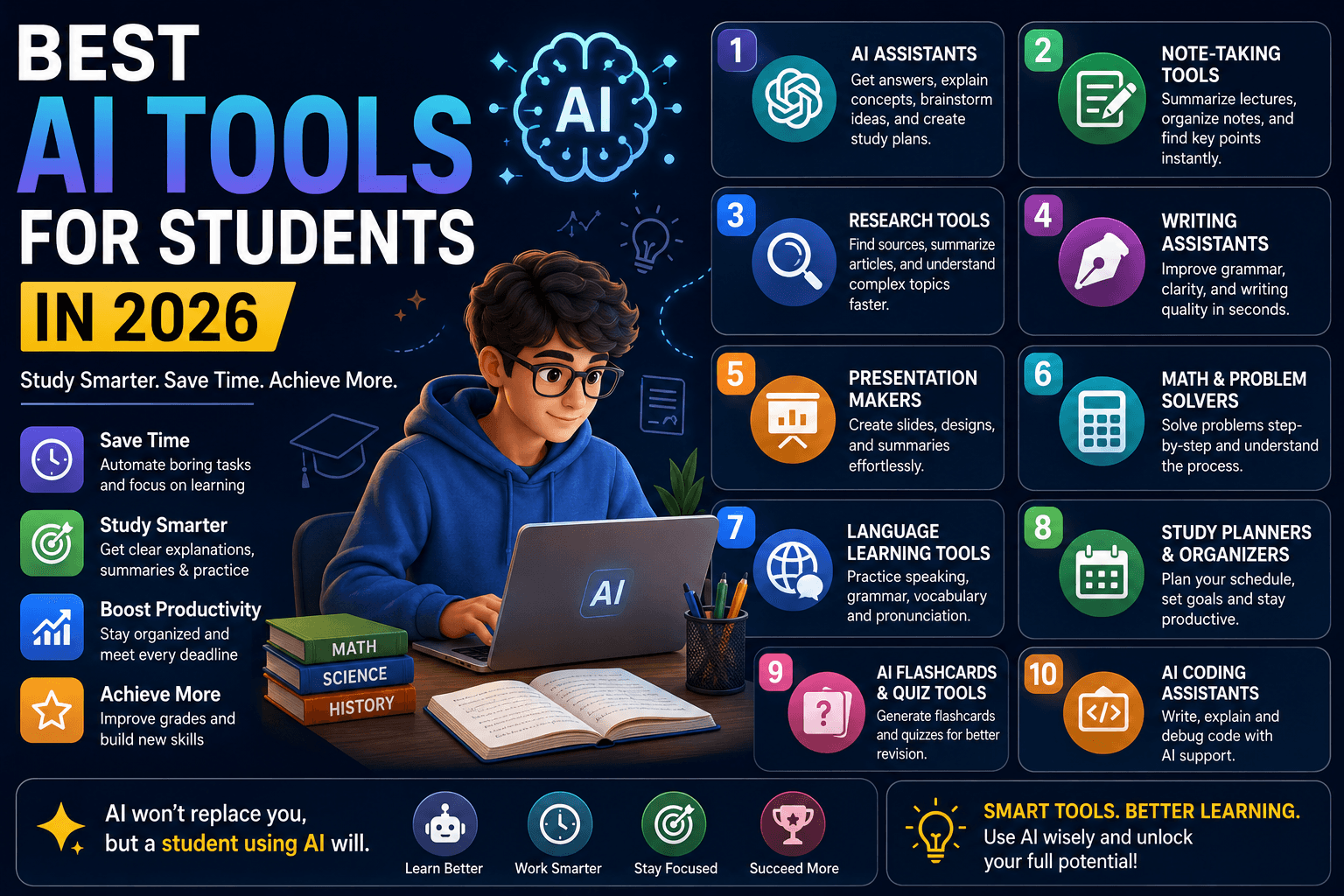

Artificial intelligence is changing the way students study, research, organize assignments, and prepare for exams. In 2026, AI tools can act like personal study assistants, helping students understand difficult concepts, summarize information, organize notes, practice questions, and manage their time.
However, AI works best as a learning assistant rather than a replacement for studying. Students should use these tools to understand subjects more deeply, check their work, and improve productivity—not simply copy answers.
Why Are AI Tools Useful for Students?
Students often have to manage multiple assignments, exams, projects, notes, and deadlines at the same time.
AI can help reduce some of the workload by assisting with:
Research and brainstorming
Summarizing difficult material
Creating study plans
Explaining complex concepts
Generating practice questions
Improving writing
Organizing notes
Preparing presentations
Learning languages
Managing productivity
The right tool can save time while helping students focus more on understanding what they are learning.
1. ChatGPT for Learning and Study Support
AI assistants such as ChatGPT can be useful for explaining concepts, brainstorming ideas, creating study plans, and generating practice questions.
For example, if a student is struggling with a difficult topic, they can ask the AI to explain it using simpler language or provide examples.
Students can also ask for quizzes based on their study material.
The best approach is to use the tool interactively rather than simply asking for final answers.
2. AI Tools for Note-Taking
Students often spend significant time organizing notes from lectures and study sessions.
AI-powered note-taking tools can help summarize discussions, identify important points, organize information, and create searchable notes.
This can be particularly useful for students who attend long lectures or participate in group study sessions.
Students should still review AI-generated summaries because automated tools can sometimes misunderstand information.
3. AI Tools for Research
Research can be time-consuming, especially when students need to explore unfamiliar subjects.
AI research assistants can help students understand topics, identify useful sources, summarize information, and generate questions for further investigation.
However, students should verify important facts using reliable academic sources.
AI-generated references should never be accepted without checking whether the cited source actually exists and supports the claim.
4. AI Writing Assistants
Writing assistants can help students improve grammar, spelling, clarity, and sentence structure.
They can also provide suggestions for organizing essays and making writing easier to understand.
Students should use these tools to improve their own writing rather than submitting AI-generated work when academic rules prohibit it.
Understanding the institution's AI policy is essential.
5. AI Presentation Tools
Creating presentations can take considerable time.
AI-powered presentation tools can help students develop slide structures, summarize information, suggest layouts, and generate presentation ideas.
Students can then edit the presentation to ensure that the information is accurate and matches their assignment requirements.
6. AI Math and Problem-Solving Tools
AI-powered educational tools can help students work through mathematical and scientific problems.
Instead of asking only for the final answer, students should ask the tool to explain the process step by step.
This approach can help students understand formulas, identify mistakes, and learn problem-solving techniques.
7. AI Language Learning Tools
AI is also useful for learning languages.
Students can practice conversations, vocabulary, pronunciation, grammar, and writing with AI-powered language tools.
One advantage is that students can practice repeatedly without worrying about making mistakes in front of other people.
8. AI Study Planning and Productivity Tools
Managing time is one of the biggest challenges for students.
AI productivity tools can help create study schedules based on exams, assignments, available time, and priorities.
For example, a student with several upcoming exams can create a study plan that divides subjects into manageable sessions.
A schedule is most effective when students realistically follow it and adjust it when circumstances change.
9. AI Flashcards and Quiz Tools
Active recall is an important study technique.
AI can generate flashcards and practice questions from notes or study materials.
Students can use these questions to identify weak areas and spend more time reviewing concepts they have not mastered.
This can make revision more interactive than simply reading notes repeatedly.
10. AI Tools for Coding Students
Students learning programming can use AI coding assistants to understand code, identify errors, explain programming concepts, and generate examples.
However, students should understand the code rather than submitting AI-generated solutions without learning how they work.
Using AI as a programming tutor can be more valuable than using it simply as a code generator.
How to Use AI Without Becoming Dependent on It
AI can save time, but overuse can negatively affect learning.
Students should try to solve a problem independently before asking AI for help.
A useful approach is:
Try → Ask for a hint → Understand the explanation → Solve it yourself → Review your answer.
This keeps the student actively involved in the learning process.
AI and Academic Integrity
Different schools, colleges, universities, and teachers have different rules about AI.
Some assignments may allow AI for brainstorming or editing, while others may prohibit AI-generated work entirely.
Students should always check their institution's policies before using AI for assignments.
Submitting AI-generated work as your own when it violates academic rules can create serious academic problems.
How to Choose the Best AI Tool
With so many AI tools available, students should not automatically choose the tool with the most features.
Consider:
Accuracy
Does the tool provide reliable information?
Ease of Use
Is it simple enough to use regularly?
Privacy
Understand what happens to the information you enter, especially when using personal or academic documents.
Cost
Check whether the free version is sufficient or whether a paid plan is necessary.
Learning Value
Does the tool actually help you understand the subject?
A tool that improves learning is more valuable than one that simply produces quick answers.
Best AI Study Workflow for Students
A simple AI-powered study workflow can look like this:
Step 1: Learn the topic yourself.
Read your textbook, lecture notes, or other approved materials.
Step 2: Ask AI for clarification.
Use AI to explain concepts you find difficult.
Step 3: Create practice questions.
Ask AI to generate quizzes based on the material.
Step 4: Test yourself.
Answer questions without looking at your notes.
Step 5: Review mistakes.
Use AI to explain why an answer was incorrect.
Step 6: Repeat.
Continue practicing until you understand the material.
Final Thoughts
AI tools can become powerful study companions in 2026. They can help students research, organize notes, practice questions, improve writing, learn languages, understand difficult subjects, and manage their time.
But the most effective use of AI is not to avoid studying. It is to make studying smarter and more interactive.
Students who combine AI with critical thinking, reliable sources, active recall, practice, and their own effort can gain the greatest benefits.
Frequently Asked Questions
1. What are the best AI tools for students in 2026?
Useful AI tools include AI assistants, research tools, note-taking platforms, writing assistants, presentation tools, language-learning applications, flashcard generators, and coding assistants.
2. Can students use ChatGPT for studying?
Yes. Students can use AI assistants to explain concepts, create quizzes, brainstorm ideas, summarize approved study material, and build study plans.
3. Is AI good for exam preparation?
AI can be useful for creating practice questions, explaining difficult topics, generating revision plans, and testing knowledge. Students should combine AI with textbooks, class material, and other reliable resources.
4. Can AI write student essays?
AI can assist with brainstorming, outlining, grammar, and editing, but students should follow their school's or university's academic-integrity rules regarding AI-generated writing.
5. Can AI help with mathematics?
Yes. AI can explain mathematical concepts, demonstrate problem-solving steps, and help identify mistakes. Students should focus on understanding the process rather than simply copying answers.
6. Can AI help students save time?
Yes. AI can speed up tasks such as organizing notes, generating practice questions, creating study plans, and explaining difficult concepts.
7. Is it safe for students to use AI?
Students should use AI responsibly and avoid entering sensitive personal information. They should also verify important information because AI systems can sometimes produce inaccurate answers.
8. Can AI replace teachers?
AI can provide additional explanations and personalized practice, but it cannot fully replace teachers. Teachers provide human guidance, context, feedback, mentorship, and classroom interaction.
9. How can students avoid becoming dependent on AI?
Students should attempt problems independently first, use AI for hints or explanations, and then solve the problem themselves. Active learning is more valuable than simply receiving answers.
10. Can AI help with research?
Yes. AI can help students understand topics, generate research questions, summarize information, and identify potentially useful sources. Important claims and sources should always be independently verified.
11. Can AI create study plans?
Yes. Students can provide their subjects, exam dates, available study hours, and priorities to an AI tool and ask it to create a realistic study schedule.
12. Can AI help students learn languages?
Yes. AI can provide conversation practice, vocabulary exercises, grammar explanations, writing feedback, and personalized practice.
13. Are AI study tools free?
Some AI tools offer free versions, while others require subscriptions for advanced features. Students should compare features and pricing before choosing a tool.
14. What is the best way to use AI for studying?
Use AI as a tutor and study assistant. Ask it to explain difficult concepts, create practice questions, provide hints, and identify knowledge gaps rather than simply giving you answers.
15. What is the future of AI in education?
AI is likely to become increasingly integrated into personalized learning, tutoring, assessment support, research, accessibility, and educational productivity. Human teachers and critical thinking will remain important parts of effective education.