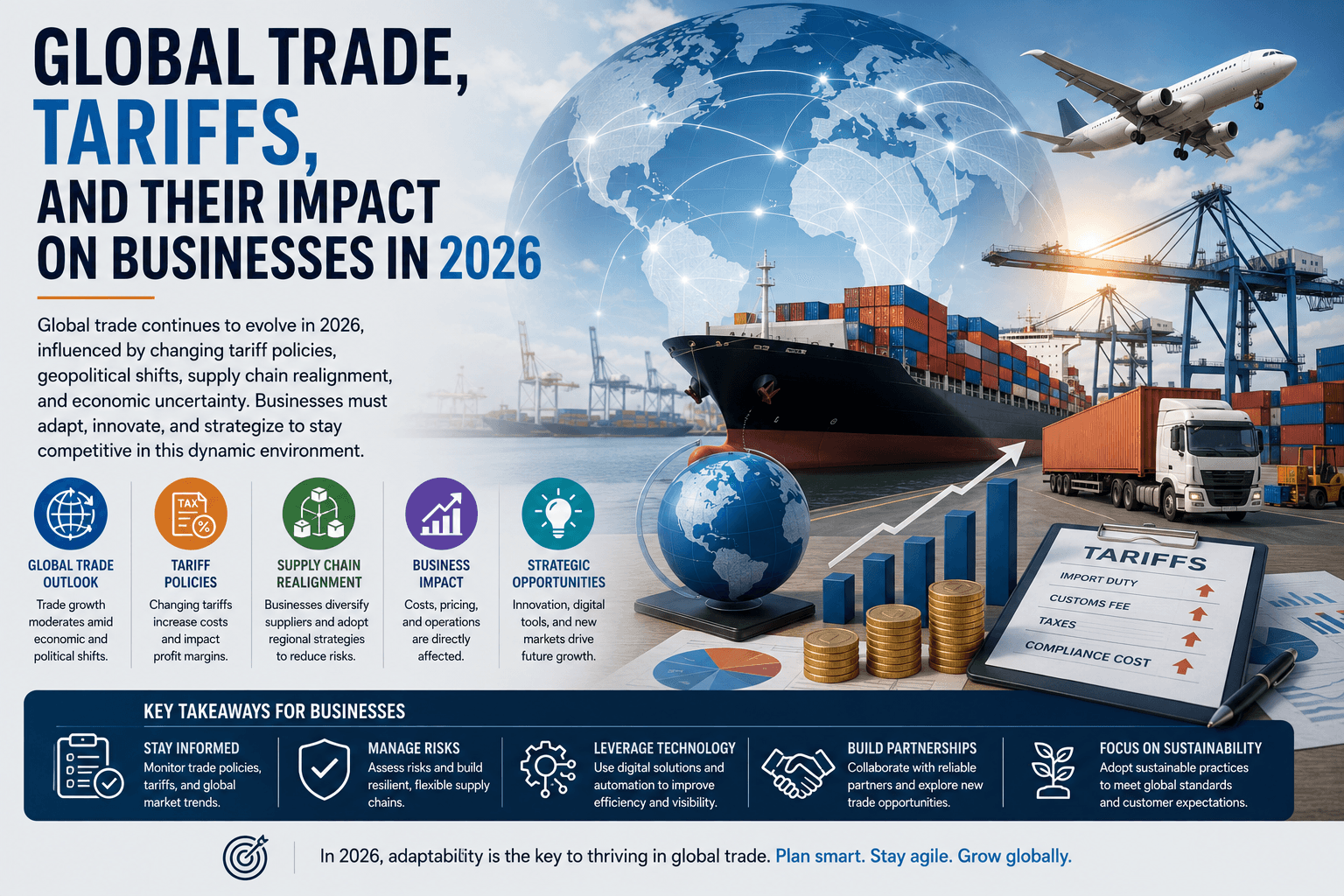
International trade remains one of the most powerful drivers of global economic growth, connecting businesses, consumers, and markets across continents. However, in 2026, global trade is being shaped by changing tariff policies, geopolitical tensions, supply chain realignment, and evolving trade agreements. These developments are creating both opportunities and challenges for businesses of every size.
Companies that understand the changing trade landscape and adapt their strategies accordingly will be better positioned to remain competitive, control costs, and expand into new international markets.
Understanding Global Trade in 2026
Global trade involves the exchange of goods and services between countries. Advances in digital technology, logistics, and communication have made international commerce more accessible than ever.
Today, businesses rely on global trade to:
Source raw materials
Access international customers
Expand manufacturing
Reduce production costs
Diversify supply chains
Increase revenue opportunities
However, global commerce is also influenced by government policies, economic conditions, and international relations.
What Are Tariffs?
Tariffs are taxes imposed by governments on imported goods.
Governments use tariffs for several reasons:
Protect domestic industries
Generate government revenue
Encourage local manufacturing
Address trade imbalances
Respond to international trade disputes
While tariffs may benefit certain domestic industries, they can also increase costs for businesses that depend on imported products or materials.
Rising Costs for Businesses
Higher import tariffs often increase operating expenses.
Businesses may face:
More expensive raw materials
Higher manufacturing costs
Increased transportation expenses
Reduced profit margins
Higher prices for consumers
Organizations must carefully evaluate pricing strategies while maintaining competitiveness.
Supply Chain Diversification
Recent global disruptions have encouraged businesses to diversify their supply chains.
Companies are increasingly:
Expanding supplier networks
Nearshoring production
Reshoring manufacturing
Building regional distribution centers
Increasing inventory resilience
Diversification helps reduce dependence on a single country or supplier while improving business continuity.
The Role of Free Trade Agreements
Trade agreements continue supporting international business by reducing barriers between participating countries.
Benefits include:
Lower tariffs
Faster customs procedures
Increased market access
Improved investment opportunities
Greater economic cooperation
Businesses that understand international trade agreements can identify valuable expansion opportunities.
Digital Trade Continues Growing
Digital commerce has become an increasingly important component of international trade.
Businesses now export:
Software
Digital services
Online education
Financial technology
Professional consulting
Cloud-based solutions
Digital trade reduces many traditional barriers while creating opportunities for businesses worldwide.
Technology Improves Global Commerce
Modern technologies help organizations manage international trade more efficiently.
Businesses use:
Artificial Intelligence
Blockchain
Cloud computing
Internet of Things (IoT)
Predictive analytics
Automation
These technologies improve supply chain visibility, reduce costs, and strengthen operational efficiency.
Managing Currency Fluctuations
Exchange rate movements can significantly affect international business operations.
Currency fluctuations influence:
Import costs
Export pricing
Profitability
Investment decisions
International competitiveness
Many businesses use financial planning and risk management strategies to reduce currency-related uncertainty.
Sustainability and International Trade
Environmental responsibility is becoming an important factor in global commerce.
Businesses increasingly invest in:
Sustainable logistics
Renewable energy
Green manufacturing
Carbon reduction initiatives
Eco-friendly packaging
Customers and investors increasingly value companies that operate responsibly across global supply chains.
Opportunities for Small and Medium-Sized Businesses
Digital technologies have made international markets more accessible for smaller businesses.
SMEs can now:
Sell through e-commerce platforms
Reach international customers
Use cloud-based business tools
Access global payment systems
Partner with international suppliers
These opportunities support business growth beyond domestic markets.
Challenges Facing Global Trade
Businesses should remain prepared for several ongoing challenges, including:
Tariff changes
Geopolitical uncertainty
Shipping delays
Cybersecurity threats
Regulatory compliance
Inflation
Labor shortages
Organizations that remain agile can respond more effectively to changing market conditions.
Strategies for Business Success
To remain competitive in global markets, businesses should:
Diversify suppliers
Monitor international trade policies
Invest in supply chain technology
Strengthen cybersecurity
Improve operational efficiency
Expand digital capabilities
Build strong international partnerships
These strategies help reduce risk while creating new opportunities for growth.
Looking Ahead
Global trade is expected to continue evolving through increased digitalization, smarter supply chains, stronger regional partnerships, and technological innovation.
Businesses that embrace flexibility, invest in digital transformation, and monitor international economic developments will be better prepared to succeed in the changing global marketplace.
Conclusion
Global trade and tariff policies continue to shape business strategies in 2026. While changing regulations, rising costs, and geopolitical uncertainty present challenges, they also encourage businesses to innovate, diversify, and strengthen operational resilience.
Organizations that understand international trade dynamics, adopt advanced technologies, and build flexible supply chains will be better positioned to manage risk and capitalize on emerging opportunities.
As global commerce continues evolving, adaptability, strategic planning, and international collaboration will remain essential drivers of sustainable business growth and long-term success.
Frequently Asked Questions (FAQs)
1. What is global trade?
Global trade refers to the exchange of goods, services, technology, and capital between countries to support economic growth and international commerce.
2. What are tariffs?
Tariffs are taxes imposed by governments on imported goods. They are often used to protect domestic industries, generate revenue, or influence international trade policies.
3. Why are tariffs important in 2026?
In 2026, tariffs continue to shape global supply chains, influence production costs, impact international trade relationships, and affect business competitiveness.
4. How do tariffs affect businesses?
Tariffs can increase import costs, reduce profit margins, influence pricing strategies, disrupt supply chains, and encourage businesses to diversify suppliers.
5. Which industries are most affected by tariffs?
Manufacturing, automotive, technology, agriculture, retail, pharmaceuticals, energy, and consumer electronics are among the industries most impacted by tariff changes.
6. How do tariffs influence consumer prices?
Higher import costs often lead to increased prices for finished goods, which may result in consumers paying more for products and services.
7. What is a global supply chain?
A global supply chain is the international network of suppliers, manufacturers, distributors, and retailers involved in producing and delivering goods worldwide.
8. How are businesses adapting to changing trade policies?
Businesses are diversifying suppliers, relocating manufacturing, investing in automation, expanding regional operations, and strengthening supply chain resilience.
9. What is supply chain diversification?
Supply chain diversification involves sourcing materials and products from multiple countries or suppliers to reduce dependence on a single market.
10. How does digital technology support global trade?
Digital technologies such as AI, blockchain, cloud computing, and data analytics improve logistics, inventory management, customs compliance, and supply chain visibility.
11. What role does artificial intelligence play in international trade?
AI helps businesses forecast demand, optimise shipping routes, automate customs documentation, identify trade risks, and improve operational efficiency.
12. How do geopolitical tensions affect global trade?
Geopolitical conflicts, sanctions, trade disputes, and political instability can disrupt supply chains, increase costs, delay shipments, and create market uncertainty.
13. What is trade compliance?
Trade compliance refers to following international trade laws, customs regulations, import-export requirements, and sanctions imposed by governments.
14. How can businesses reduce tariff-related risks?
Businesses can reduce risks by diversifying suppliers, reviewing sourcing strategies, leveraging free trade agreements, improving inventory planning, and monitoring regulatory changes.
15. What are free trade agreements?
Free trade agreements (FTAs) are agreements between countries that reduce or eliminate tariffs and trade barriers to encourage international commerce.
16. How do tariffs impact small and medium-sized businesses?
SMEs may experience higher operating costs, reduced competitiveness, supply chain disruptions, and increased administrative challenges due to changing trade regulations.
17. Why is supply chain resilience important in 2026?
Supply chain resilience helps businesses minimise disruptions, respond to market changes quickly, maintain customer satisfaction, and ensure operational continuity.
18. What strategies can businesses use to remain competitive in global trade?
Businesses can invest in digital transformation, strengthen supplier relationships, optimise logistics, improve risk management, expand into new markets, and adopt sustainable sourcing practices.
19. How is sustainability influencing international trade?
Companies are increasingly adopting environmentally responsible sourcing, reducing carbon emissions, improving supply chain transparency, and meeting global sustainability regulations.
20. What is the future of global trade in 2026 and beyond?
The future of global trade will be shaped by digital innovation, AI-powered supply chains, evolving trade agreements, regional manufacturing, sustainability initiatives, and changing geopolitical dynamics, requiring businesses to remain agile and resilient in an increasingly interconnected global economy.