

Introduction
In today's fast-changing business environment, data has become one of the world's most valuable assets. Every customer interaction, online purchase, marketing campaign, and financial transaction generates information that can help businesses make better decisions. However, raw data alone has little value unless it can be transformed into meaningful insights.
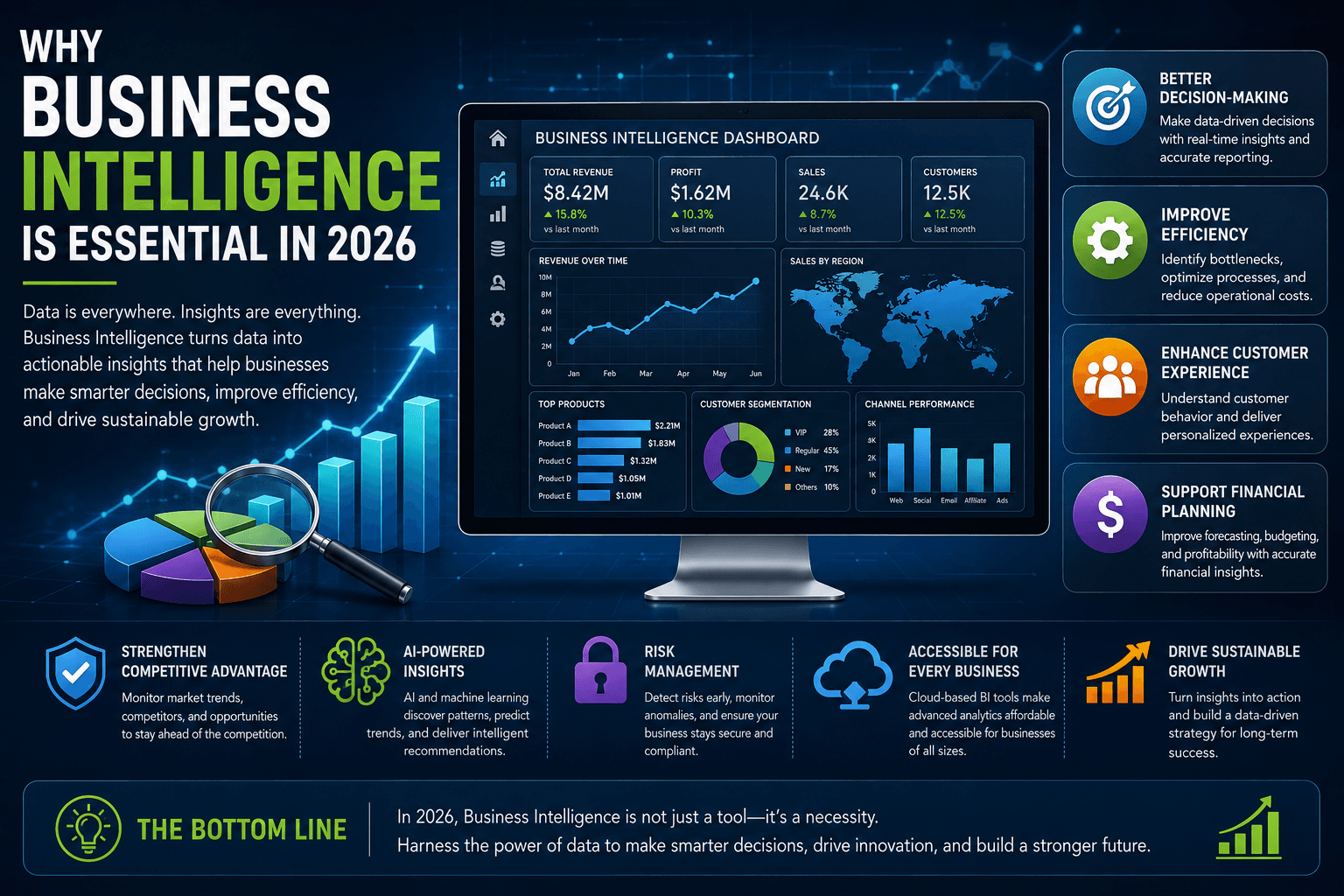
This is where Business Intelligence (BI) comes in. Business Intelligence combines data analytics, reporting, dashboards, and visualization tools to help organizations understand performance, identify trends, and make informed strategic decisions. In 2026, BI is no longer reserved for large enterprises—businesses of all sizes are using it to improve efficiency, reduce costs, and stay ahead of the competition.
Business Intelligence helps companies answer questions such as:
Which products generate the highest profits?
What marketing campaigns deliver the best return on investment?
Where can operating costs be reduced?
Which customers are most valuable?
What trends are shaping future demand?
By turning complex data into actionable insights, BI enables faster and smarter decision-making.
Better Decision-Making
One of the greatest advantages of Business Intelligence is improved decision-making.
Executives and managers can monitor key performance indicators (KPIs) through interactive dashboards that provide real-time updates on sales, revenue, expenses, customer behavior, and operational performance.
Instead of waiting for monthly reports, leaders can respond immediately to changing market conditions and seize new opportunities.
Improving Operational Efficiency
Business Intelligence helps organizations identify inefficiencies across their operations.
Companies use BI to:
Monitor production performance
Optimize inventory levels
Improve supply chain management
Track employee productivity
Reduce operational waste
By identifying bottlenecks and streamlining workflows, businesses can lower costs while increasing productivity.
Enhancing Customer Experience
Understanding customer behavior has become a competitive advantage.
Business Intelligence enables companies to analyze:
Purchasing patterns
Customer preferences
Feedback and reviews
Website traffic
Sales trends
These insights allow businesses to personalize marketing campaigns, improve customer service, and create products that better meet customer needs.
Supporting Financial Planning
Finance departments increasingly rely on Business Intelligence to improve forecasting and budgeting.
BI tools help organizations:
Analyze cash flow
Monitor expenses
Predict revenue trends
Track profitability
Identify financial risks
Accurate financial insights enable better investment decisions and stronger long-term planning.
Strengthening Competitive Advantage
Markets are becoming more competitive every year.
Business Intelligence allows organizations to:
Monitor competitor activity
Analyze market trends
Identify emerging opportunities
Measure customer demand
Respond faster to industry changes
Companies that leverage data effectively are often better positioned to outperform competitors.
AI and Business Intelligence
Artificial Intelligence is making Business Intelligence even more powerful.
Modern BI platforms use AI to:
Detect hidden patterns
Predict future trends
Automate reporting
Generate intelligent recommendations
Identify unusual business activity
These capabilities help businesses make proactive decisions instead of simply reacting to past events.
Risk Management
Every business faces financial, operational, and cybersecurity risks.
Business Intelligence improves risk management by providing early warning indicators and continuous monitoring.
Organizations can identify declining sales, supply chain disruptions, unusual transactions, or customer churn before they become major problems.
Business Intelligence for Small Businesses
Business Intelligence is no longer limited to large corporations.
Cloud-based BI solutions have made advanced analytics affordable for startups and small businesses. Even organizations with limited budgets can access dashboards, reporting tools, and predictive analytics without investing in expensive infrastructure.
This democratization of data helps smaller companies compete more effectively in today's digital economy.
The Future of Business Intelligence
Looking ahead, Business Intelligence will continue evolving through advances in artificial intelligence, machine learning, automation, and cloud computing.
Future BI platforms will provide:
More accurate predictive analytics
Faster real-time reporting
Improved data visualization
Greater automation
Enhanced decision support
Businesses that embrace these innovations will be better prepared for future market changes.
Conclusion
Business Intelligence has become an essential component of modern business strategy. By transforming raw data into actionable insights, BI empowers organizations to improve decision-making, increase efficiency, strengthen customer relationships, and achieve sustainable growth.
In 2026, businesses that invest in Business Intelligence are not simply collecting data—they are using it to build smarter strategies, drive innovation, and gain a lasting competitive advantage in an increasingly data-driven world.
Frequently Asked Questions (FAQs)
1. What is business intelligence?
Business intelligence (BI) refers to the technologies, processes, and tools that collect, analyse, and visualise business data to support informed decision-making.
2. Why is business intelligence essential in 2026?
Business intelligence is essential in 2026 because organisations rely on real-time data, AI-powered insights, and predictive analytics to remain competitive and make faster, more accurate business decisions.
3. How does AI improve business intelligence?
AI enhances business intelligence by automating data analysis, identifying trends, forecasting outcomes, and providing actionable insights that improve business performance.
4. What are the benefits of business intelligence?
Business intelligence improves decision-making, operational efficiency, customer insights, financial performance, risk management, and strategic planning.
5. Which industries benefit from business intelligence?
Healthcare, finance, retail, manufacturing, logistics, education, technology, and professional services all benefit from business intelligence solutions.
6. What is the difference between business intelligence and business analytics?
Business intelligence focuses on analysing historical and current data for decision-making, while business analytics uses statistical models and predictive techniques to forecast future outcomes.
7. How does business intelligence support business growth?
Business intelligence identifies opportunities, measures performance, improves resource allocation, and helps organisations make data-driven decisions that support sustainable growth.
8. What are the key features of modern business intelligence platforms?
Modern BI platforms include interactive dashboards, real-time reporting, data visualisation, AI-powered analytics, predictive modelling, cloud integration, and automated reporting.
9. Is business intelligence suitable for small businesses?
Yes. Cloud-based business intelligence solutions make advanced analytics affordable and scalable for businesses of all sizes.
10. What is the future of business intelligence?
The future of business intelligence includes greater AI integration, real-time predictive analytics, automation, natural language querying, and more personalised decision support for organisations.
11. How does business intelligence improve decision-making?
Business intelligence provides accurate, real-time insights that enable business leaders to make informed decisions based on reliable data rather than assumptions.
12. What role does real-time data play in business intelligence?
Real-time data allows organisations to monitor performance, identify issues quickly, respond to market changes, and make timely strategic decisions.
13. How does business intelligence help reduce operational costs?
By identifying inefficiencies, automating reporting, and optimising resource allocation, business intelligence helps organisations reduce unnecessary expenses and improve profitability.
14. Can business intelligence improve customer experience?
Yes. Business intelligence analyses customer behaviour, preferences, and feedback to help businesses personalise services, improve satisfaction, and strengthen customer loyalty.
15. What types of data are used in business intelligence?
Business intelligence uses financial, operational, sales, marketing, customer, supply chain, and external market data to generate valuable business insights.
16. How does predictive analytics support business intelligence?
Predictive analytics uses historical data and AI algorithms to forecast future trends, customer behaviour, and business outcomes, enabling proactive decision-making.
17. What are the biggest challenges in implementing business intelligence?
Common challenges include poor data quality, data integration issues, user adoption, cybersecurity concerns, and ensuring employees have the necessary analytical skills.
18. How does cloud technology enhance business intelligence?
Cloud-based BI platforms provide scalable storage, faster processing, remote accessibility, lower infrastructure costs, and seamless collaboration across teams.
19. What is self-service business intelligence?
Self-service BI enables employees to create reports, dashboards, and analyse data independently without relying heavily on IT departments.
20. How does business intelligence support strategic planning?
Business intelligence provides performance metrics, trend analysis, and market insights that help organisations develop effective long-term business strategies.
21. How does business intelligence improve financial performance?
Business intelligence tracks revenue, expenses, profitability, and financial trends, enabling businesses to optimise budgeting, forecasting, and financial planning.
22. What are the most important business intelligence KPIs?
Common BI KPIs include revenue growth, profit margins, customer acquisition cost, customer retention, sales performance, operational efficiency, and return on investment (ROI).
23. Is business intelligence secure?
Modern business intelligence platforms include advanced security features such as data encryption, role-based access controls, user authentication, and regulatory compliance measures to protect sensitive business information.
24. How can organisations successfully implement business intelligence?
Successful implementation requires clear business objectives, high-quality data, employee training, the right BI tools, and continuous performance monitoring to maximise business value.
25. Why will business intelligence remain important in the future?
As organisations generate increasing amounts of data, business intelligence will remain essential for transforming complex information into actionable insights that drive innovation, competitive advantage, and sustainable business growth.