
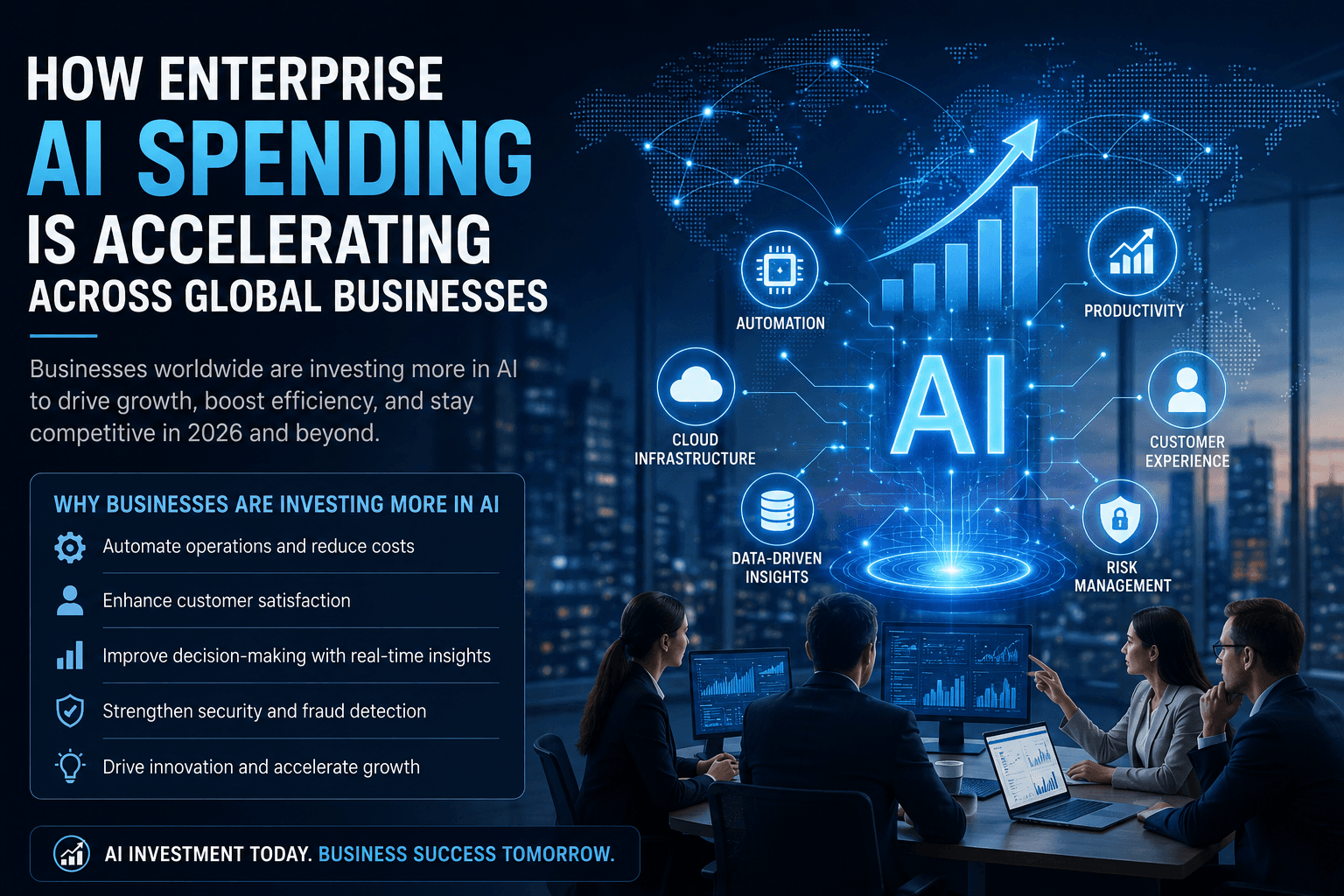

Artificial intelligence has evolved from an experimental technology into a core business investment. In 2026, organizations across industries are significantly increasing their AI budgets to improve productivity, enhance customer experiences, strengthen decision-making, and remain competitive in an increasingly digital economy.
From multinational corporations to small and medium-sized enterprises, businesses are embracing AI-powered solutions at an unprecedented pace. Enterprise AI spending is no longer focused solely on innovation—it has become a strategic priority that drives operational efficiency, business growth, and long-term resilience.
Why Businesses Are Increasing AI Investments
Several factors are fueling the rapid rise in enterprise AI spending. Organizations are under pressure to reduce costs, streamline operations, and respond quickly to changing market conditions. AI technologies provide practical solutions that automate repetitive tasks, generate valuable insights from large datasets, and improve overall business performance.
Companies are investing in AI to:
Automate routine business processes
Improve customer service through intelligent virtual assistants
Enhance cybersecurity and fraud detection
Optimize supply chain management
Strengthen financial forecasting
Support data-driven decision-making
Increase employee productivity
Accelerate product development
Rather than viewing AI as an optional technology, business leaders increasingly see it as a critical investment for future success.
AI Is Moving Beyond Pilot Projects
In previous years, many organizations experimented with AI through small pilot initiatives. Today, those experiments have matured into large-scale deployments across multiple business functions.
Enterprise AI is now integrated into departments such as:
Customer Support
AI-powered chatbots and virtual assistants provide 24/7 support, resolve common inquiries, and improve customer satisfaction while reducing operational costs.
Finance
Financial teams use AI for budgeting, forecasting, expense analysis, fraud detection, and risk assessment, enabling faster and more accurate financial decisions.
Marketing
Marketing professionals leverage AI to personalize customer experiences, optimize advertising campaigns, generate content ideas, and analyze consumer behavior.
Human Resources
Recruitment teams use AI to screen candidates, identify top talent, automate administrative tasks, and enhance employee engagement.
Supply Chain Management
AI helps organizations predict demand, optimize inventory levels, improve logistics, and reduce supply chain disruptions.
Cloud Computing Is Driving Enterprise AI
Cloud platforms have made advanced AI technologies more accessible than ever before. Businesses no longer need expensive infrastructure to implement sophisticated AI solutions.
Cloud-based AI offers several advantages:
Lower implementation costs
Faster deployment
Scalable computing resources
Automatic software updates
Improved collaboration across teams
Easy integration with existing business systems
This accessibility has enabled businesses of all sizes to adopt enterprise AI solutions.
The Growing Importance of AI Governance
As AI adoption increases, organizations are placing greater emphasis on responsible AI governance. Companies must ensure that AI systems operate transparently, fairly, securely, and in compliance with evolving regulations.
Effective AI governance includes:
Protecting sensitive business and customer data
Monitoring AI-generated decisions
Reducing algorithmic bias
Maintaining regulatory compliance
Establishing clear ethical guidelines
Conducting regular AI performance reviews
Organizations that prioritize responsible AI practices build stronger customer trust and reduce long-term risks.
Business Benefits of Enterprise AI
Companies investing in AI are already experiencing measurable business outcomes.
Higher Productivity
Automation allows employees to focus on strategic and creative work while AI handles repetitive administrative tasks.
Better Decision-Making
AI analyzes vast amounts of business data in real time, helping leaders identify trends, forecast outcomes, and make informed decisions faster.
Improved Customer Experience
Personalized recommendations, intelligent support systems, and predictive analytics enable businesses to deliver more relevant and engaging customer interactions.
Cost Optimization
AI improves operational efficiency by reducing manual workloads, minimizing errors, and optimizing resource allocation.
Competitive Advantage
Organizations that successfully integrate AI are better positioned to innovate, respond to market changes, and outperform competitors.
Challenges Businesses Must Address
Although AI offers significant benefits, implementation also presents challenges.
Common obstacles include:
Data privacy concerns
Integration with legacy systems
Shortage of AI talent
Employee training requirements
High initial investment costs
Compliance with emerging AI regulations
Successful organizations address these challenges through careful planning, continuous learning, and strong leadership support.
The Future of Enterprise AI Investment
Enterprise AI spending is expected to continue growing as organizations recognize AI's long-term value. Future investments will focus on autonomous business processes, AI-powered decision support, intelligent cybersecurity, predictive analytics, and industry-specific AI applications.
Businesses that invest early in scalable AI solutions will be better prepared to adapt to technological advancements and changing customer expectations.
Rather than replacing human expertise, AI will increasingly serve as a powerful partner that enhances productivity, creativity, and innovation across every business function.
Final Thoughts
Enterprise AI is transforming the way organizations operate, compete, and grow. As investment in artificial intelligence accelerates across global businesses, companies are discovering new opportunities to improve efficiency, strengthen decision-making, and deliver greater value to customers.
Organizations that adopt AI strategically—while prioritizing governance, security, and workforce development—will be well positioned for sustained success in the digital economy.
In 2026 and beyond, enterprise AI is no longer simply an emerging technology. It is a business necessity that is shaping the future of industries worldwide.
Read more business insights and technology trends at: https://www.1st4ebusiness.com