
The modern workplace is evolving faster than ever. Businesses are under increasing pressure to improve efficiency, reduce operational costs, and deliver exceptional customer experiences while adapting to constant technological change. In 2026, intelligent automation has become one of the most important technologies helping organizations achieve these goals.
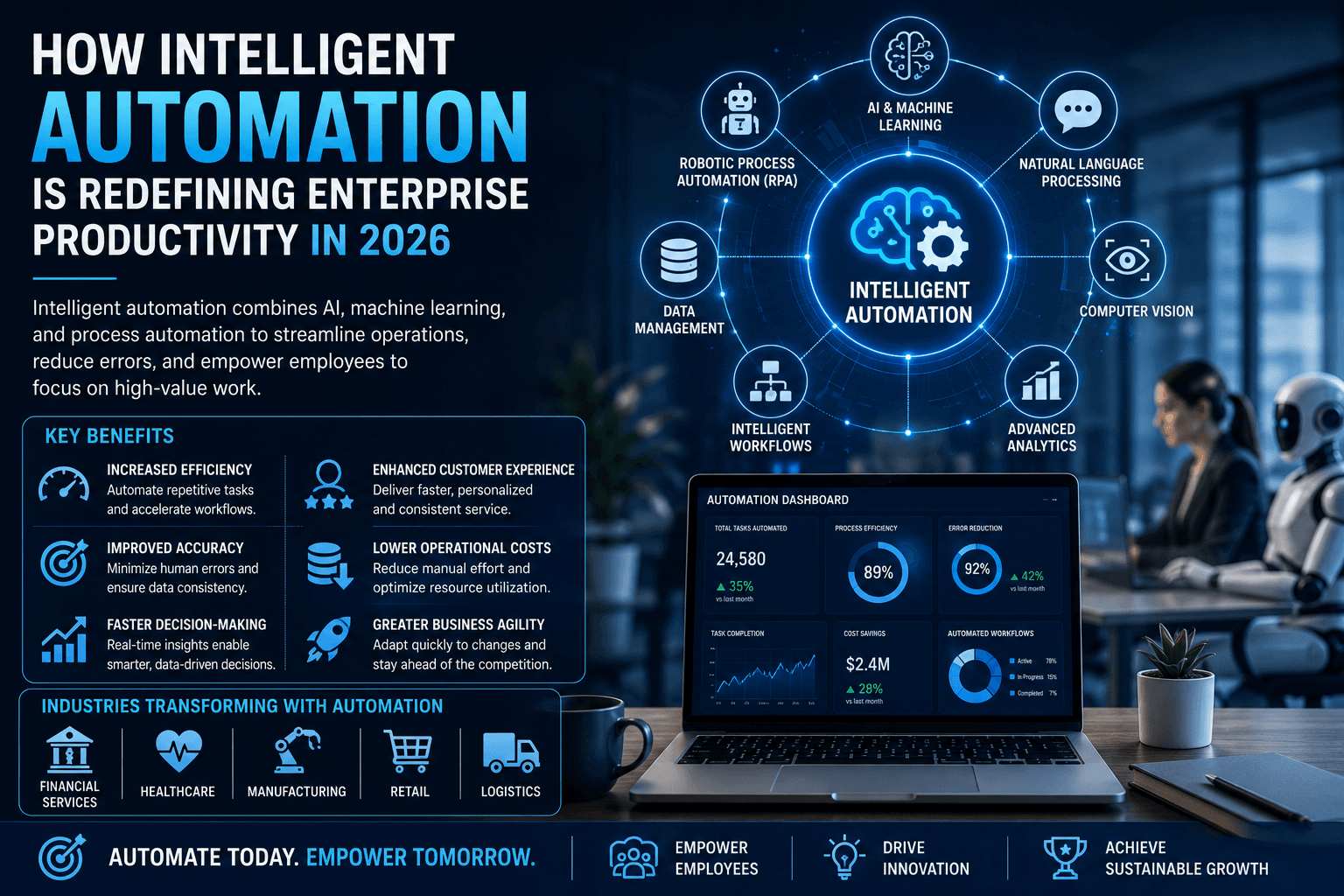
Unlike traditional automation, which focuses on repetitive rule-based tasks, intelligent automation combines artificial intelligence (AI), machine learning, robotic process automation (RPA), natural language processing, and advanced analytics to automate more complex business processes. The result is smarter operations, faster decision-making, and significantly higher enterprise productivity.
Organizations across industries are investing in intelligent automation not only to streamline workflows but also to empower employees, improve accuracy, and accelerate business growth.
What Is Intelligent Automation?
Intelligent automation is the integration of AI-powered technologies with business automation tools to perform tasks that previously required human judgment. These systems can analyze data, recognize patterns, make recommendations, and continuously improve through machine learning.
Common examples include:
Automated invoice processing
AI-powered customer support
Intelligent document management
Predictive maintenance
Employee onboarding automation
Smart financial reporting
Automated compliance monitoring
Supply chain optimization
Rather than replacing employees, intelligent automation enables teams to focus on strategic, creative, and customer-focused work.
Why Businesses Are Accelerating Automation
Several factors are driving enterprise investment in intelligent automation.
Rising Operational Costs
Businesses are looking for ways to reduce expenses while maintaining high levels of service and productivity. Automation helps eliminate repetitive manual work and improves resource utilization.
Growing Data Volumes
Organizations generate enormous amounts of business data every day. Intelligent automation processes information quickly, transforming raw data into valuable business insights.
Customer Expectations
Modern customers expect fast responses, personalized services, and seamless digital experiences. Automation enables businesses to meet these expectations consistently.
Workforce Productivity
Employees spend less time on administrative tasks and more time solving problems, developing strategies, and building customer relationships.
Key Benefits of Intelligent Automation
Increased Efficiency
Automated workflows reduce delays, eliminate bottlenecks, and improve collaboration across departments.
Improved Accuracy
Automation minimizes human error in tasks such as data entry, reporting, billing, and compliance documentation.
Faster Decision-Making
AI-powered analytics provide real-time insights that help business leaders make informed decisions more quickly.
Enhanced Customer Experience
Intelligent systems deliver personalized recommendations, faster support, and proactive customer engagement.
Greater Business Agility
Organizations can adapt more quickly to market changes by automating routine operations and improving operational visibility.
Industries Leading the Transformation
Banking and Financial Services
Financial institutions automate loan processing, fraud detection, compliance monitoring, and customer support.
Healthcare
Hospitals use intelligent automation to improve patient scheduling, medical documentation, billing, and diagnostics support.
Manufacturing
Manufacturers automate quality control, equipment monitoring, inventory management, and predictive maintenance.
Retail
Retailers optimize pricing, personalize shopping experiences, forecast demand, and improve inventory planning.
Logistics and Supply Chain
Automation improves warehouse operations, shipment tracking, route planning, and supplier coordination.
Challenges Businesses Should Prepare For
Successful automation requires thoughtful planning.
Organizations should address:
Data quality
Employee training
Cybersecurity
System integration
AI governance
Change management
Regulatory compliance
Businesses that combine technology with strong leadership are more likely to achieve successful automation outcomes.
Best Practices for Implementation
To maximize the value of intelligent automation, organizations should:
Identify repetitive, high-volume processes.
Set measurable business objectives.
Invest in scalable AI-powered platforms.
Train employees to work alongside automation tools.
Continuously monitor workflow performance.
Maintain strong cybersecurity practices.
Review automation strategies regularly as business needs evolve.
These practices help organizations build long-term operational resilience.
The Future of Enterprise Productivity
The next generation of intelligent automation will include autonomous AI agents capable of coordinating multiple business functions with minimal human intervention. Organizations will increasingly rely on predictive analytics, conversational AI, and real-time decision support to improve business performance.
As automation technologies continue to mature, businesses will achieve higher productivity while creating new opportunities for innovation and growth.
Companies that embrace intelligent automation today will be better positioned to compete in tomorrow's digital economy.
Final Thoughts
Intelligent automation is transforming enterprise productivity by combining artificial intelligence with advanced workflow automation. Organizations are reducing costs, improving operational efficiency, enhancing customer experiences, and enabling employees to focus on higher-value work.
As digital transformation continues to accelerate in 2026, intelligent automation will remain one of the most valuable investments businesses can make. Companies that adopt these technologies strategically will gain a stronger competitive advantage, improve long-term resilience, and unlock new opportunities for sustainable growth.
For more business insights, technology trends, and digital transformation strategies, visit https://www.1st4ebusiness.com.