

Introduction
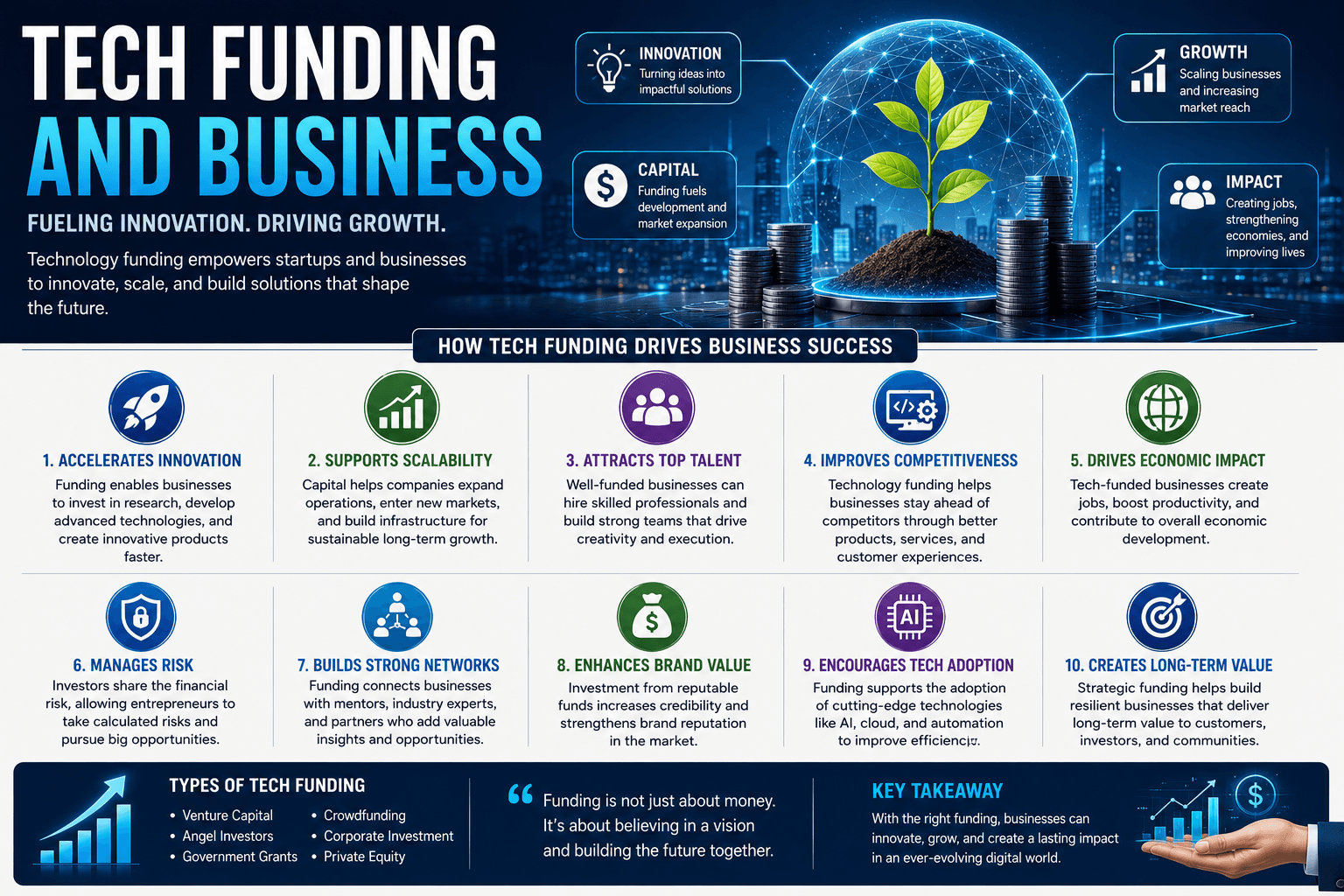
At our organisation, we believe technology funding is more than securing capital—it's about creating opportunities for sustainable innovation, business expansion, and long-term success. As technology continues to reshape industries, businesses need access to the right financial resources to develop new products, adopt emerging technologies, and compete in global markets.
Our strategy focuses on helping businesses leverage funding effectively through innovation, strategic planning, financial discipline, and scalable growth. By combining modern technology with smart investment decisions, organisations can accelerate development while building a strong foundation for future success.
1. Focus on Scalable Innovation
Our approach prioritises funding initiatives that support scalable technologies and long-term business value. Investing in innovative products, digital transformation, and emerging technologies enables businesses to remain competitive in rapidly evolving markets.
2. Strengthen Business Foundations
Successful funding begins with strong business fundamentals. We encourage organisations to develop clear business models, realistic financial plans, measurable growth strategies, and sustainable revenue opportunities before seeking investment.
3. Encourage Research and Development
Innovation requires continuous improvement. Our strategy supports investment in research and development (R&D) to create better products, improve existing solutions, and respond to changing customer demands.
4. Embrace Digital Transformation
Businesses that adopt cloud computing, artificial intelligence, automation, cybersecurity, and data analytics are better positioned for long-term growth. We promote technology investments that improve efficiency, productivity, and customer experiences.
5. Support Sustainable Business Expansion
Funding should enable businesses to grow responsibly. Our strategy encourages organisations to invest in infrastructure, talent acquisition, operational improvements, and market expansion while maintaining financial stability.
6. Build Investor Confidence
Investor trust is built through transparency, strong leadership, and measurable performance. Businesses should present clear financial planning, realistic projections, market opportunities, and scalable growth strategies to strengthen investment potential.
7. Leverage Data for Smarter Decisions
Data-driven decision-making improves financial planning and operational performance. By analysing customer behaviour, market trends, and business performance, organisations can make informed investment decisions and identify new growth opportunities.
8. Promote Responsible Financial Management
Effective funding strategies require disciplined financial management. Businesses should monitor cash flow, control operating costs, manage investment wisely, and ensure that funding supports long-term business objectives.
9. Invest in People and Skills
Technology alone does not drive innovation. Skilled employees, experienced leadership, and continuous professional development are essential for transforming investment into sustainable business success.
10. Prepare for Future Opportunities
Technology markets continue evolving rapidly. Our strategy encourages businesses to remain adaptable, monitor emerging trends, embrace innovation, and continuously refine their growth strategies to remain competitive in the future.
Conclusion
Our technology funding strategy is built on innovation, responsible investment, financial discipline, and sustainable growth. By aligning funding with long-term business objectives and digital transformation, organisations can create lasting value, strengthen competitiveness, and achieve continued success in an increasingly technology-driven economy.
Frequently Asked Questions (FAQs)
1. What is a technology funding strategy?
A technology funding strategy is a structured approach to securing and managing financial resources that support innovation, product development, digital transformation, and long-term business growth.
2. Why is technology funding important?
Technology funding enables businesses to invest in research, develop innovative products, adopt new technologies, hire skilled professionals, and expand into new markets.
3. What are the main sources of technology funding?
Common funding sources include venture capital, angel investors, government grants, private equity, crowdfunding, corporate investment funds, and traditional business loans.
4. How can startups attract technology investors?
Startups should demonstrate a scalable business model, strong leadership, clear financial planning, market demand, competitive advantages, and realistic growth projections.
5. What role does innovation play in securing funding?
Innovation is one of the key factors investors evaluate. Businesses that solve real-world problems with unique and scalable solutions are often more attractive to potential investors.
6. How does digital transformation support business growth?
Digital transformation improves operational efficiency, customer experiences, decision-making, and productivity by integrating technologies such as AI, cloud computing, automation, and data analytics.
7. Why is financial planning important before seeking funding?
A solid financial plan helps businesses manage investment effectively, forecast future growth, control expenses, and demonstrate credibility to investors.
8. How can businesses build investor confidence?
Businesses can strengthen investor confidence by maintaining transparent financial records, presenting realistic business plans, showing measurable progress, and demonstrating market potential.
9. What is venture capital?
Venture capital is funding provided by investors to high-growth startups in exchange for equity ownership, helping businesses scale more rapidly.
10. How do government funding programmes support technology companies?
Governments often provide grants, tax incentives, innovation programmes, and research funding that help businesses develop new technologies and create employment opportunities.
11. What industries receive the most technology funding?
Industries attracting significant investment include artificial intelligence, fintech, cybersecurity, healthcare technology, cloud computing, green technology, biotechnology, and enterprise software.
12. How does artificial intelligence improve funding decisions?
AI helps analyse financial data, predict market trends, assess investment risks, and identify growth opportunities, enabling more informed investment decisions.
13. What challenges should businesses consider before accepting funding?
Businesses should evaluate equity dilution, investor expectations, repayment obligations, financial risks, compliance requirements, and long-term growth objectives.
14. How can businesses use funding effectively?
Funding should be allocated strategically to research and development, technology upgrades, marketing, infrastructure, talent acquisition, cybersecurity, and business expansion.
15. Why is scalability important to investors?
Scalable businesses have greater potential to increase revenue without proportionally increasing costs, making them more attractive for long-term investment.
16. How does technology funding support digital innovation?
Technology funding provides the resources needed to develop software, improve digital infrastructure, launch innovative products, and accelerate digital transformation initiatives.
17. What is sustainable technology investment?
Sustainable technology investment focuses on supporting businesses that promote environmental responsibility, energy efficiency, clean technology, and long-term economic value.
18. How can small businesses secure technology funding?
Small businesses can improve their chances by preparing a comprehensive business plan, maintaining accurate financial records, demonstrating customer demand, and exploring multiple funding sources.
19. What trends are shaping technology funding in 2026?
Major trends include increased investment in AI, automation, climate technology, cybersecurity, fintech, digital healthcare, cloud computing, and sustainable innovation.
20. Why is a long-term funding strategy important?
A long-term funding strategy helps businesses secure the capital needed for continuous innovation, manage financial risks, support sustainable growth, and remain competitive in an evolving global marketplace.
21. How can businesses prepare for future funding opportunities?
Businesses should continuously improve their products, monitor industry trends, strengthen financial performance, and maintain strong relationships with investors. Being investment-ready increases the likelihood of securing funding when new opportunities arise.
22. What role does research and development (R&D) play in technology funding?
Research and development drives innovation by creating new products, improving existing solutions, and developing advanced technologies. Companies with strong R&D initiatives are often more attractive to investors seeking long-term growth potential.
23. How can businesses measure the success of funded projects?
Success can be measured through key performance indicators (KPIs) such as revenue growth, customer acquisition, product adoption, return on investment (ROI), operational efficiency, and market expansion. Regular performance reviews help ensure funding delivers measurable business outcomes.
24. Can established businesses benefit from technology funding?
Yes. Technology funding is not limited to startups. Established businesses often use funding to modernise operations, adopt emerging technologies, expand into new markets, strengthen cybersecurity, and accelerate digital transformation initiatives.
25. What is the future of technology funding?
The future of technology funding will be shaped by artificial intelligence, automation, sustainable innovation, digital finance, biotechnology, and climate technology. Businesses that embrace innovation, demonstrate scalability, and maintain strong financial management will be better positioned to attract investment and achieve long-term success.