
BABest AI Apps in 2026: 15 Smart Tools Everyone Should Try
Introduction
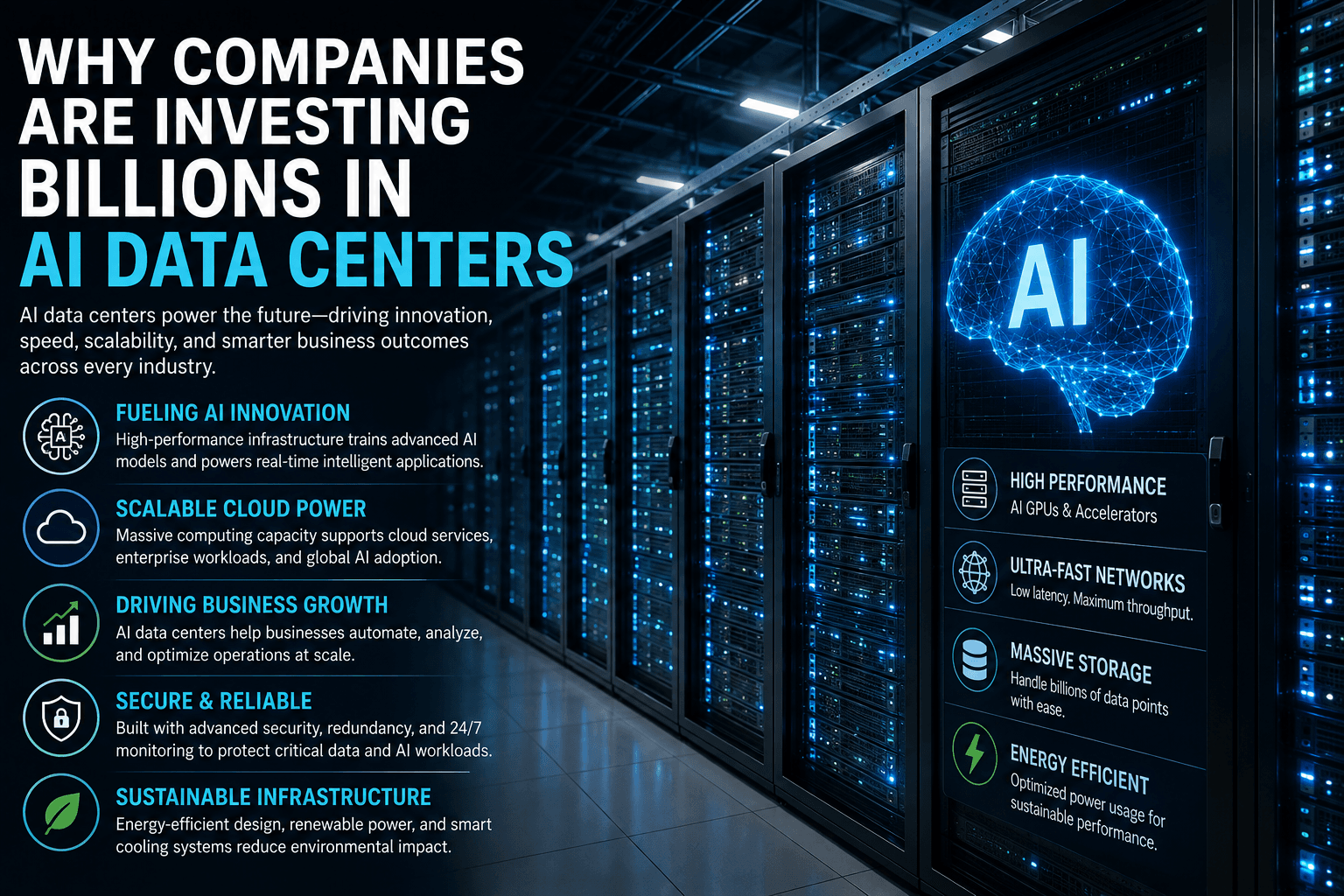
Artificial intelligence is transforming the global business landscape, and AI data centers have become the foundation of this technological revolution. In 2026, companies are investing billions of dollars to build next-generation AI data centers capable of supporting advanced machine learning models, generative AI applications, and enterprise automation.
Unlike traditional data centers, AI facilities are specifically designed to handle massive computational workloads. They combine high-performance GPUs, advanced networking, large-scale storage, and energy-efficient cooling systems to process enormous volumes of data at incredible speeds.
As businesses increasingly adopt AI-powered solutions, demand for AI-ready infrastructure continues to grow. Technology companies, cloud providers, governments, and enterprises recognize that investing in AI data centers is essential for remaining competitive in the digital economy.
What Are AI Data Centers?
AI data centers are specialized facilities built to train, deploy, and operate artificial intelligence models. They contain thousands of high-performance servers connected through ultra-fast networks that can process complex AI workloads around the clock.
Key components include:
AI GPUs and accelerators
High-speed networking
Large-scale cloud storage
Advanced cooling technologies
Energy management systems
AI security infrastructure
These components work together to deliver the computing power required for modern AI applications.
Growing Enterprise AI Adoption
Businesses across healthcare, finance, manufacturing, retail, logistics, education, and cybersecurity are rapidly integrating AI into their daily operations.
Organizations use AI to:
Automate repetitive tasks
Analyze large datasets
Improve customer service
Detect fraud
Optimize supply chains
Generate content
Support software development
As AI workloads expand, companies require more powerful infrastructure, making AI data centers a strategic investment.
Cloud Computing Is Driving Demand
Cloud providers play a central role in AI adoption by offering scalable computing resources without requiring businesses to purchase expensive hardware.
Modern cloud platforms provide:
AI model training
GPU computing
Machine learning platforms
Data storage
AI development tools
Enterprise security services
To meet growing customer demand, cloud providers continue expanding AI-focused data center capacity worldwide.
AI Chips Require Specialized Infrastructure
Modern AI models rely on specialized processors capable of performing trillions of calculations every second. These chips generate significant heat and consume substantial power, requiring purpose-built facilities with advanced cooling and electrical systems.
Companies are investing heavily in infrastructure that supports next-generation AI hardware while ensuring reliability, efficiency, and maximum performance.
Sustainability Is Becoming a Design Priority
AI computing consumes significant amounts of electricity, making sustainability a major focus for new data center projects.
Many companies are implementing:
Renewable energy sources
Liquid cooling systems
High-efficiency power distribution
Intelligent energy management
Water-saving cooling technologies
These innovations reduce operating costs while supporting environmental goals and long-term business sustainability.
AI Data Centers Are Creating New Economic Opportunities
The rapid expansion of AI data centers is generating significant economic benefits around the world. New facilities create thousands of jobs in construction, engineering, cybersecurity, cloud operations, and information technology. They also stimulate investment in local infrastructure, renewable energy projects, and telecommunications networks.
Regions that attract AI infrastructure investment are becoming major technology hubs, encouraging startups, research institutions, and global enterprises to establish operations nearby.
Security and Reliability Are Top Priorities
AI data centers process enormous volumes of sensitive business and customer information. As a result, companies are investing heavily in cybersecurity, disaster recovery, and business continuity planning.
Modern AI data centers include:
Multi-layer cybersecurity systems
AI-powered threat detection
Data encryption
Backup and disaster recovery solutions
Continuous infrastructure monitoring
Physical security and access control
These measures help organizations protect critical data while ensuring uninterrupted AI services.
Edge Computing Is Expanding AI Infrastructure
While centralized AI data centers remain essential, many organizations are also investing in edge computing. Edge infrastructure processes data closer to users and connected devices, reducing latency and improving real-time performance.
Industries such as healthcare, manufacturing, autonomous vehicles, smart cities, and retail increasingly rely on edge AI to deliver faster decision-making and improved customer experiences.
Challenges Facing AI Data Center Expansion
Despite enormous investment, companies face several challenges when building AI infrastructure, including:
Rising construction costs
Limited availability of AI chips
High electricity demand
Cooling requirements
Skilled workforce shortages
Regulatory and environmental compliance
Businesses that successfully address these challenges will be better positioned to scale their AI capabilities while maintaining operational efficiency.
Future Outlook
AI data centers are expected to remain one of the fastest-growing segments of the global technology industry throughout the decade. Advances in AI processors, cloud computing, networking, renewable energy, and cooling technologies will continue improving performance while reducing operating costs.
As artificial intelligence becomes a core component of business strategy, investment in AI infrastructure will continue expanding across every major industry.
Conclusion
Companies are investing billions in AI data centers because they provide the foundation for modern artificial intelligence. These facilities enable organizations to train advanced AI models, process massive datasets, support cloud services, and deliver intelligent applications at scale.
Businesses that invest in reliable, secure, and sustainable AI infrastructure today will gain a competitive advantage, improve operational efficiency, and accelerate digital transformation. As AI adoption continues to grow, data centers will remain one of the most valuable assets in the global technology ecosystem.
Frequently Asked Questions (FAQs)
1. What is an AI data center?
An AI data center is a specialized facility designed to support artificial intelligence workloads using high-performance computing, advanced networking, and large-scale storage.
2. Why are companies investing billions in AI data centers?
Growing enterprise AI adoption, cloud computing demand, and the need for powerful computing infrastructure are driving record investments.
3. How are AI data centers different from traditional data centers?
AI data centers use specialized AI chips, GPU clusters, high-speed networking, and advanced cooling systems optimized for machine learning workloads.
4. What industries benefit most from AI data centers?
Healthcare, finance, manufacturing, retail, logistics, telecommunications, education, and cybersecurity all benefit from AI infrastructure.
5. Why are GPUs important in AI data centers?
GPUs accelerate AI training and inference by processing massive parallel calculations much faster than traditional processors.
6. How does cloud computing support AI data centers?
Cloud providers offer scalable AI resources, allowing businesses to access advanced computing power without building their own infrastructure.
7. Are AI data centers environmentally friendly?
Many new AI facilities use renewable energy, liquid cooling, energy-efficient hardware, and intelligent power management to improve sustainability.
8. What challenges do AI data centers face?
Major challenges include energy consumption, cooling requirements, construction costs, chip shortages, cybersecurity risks, and regulatory compliance.
9. How does edge computing complement AI data centers?
Edge computing processes data closer to users, reducing latency while centralized AI data centers handle large-scale training and cloud workloads.
10. What is the future of AI data centers?
The future includes larger AI infrastructure investments, more sustainable operations, faster AI processors, advanced cloud platforms, and greater enterprise AI adoption.
Additional Frequently Asked Questions (FAQs)
11. What role do AI data centers play in digital transformation?
AI data centers provide the computing power and infrastructure businesses need to automate operations, analyze data, and deploy advanced AI applications, making them essential for digital transformation.
12. How do AI data centers improve business performance?
They enable faster AI model training, real-time data processing, improved scalability, stronger security, and more efficient cloud services, helping businesses increase productivity and innovation.
13. Why is high-speed networking important in AI data centers?
High-speed networking allows thousands of AI processors and servers to communicate efficiently, reducing delays and improving the performance of large-scale AI workloads.
14. How are governments supporting AI data center development?
Many governments are investing in AI infrastructure through funding programs, semiconductor initiatives, renewable energy projects, and policies that encourage technology innovation and data center expansion.
15. What trends will shape the future of AI data centers?
Future trends include AI-optimized processors, liquid cooling, renewable energy integration, edge AI infrastructure, autonomous data center management, and more sustainable, energy-efficient computing facilities.