
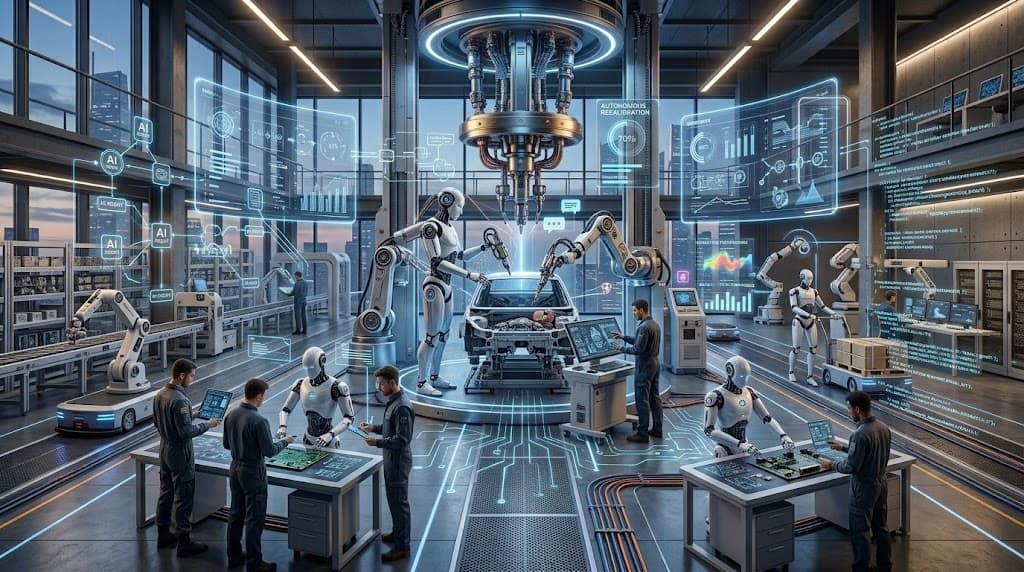

Artificial intelligence is moving beyond simple chatbots and question-answering tools. In 2026, AI agents are becoming capable of planning tasks, using software, analyzing information, making decisions, and completing multi-step workflows with much less human intervention.
From customer service and marketing to software development and business operations, autonomous AI agents are changing how organizations approach work. The biggest question is no longer whether AI will affect jobs—it is which tasks AI agents will automate, which skills will become more valuable, and how businesses can adapt.
What Are AI Agents?
An AI agent is a software system that can perceive information, reason about a goal, decide what actions to take, use available tools, and evaluate the results.
A traditional chatbot generally waits for a prompt and generates a response. An AI agent can work toward a broader objective by breaking it into smaller steps.
For example, instead of asking an AI to “write a sales report,” a business could give an AI agent a goal such as:
“Analyze this month's sales data, identify unusual changes, summarize the main trends, and prepare a report for the management team.”
Depending on its permissions and connected tools, the agent could retrieve data, analyze it, create a report, and flag issues for human review.
How Do AI Agents Work?
Most AI agents combine several capabilities:
1. Goal Understanding
The agent receives a goal or task and determines what needs to be accomplished.
2. Planning
It can break a complex objective into smaller actions and determine an appropriate sequence.
3. Tool Use
Agents may interact with software, databases, APIs, search systems, spreadsheets, or other digital tools.
4. Memory and Context
Some agent systems can maintain relevant information across multiple steps so they don't have to start from scratch after every action.
5. Evaluation
An agent can inspect the result of an action and decide whether another step is necessary.
This creates a basic loop:
Goal → Plan → Act → Observe → Evaluate → Repeat
The sophistication of this process varies significantly between different AI-agent systems.
AI Agents vs. Traditional AI
Traditional AI often performs a specific task after receiving an instruction. AI agents are designed to handle a sequence of related actions toward a goal.
Feature | Traditional AI | AI Agents |
|---|---|---|
Main role | Generate or analyze | Plan and execute workflows |
Autonomy | Usually limited | Potentially much higher |
Tool usage | May be limited | Often central |
Multi-step tasks | Limited | Designed for them |
Human involvement | Frequent | Can be reduced, depending on risk |
Example | Generate an email | Research, draft, organize, and route an email |
AI agents don't automatically make every task fully autonomous. In many business environments, humans still need to approve important decisions.
How AI Agents Are Changing Jobs in 2026
AI agents are likely to have their biggest impact on tasks, rather than eliminating entire occupations overnight.
Customer Service
Agents can help answer common questions, retrieve customer information, classify requests, summarize conversations, and route complex cases to human employees.
This allows customer-service professionals to focus more on unusual or emotionally sensitive problems.
Software Development
AI coding agents can assist with debugging, code generation, documentation, testing, and development workflows.
Developers still need to review generated code, understand system architecture, and make important technical decisions.
Marketing
AI agents can support market research, content planning, campaign analysis, customer segmentation, and repetitive reporting.
Human marketers remain important for strategy, brand positioning, creativity, and judgment.
Finance and Accounting
Agent-based systems can assist with data processing, reconciliation workflows, reporting, and identifying unusual transactions.
Because financial errors can have serious consequences, organizations generally need strong controls and human oversight.
Human Resources
AI agents can help organize candidate information, schedule interviews, answer routine employee questions, and automate administrative processes.
Sensitive decisions involving people require careful review to reduce unfair or inappropriate outcomes.
Healthcare Administration
AI agents may help with scheduling, documentation workflows, information retrieval, and administrative tasks.
Clinical decisions are a different matter: high-stakes medical applications require appropriate professional oversight, validation, privacy protections, and regulatory compliance.
Which Jobs Are Most Exposed to AI Automation?
Jobs with large amounts of repetitive, predictable, digital tasks are generally more exposed to automation.
Examples can include:
Data entry
Basic customer support
Routine reporting
Simple administrative work
Repetitive document processing
Basic content formatting
Certain repetitive coding tasks
Scheduling and coordination
However, exposure to automation does not necessarily mean a job disappears. In many cases, the role may change as workers use AI to complete some tasks faster.
Which Skills Will Become More Valuable?
As AI agents become more capable, uniquely human and higher-level skills can become increasingly important.
Critical Thinking
Workers need to evaluate whether an AI-generated result is actually correct.
Problem Solving
Understanding the real problem matters more than simply generating an answer.
Communication
People who can clearly explain goals, requirements, and decisions remain valuable.
Creativity
AI can generate possibilities, but humans still play a major role in deciding what is meaningful, useful, and appropriate.
AI Literacy
Knowing how AI systems work, where they fail, and how to use them responsibly is becoming an important workplace skill.
Domain Expertise
A person with strong knowledge of medicine, law, finance, engineering, education, or another field can often use AI more effectively because they can evaluate its output.
Are AI Agents Going to Replace Humans?
The short answer is: some tasks will be automated, but that does not mean humans will become unnecessary.
A more realistic scenario is a collaboration between people and AI.
For example, a human employee might:
Define the objective.
Give the AI agent appropriate access.
Let the agent perform routine work.
Review important results.
Correct errors.
Make the final high-impact decision.
The future of work may therefore involve humans supervising and collaborating with increasingly capable AI systems rather than simply competing against them.
Benefits of AI Agents for Businesses
Businesses are interested in AI agents because they can potentially provide several benefits.
Increased Productivity
Agents can handle repetitive digital workflows while employees concentrate on higher-value activities.
Faster Operations
Automated workflows can potentially operate continuously and reduce delays between tasks.
Lower Administrative Workload
Employees can spend less time copying information between systems or preparing routine reports.
Better Scalability
Businesses may be able to handle increasing workloads without increasing every administrative resource proportionally.
More Consistent Processes
Well-designed automated workflows can follow defined procedures consistently.
However, these benefits depend on implementation quality. An unreliable agent can create more work rather than less.
Risks and Challenges of AI Agents
Autonomous systems also introduce significant risks.
Incorrect Decisions
AI systems can produce inaccurate information or make poor decisions.
Security Risks
An agent with access to email, files, databases, or financial systems could cause serious damage if its permissions or security controls are poorly designed.
Privacy Concerns
Organizations must carefully control what personal or confidential information AI systems can access.
Loss of Human Oversight
Giving an AI too much autonomy without appropriate approval mechanisms can increase operational risk.
Job Displacement
Some roles and tasks may shrink as organizations automate repetitive work.
Bias
AI systems can reproduce or amplify problematic patterns in their training data or workflows.
How Businesses Can Prepare for AI Agents
Companies considering AI agents should avoid automating everything at once.
A better approach is to identify repetitive workflows and evaluate where automation provides clear value.
Step 1: Identify Repetitive Tasks
Look for processes involving predictable digital actions.
Step 2: Start With Low-Risk Work
Use AI agents for tasks where mistakes are relatively easy to detect and correct.
Step 3: Set Permission Limits
Agents should only receive the access necessary to perform their assigned work.
Step 4: Add Human Approval
Important actions—especially financial, legal, security, or customer-impacting actions—may require human approval.
Step 5: Monitor Performance
Track errors, costs, completion rates, and unexpected behavior.
Step 6: Improve the Workflow
AI-agent systems should be continuously tested and refined rather than treated as “set and forget” technology.
How Students Can Prepare for the AI-Agent Era
Students don't necessarily need to become AI researchers to benefit from this technology.
Start by learning:
AI fundamentals
Prompt and task design
Basic programming
Data analysis
Research and fact-checking
Digital productivity tools
Cybersecurity fundamentals
Communication and presentation skills
The most valuable combination may be AI skills + subject expertise + human judgment.
What Is the Future of AI Agents?
AI agents are likely to become more integrated into everyday software and business systems.
Instead of opening separate applications and manually moving information between them, users may increasingly describe a goal and let AI coordinate multiple tools.
For example:
“Prepare next week's meeting package.”
An agent could potentially gather relevant documents, summarize previous discussions, organize information, create a draft agenda, and prepare follow-up tasks—while leaving important decisions to humans.
The key challenge will be making these systems reliable, secure, transparent, and controllable.
Final Thoughts
AI agents represent an important shift in artificial intelligence. The technology is moving from systems that simply respond to instructions toward systems capable of carrying out multi-step tasks.
For businesses, this could mean faster workflows and higher productivity. For workers, it means that some repetitive tasks may increasingly be automated while skills such as critical thinking, communication, creativity, domain expertise, and AI literacy become more important.
The biggest opportunity isn't necessarily humans versus AI.
It is humans using AI effectively to accomplish more.
Frequently Asked Questions About AI Agents in 2026
1. What is an AI agent?
An AI agent is a software system designed to pursue a goal by planning actions, using tools, processing information, and completing multiple steps with varying levels of autonomy.
2. Are AI agents the same as chatbots?
No. Chatbots primarily respond to conversations, while AI agents can be designed to plan and execute multi-step workflows using tools.
3. Will AI agents replace jobs in 2026?
AI agents may automate some tasks and change how certain jobs are performed. The impact will vary by industry, occupation, and the complexity of the work.
4. Which jobs are most affected by AI agents?
Roles containing repetitive and predictable digital tasks may face greater automation pressure, although entire occupations are not necessarily eliminated.
5. Can AI agents work without humans?
Some agents can perform tasks with substantial autonomy, but the appropriate level of human oversight depends on the task's risk and the system's reliability.
6. How are businesses using AI agents?
Businesses can use them for customer support, research, software development, marketing workflows, reporting, scheduling, data processing, and other repetitive digital processes.
7. Are AI agents expensive?
Costs vary widely depending on the AI model, tools, infrastructure, usage, and complexity of the workflow. Some basic solutions can be relatively inexpensive, while enterprise systems can cost substantially more.
8. Are AI agents safe?
AI agents can be useful, but they are not automatically safe. Strong permissions, monitoring, testing, security controls, and human oversight are important.
9. What skills should students learn for the AI future?
Students should consider developing AI literacy alongside critical thinking, communication, problem-solving, programming, data skills, creativity, and expertise in a chosen field.
10. What is the biggest advantage of AI agents?
Their major advantage is the ability to automate or assist with multi-step workflows rather than simply generating a single response.
11. Can AI agents browse the internet?
Some AI-agent systems can access web or search tools when those capabilities are provided to them. Their access depends on the system and its permissions.
12. Can AI agents write software?
Yes. AI coding agents can assist with generating, modifying, testing, and debugging software, although human review remains important.
13. Can AI agents make business decisions?
They can support or, in some controlled systems, make defined decisions. High-impact decisions should have appropriate safeguards and human oversight.
14. Will AI create new jobs?
AI is likely to create demand for new skills and roles while changing existing occupations. The exact job impact will vary as adoption develops.
15. How can a small business start using AI agents?
Start with a low-risk repetitive workflow, measure its results, limit permissions, and gradually expand automation after the system proves reliable.
16. What is agentic AI?
Agentic AI generally refers to AI systems designed to pursue goals, plan actions, use tools, and operate with a degree of autonomy.
17. Can AI agents access private company data?
They can if they are connected to systems containing that data and are granted the necessary permissions. Access should therefore be carefully controlled.
18. Do AI agents always give correct answers?
No. AI systems can make mistakes, misunderstand instructions, or produce inaccurate information. Important outputs should be checked.
19. How will AI agents change office work?
They may automate repetitive administrative workflows, assist with research and reporting, and allow employees to focus more on decision-making and higher-value work.
20. What is the future of AI agents?
AI agents are likely to become increasingly integrated into software and business workflows, with the strongest systems combining automation with human supervision and strong security controls.