Businesses are rapidly moving beyond traditional automation toward systems that can understand objectives, make decisions, use enterprise tools, and execute complex workflows with minimal human intervention. At the center of this transformation are autonomous AI agents and agentic workflows.
Unlike conventional automation, which follows predefined rules, autonomous AI agents can interpret changing situations, reason through problems, select appropriate actions, and adapt their behavior based on context. When these agents are integrated into structured business processes, they create agentic workflows capable of automating sophisticated enterprise operations.
What Are Autonomous AI Agents?
Autonomous AI agents are software systems powered by artificial intelligence that can independently perform tasks to achieve a defined objective.
An AI agent typically combines a large language model with:
Planning and reasoning capabilities
Access to enterprise data and knowledge
Tools and APIs
Memory and contextual information
Decision-making logic
Security and permission controls
Monitoring and evaluation mechanisms
For example, instead of simply answering a customer-service question, an autonomous agent could identify the customer's issue, retrieve their account information, check relevant policies, investigate the problem, determine an appropriate resolution, update the CRM, and escalate the case when human intervention is required.
What Are Agentic Workflows?
Agentic workflows combine AI agents with business processes, rules, enterprise applications, and human approval mechanisms.
A typical workflow may look like:
Business Event → AI Agent → Data Retrieval → Reasoning → Tool Execution → Validation → Human Approval → Action → Monitoring
The agent can determine what steps are required rather than merely executing a rigid sequence of predefined instructions.
This makes agentic workflows particularly useful for processes involving unstructured information, multiple applications, exceptions, and decisions.
Autonomous AI Agents vs. Traditional Automation
Traditional robotic process automation (RPA) and workflow automation generally depend on predefined rules.
For example:
Traditional automation:
If invoice amount is below a defined threshold, route it to department A.
Agentic automation:
Review the invoice, compare it with the purchase order and contract, identify discrepancies, determine whether they are material, gather supporting information, and recommend or execute the appropriate resolution according to company policy.
Traditional automation remains highly effective for predictable, deterministic processes. Agentic automation becomes more valuable when workflows require interpretation, reasoning, judgment, or adaptation.
How Autonomous AI Agents Work in the Enterprise
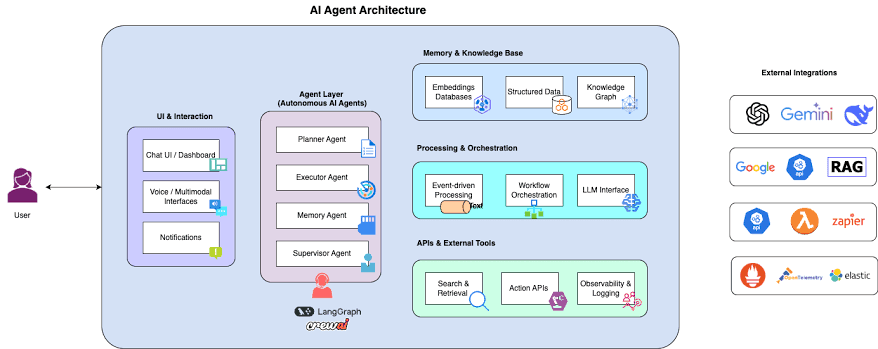
An enterprise AI agent usually operates through several interconnected layers.
1. Goal and Context
The agent receives an objective, business event, or task along with the relevant context.
For example:
Investigate why a strategic customer's order has been delayed and determine the next appropriate action.
2. Planning and Reasoning
The agent breaks the objective into smaller tasks.
It might determine that it needs to:
Retrieve the customer's order.
Check inventory.
Review shipment information.
Examine recent support tickets.
Identify the cause of the delay.
Recommend a resolution.
3. Knowledge Retrieval
The agent accesses relevant enterprise information from sources such as:
Knowledge bases
Databases
CRM systems
ERP platforms
Internal documents
Contracts
Policies
Data warehouses
Retrieval-augmented generation (RAG) can help ground responses and decisions in current organizational information.
4. Tool Use
Agents can interact with business applications through APIs and other tools.
These may include:
CRM systems
ERP systems
Ticketing platforms
Email
Databases
Payment systems
Supply-chain applications
Cloud infrastructure
Internal APIs
5. Decision and Execution
After gathering information, the agent determines the appropriate next action and executes it when it has the required authorization.
6. Validation and Human Oversight
Enterprise agents should operate within clearly defined policies.
High-impact actions can require human approval before execution, creating a human-in-the-loop model.
7. Monitoring and Audit
Organizations can monitor agent activity, tool calls, decisions, errors, costs, and business outcomes.
This provides the observability required for reliable enterprise deployment.
Enterprise Use Cases for Autonomous AI Agents
Customer Service Automation
AI agents can manage customer interactions from initial inquiry through resolution.
They can:
Understand customer requests
Search knowledge bases
Retrieve account information
Troubleshoot issues
Create or update tickets
Recommend solutions
Escalate complex cases
This can reduce response times while allowing human agents to focus on higher-value interactions.
Finance and Accounting
Finance teams can use agents for:
Invoice processing
Accounts reconciliation
Expense analysis
Financial reporting
Payment exception handling
Fraud or anomaly investigation
An agent can gather information from multiple systems and prepare recommendations for finance professionals.
Sales and CRM Automation
Sales agents can research prospects, analyze accounts, summarize customer interactions, update CRM records, prepare meeting briefs, and assist with proposal creation.
Instead of simply automating individual CRM actions, an agent can coordinate multiple steps around a sales objective.
IT Operations
AI agents can assist IT teams with:
Incident triage
Log analysis
Root-cause investigation
Knowledge retrieval
Service-desk automation
Routine remediation
Infrastructure monitoring
For sensitive infrastructure operations, organizations can use approval gates and strict permissions.
Human Resources
HR agents can automate employee-facing and administrative workflows such as:
Employee onboarding
Policy questions
Document processing
Benefits information
HR ticket routing
Employee record updates
Procurement and Supply Chain
Procurement agents can compare suppliers, analyze quotations, review purchase requirements, identify exceptions, and coordinate approval workflows.
Supply-chain agents can monitor events and investigate issues such as inventory shortages, delayed shipments, or supplier disruptions.
Legal and Compliance
AI agents can support legal and compliance teams by analyzing documents, extracting clauses, comparing policies, identifying potential issues, and routing matters for review.
Human professionals should remain responsible for consequential legal decisions.
Benefits of Agentic Enterprise Automation
Greater Operational Efficiency
Agents can automate multi-step processes that previously required employees to switch between several applications.
Reduced Manual Work
Employees spend less time on repetitive information gathering, data entry, and routine coordination.
Faster Decision Cycles
Agents can retrieve and analyze information rapidly, helping organizations respond to operational events more quickly.
24/7 Operations
Autonomous systems can monitor workflows continuously and initiate appropriate actions outside traditional working hours.
Better Employee Productivity
Instead of replacing every human decision, agents can remove administrative work and allow employees to focus on strategic and creative activities.
Scalable Automation
Once an agentic workflow is designed and governed appropriately, it can potentially handle large volumes of similar tasks.
Challenges of Autonomous AI Agents
Enterprise adoption also introduces important challenges.
Security
Agents may have access to sensitive business information and operational systems. Strong authentication, authorization, least-privilege access, and data protection are essential.
Reliability
AI systems can make incorrect assumptions or produce inaccurate outputs. Critical workflows therefore require validation mechanisms and appropriate human oversight.
Hallucinations
An agent may generate information that is not supported by available evidence. Grounding agents in trusted enterprise data and requiring verification can reduce this risk.
Cost
Complex workflows can require multiple model calls, retrieval operations, and tool executions. Organizations should monitor both technical and business costs.
Governance
Enterprises need clear policies defining what agents are allowed to see, decide, and execute.
Observability
Without detailed monitoring, it can be difficult to determine why an agent made a particular decision or where a workflow failed.
Best Practices for Enterprise Agentic Automation
Organizations should approach autonomous AI agents as enterprise software systems rather than simply deploying a chatbot.
Start With a Specific Business Problem
Choose a workflow with measurable value rather than attempting to automate an entire department immediately.
Give Agents Limited Permissions
Use the principle of least privilege. An agent should have access only to the systems and actions required for its assigned responsibilities.
Combine AI With Deterministic Rules
Not every decision should be delegated to an AI model. Business rules, validation logic, and policy engines can provide predictable controls around agentic behavior.
Keep Humans in the Loop
Human approval is particularly important for financial transactions, legal commitments, security changes, employment decisions, and other high-impact actions.
Build Strong Evaluation Processes
Test agents against realistic scenarios, edge cases, failure conditions, and adversarial inputs before allowing them to operate autonomously.
Monitor Business Outcomes
Success should not be measured only by model accuracy. Organizations should also measure:
Processing time
Cost per transaction
Error rates
Escalation rates
Customer satisfaction
Employee productivity
Workflow completion rates
Return on investment
The Future of Enterprise Automation
Enterprise automation is evolving from simple task automation toward intelligent systems capable of coordinating entire business processes.
The next generation of enterprise platforms will increasingly combine:
AI agents + enterprise data + APIs + workflow orchestration + governance + human oversight.
Rather than replacing every existing automation technology, agentic AI is likely to work alongside RPA, traditional workflow engines, business rules, databases, and enterprise applications.
The organizations that gain the most value will be those that treat agents as governed digital workers—with clearly defined responsibilities, permissions, performance metrics, and accountability.
Conclusion
Autonomous AI agents and agentic workflows represent a significant evolution in enterprise automation. They enable organizations to automate processes that require more than simple rules by combining reasoning, knowledge retrieval, tool use, decision-making, and workflow execution.
However, successful adoption requires more than giving an AI model access to business systems. Enterprises need secure architecture, controlled permissions, reliable data, human oversight, monitoring, evaluation, and governance.
When implemented responsibly, agentic automation can help organizations reduce operational effort, accelerate business processes, improve employee productivity, and create more adaptive digital operations.
Frequently Asked Questions (FAQs)
1. What is an autonomous AI agent?
An autonomous AI agent is an AI-powered software system that can independently plan and execute multiple steps to accomplish a defined objective. It can reason about a task, use tools, retrieve information, make decisions, and take authorized actions.
2. What is an agentic workflow?
An agentic workflow is a business process in which an AI agent can determine and execute one or more steps toward a specific outcome. It can combine AI reasoning with business rules, enterprise systems, APIs, and human approvals.
3. How are AI agents different from traditional automation?
Traditional automation generally follows predefined rules and workflows. AI agents can interpret natural language and changing circumstances, reason about problems, select tools, and adapt their actions within defined constraints.
4. Can AI agents work with existing enterprise systems?
Yes. Enterprise agents can integrate with CRM, ERP, HR, ITSM, databases, knowledge bases, communication platforms, and other applications through APIs, connectors, or enterprise integration layers.
5. Are autonomous AI agents safe for enterprise use?
They can be used safely when deployed with appropriate security and governance controls. Organizations should implement authentication, authorization, least-privilege access, data protection, monitoring, validation, audit trails, and human approval for high-risk actions.
6. What is human-in-the-loop AI?
Human-in-the-loop AI means that people remain involved at specific points in an AI-driven process. For example, an agent may analyze a contract and recommend an action, but a lawyer must approve the final decision.
7. What industries can benefit from agentic workflows?
Almost any industry with complex, repetitive, information-intensive processes can benefit. Common applications include banking, insurance, healthcare administration, retail, manufacturing, logistics, telecommunications, professional services, finance, HR, and IT.
8. Can AI agents completely replace employees?
The more practical enterprise approach is usually augmentation rather than complete replacement. Agents can automate repetitive work and coordinate processes while employees retain responsibility for strategic decisions, complex judgment, relationships, and high-impact actions.
9. What technologies are required to build agentic workflows?
A typical architecture may include an AI model, agent orchestration layer, enterprise data sources, RAG or search, APIs and tools, workflow systems, identity and access management, security controls, monitoring, and evaluation infrastructure.
10. How do companies measure the ROI of AI agents?
Organizations can measure ROI using metrics such as time saved, cost per workflow, processing speed, error reduction, automation rate, employee productivity, customer satisfaction, revenue impact, and overall operating-cost reduction.
11. What is the first step toward implementing autonomous AI agents?
The best starting point is to identify a well-defined, high-volume business process with measurable inefficiencies. Organizations can then build a controlled pilot, establish success metrics, integrate only the necessary tools, and gradually expand agent autonomy.
12. What is the future of agentic automation?
The future is likely to involve networks of specialized AI agents working with enterprise applications and human teams. These systems will increasingly coordinate complex workflows while operating within organizational policies, security controls, and governance frameworks.