
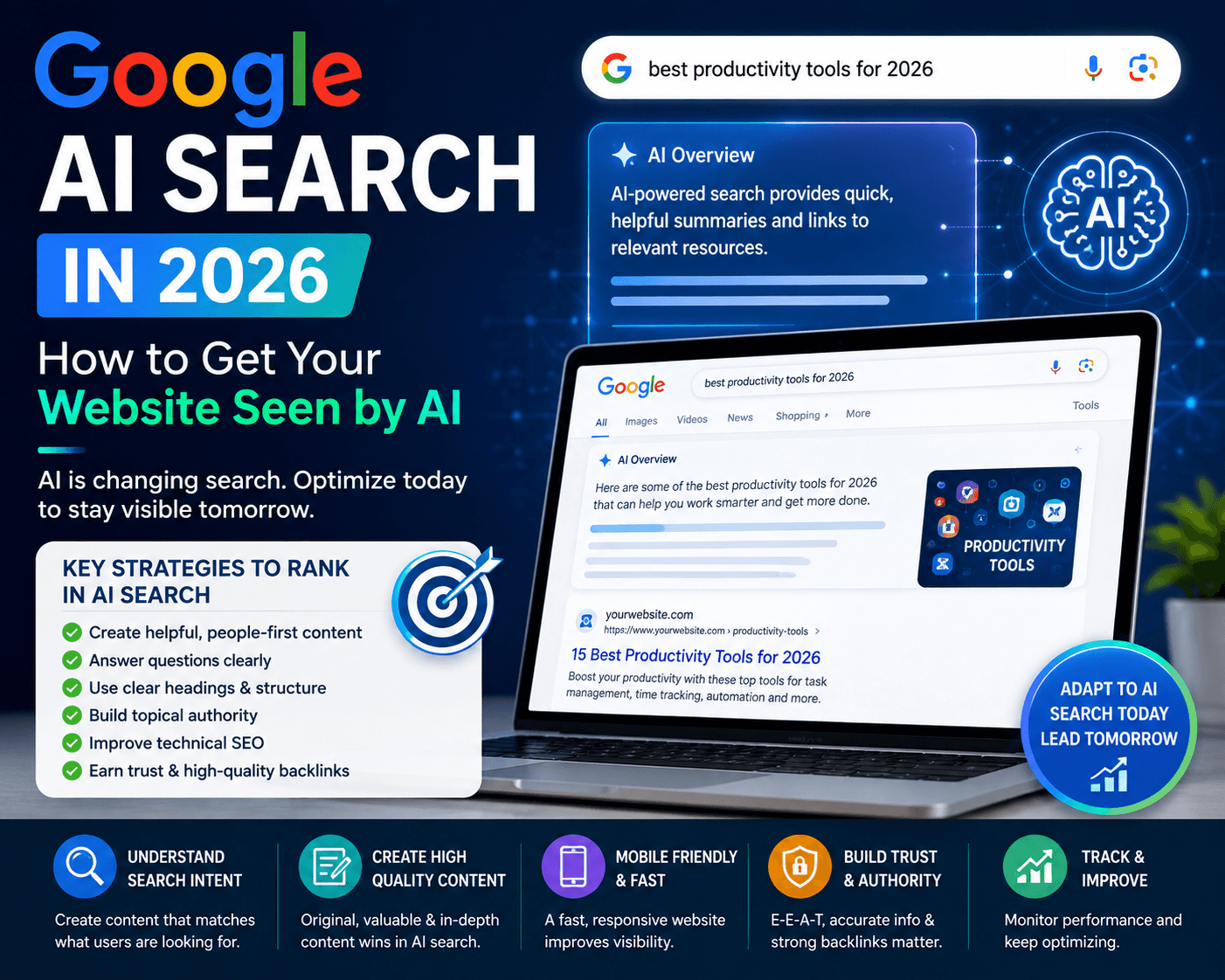

Search is changing rapidly. In 2026, artificial intelligence is playing a bigger role in how people discover information online. Google and other search platforms increasingly use AI-powered features to understand questions, summarize information, and help users find relevant answers.
For website owners, bloggers, businesses, and digital marketers, this means that traditional SEO is evolving. Ranking for a keyword is still important, but creating useful, trustworthy, and well-structured content is becoming even more essential.
In this guide, we will explore how Google AI search is changing website traffic and what you can do to improve your chances of being discovered.
What Is AI-Powered Search?
AI-powered search uses artificial intelligence to better understand what users are looking for.
Instead of simply matching keywords, modern search systems can analyze:
The meaning behind a search query
The context of a user's question
Relationships between different topics
The quality and usefulness of content
Relevant information from multiple sources
AI search experiences may present information in new ways, including summaries, direct answers, links, recommendations, and traditional search results.
This means websites need to focus on providing genuine value rather than simply repeating keywords.
Why AI Search Matters for Websites
AI-powered search can change how people interact with search results.
Some users may receive answers directly within the search experience. Others may click through to websites when they need detailed information, original insights, products, services, or additional resources.
This creates both challenges and opportunities.
The challenge is that some simple informational searches may generate fewer website clicks. The opportunity is that high-quality websites can still attract valuable visitors by offering information and experiences that AI summaries cannot fully replace.
How to Optimize Your Website for AI Search
1. Create Helpful and Original Content
The foundation of good SEO remains useful content.
Avoid creating articles simply to target search engines. Instead, focus on answering real questions and solving real problems.
Your content should provide:
Clear explanations
Original insights
Useful examples
Practical advice
Accurate information
Updated details
The more useful your content is, the more likely it is to provide value to users regardless of how search technology evolves.
2. Focus on Search Intent
Understanding search intent is extremely important.
Before creating content, ask yourself:
What does the person searching for this information actually want?
A user may be looking for:
A quick answer
A detailed guide
A product
A comparison
A tutorial
A solution to a problem
Your content should match that intent.
For example, someone searching for “how to start a blog” likely wants a step-by-step guide. Someone searching for “best blogging platforms” may want comparisons and recommendations.
3. Use Clear Content Structure
Well-organized content is easier for both users and search systems to understand.
Use:
Clear headings
Short paragraphs
Bullet points
Numbered steps
Descriptive titles
Relevant subheadings
A logical structure can make important information easier to identify and understand.
4. Build Topical Authority
Instead of publishing random articles about unrelated subjects, consider building authority around a specific topic.
For example, a website focused on digital business could create detailed content about:
Online business ideas
AI tools
Digital marketing
Ecommerce
SEO
Freelancing
Publishing useful content across related topics can help create a strong knowledge base for your audience.
5. Answer Common Questions Clearly
People often use AI-powered search to ask direct questions.
Adding clear answers to common questions can make your content more useful.
For example:
Question: What is AI search?
Answer: AI search uses artificial intelligence to understand search queries and provide relevant information and answers.
You can include FAQ sections when they genuinely help users understand the topic.
6. Demonstrate Experience and Trust
Trust is becoming increasingly important online.
When creating content, demonstrate why readers should trust the information.
You can do this by:
Providing accurate information
Updating outdated content
Using reliable sources
Including real examples
Showing relevant expertise
Being transparent about your content
Avoid making exaggerated claims that cannot be supported.
7. Improve Technical SEO
AI search does not eliminate the importance of technical SEO.
Your website should still be:
Mobile-friendly
Fast-loading
Easy to navigate
Secure
Properly structured
Search engines need to access and understand your website effectively.
Regularly check for broken pages, indexing problems, and other technical issues.
8. Use Relevant Keywords Naturally
Keywords are still useful because they help connect your content with the language people use when searching.
However, keyword stuffing is not an effective strategy.
Instead:
Research relevant search terms
Use them naturally
Include related topics and questions
Focus on readability
Write primarily for people while making your topic clear to search engines.
9. Create Content Beyond Simple Answers
AI can often summarize basic information. Therefore, websites should aim to provide value beyond what can be found in a short answer.
Consider adding:
Original research
Personal experience
Detailed tutorials
Case studies
Expert analysis
Interactive tools
Templates
Unique data
This type of content can give users a reason to visit your website.
How AI Search May Affect Website Traffic
The impact of AI search will likely vary depending on the type of website and the type of search query.
Some websites may experience changes in traffic from simple informational queries. However, businesses can still attract valuable visitors by focusing on useful and original content.
It may become more important to measure success beyond page views alone.
Useful metrics may include:
Leads
Sales
Newsletter subscriptions
Engagement
Returning visitors
Brand searches
Conversion rates
High-quality traffic can be more valuable than a large number of visitors who immediately leave.
The Importance of Content Quality
Content quality should be a top priority in 2026.
Avoid publishing large amounts of low-quality or repetitive content simply because AI makes content creation faster.
Instead, use AI as a tool to support your work.
Human editors should review important content for:
Accuracy
Clarity
Originality
Relevance
Quality
The best approach is often a combination of AI efficiency and human expertise.
A Simple AI Search Optimization Strategy
Here is a practical strategy for website owners:
Step 1: Understand Your Audience
Identify the questions and problems your audience wants to solve.
Step 2: Research Topics
Find relevant topics and search queries connected to your business.
Step 3: Create High-Quality Content
Write helpful, accurate, and well-structured articles.
Step 4: Add Original Value
Include examples, insights, research, or practical information.
Step 5: Improve Your Website
Ensure your site is fast, mobile-friendly, and easy to navigate.
Step 6: Update Existing Content
Review older articles and improve information when necessary.
Step 7: Measure Results
Track traffic, engagement, conversions, and other important business metrics.
The Future of SEO in an AI-Powered World
SEO is not disappearing. It is evolving.
The future of search will likely involve a combination of traditional search results, AI-generated experiences, voice search, conversational search, and other technologies.
Businesses that focus only on one search format may miss opportunities.
The best long-term strategy is to build a strong website that provides real value to users.
Create content that people want to read, share, save, and return to.
Final Thoughts
Google AI search is changing how people discover information online. Website owners need to adapt by focusing on helpful content, search intent, technical quality, trust, and originality.
Trying to manipulate search algorithms with shortcuts is unlikely to create long-term success.
Instead, focus on building a useful and trustworthy online presence.
In 2026 and beyond, the websites most likely to succeed will be those that understand their audience and consistently provide valuable experiences—whether visitors arrive through traditional search results or AI-powered search.
FAQs
1. What is Google AI search?
Google AI search refers to AI-powered search experiences that use artificial intelligence to understand queries and help users find relevant information.
2. Is SEO still important in 2026?
Yes. SEO remains important, but strategies continue to evolve as search technology changes.
3. Can AI search reduce website traffic?
Some websites may see changes in traffic, particularly for simple informational searches. However, useful and original content can continue to attract valuable visitors.
4. How can I optimize for AI search?
Focus on helpful content, clear structure, search intent, originality, technical SEO, and user experience.
5. Are keywords still important?
Yes, but they should be used naturally and in the context of genuinely useful content.
6. What type of content performs well in AI-powered search?
Detailed guides, original research, expert insights, practical tutorials, and content that directly answers user questions can provide strong value.
7. Should I use AI to write website content?
AI can help with research and productivity, but important content should be reviewed for accuracy, quality, and originality.
8. What is topical authority?
Topical authority refers to building strong, comprehensive knowledge and useful content around a particular subject.
9. Is technical SEO still necessary?
Yes. A fast, secure, mobile-friendly, and accessible website remains important.
10. What is the future of SEO?
SEO will likely continue evolving alongside AI, with greater emphasis on helpful content, user experience, trust, and multiple search formats.