Software development is undergoing one of the most significant transformations in its history. In 2026, autonomous coding powered by artificial intelligence is changing how developers build, test, deploy, and maintain applications. What once required hours or even days of manual programming can now be completed within minutes using intelligent AI coding systems.
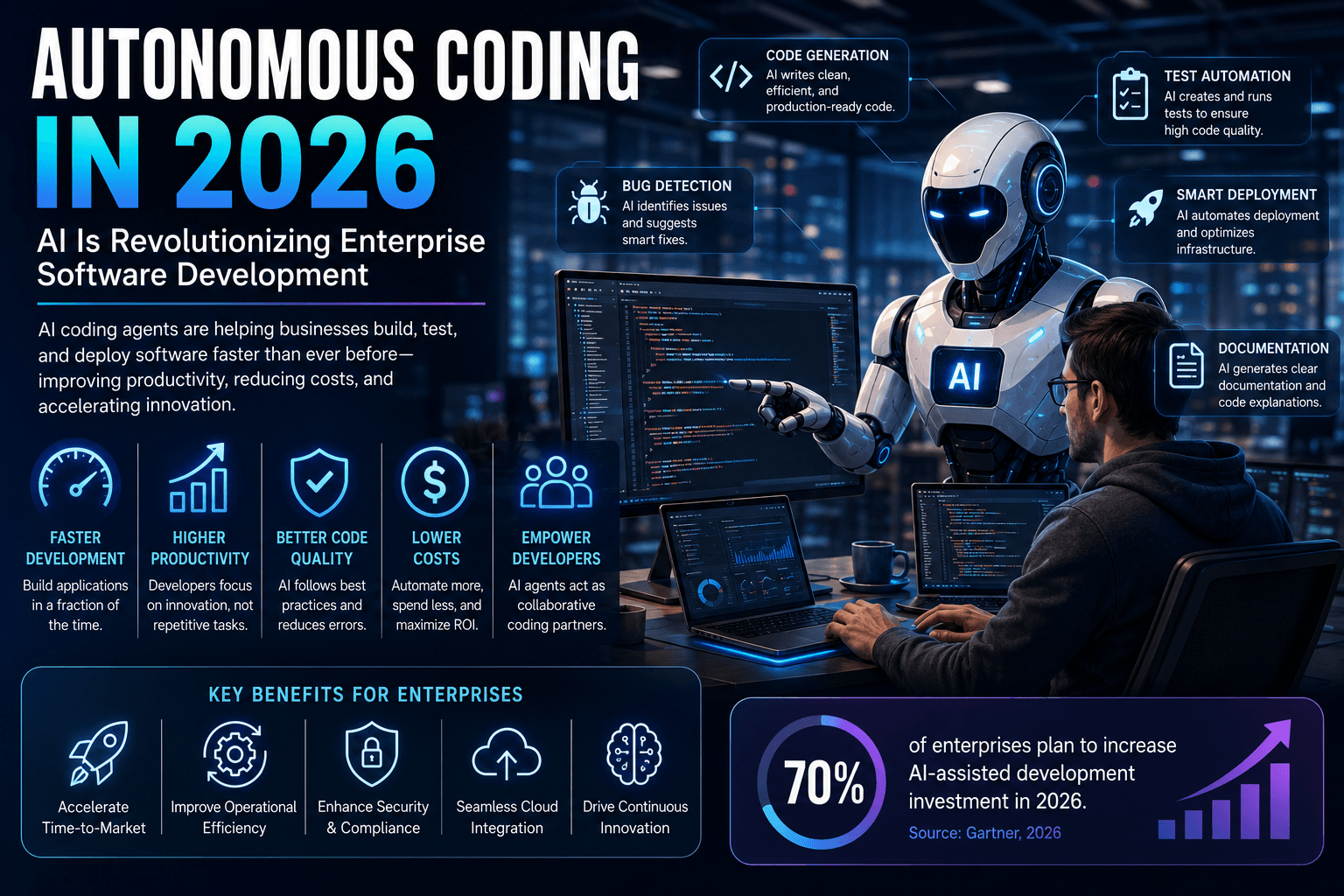
Autonomous coding is no longer limited to generating simple code snippets. Modern AI coding agents can understand business requirements, write production-ready code, identify bugs, perform testing, optimize software performance, generate documentation, and even assist in deploying applications. These capabilities are helping enterprises accelerate software development while improving quality and reducing operational costs.
As businesses race toward digital transformation, autonomous coding is becoming a critical competitive advantage, enabling organizations to innovate faster and respond more quickly to changing market demands.
What Is Autonomous Coding?
Autonomous coding refers to the use of advanced artificial intelligence systems that can perform software development tasks with minimal human intervention. These AI-powered tools analyze natural language instructions, interpret programming requirements, generate high-quality code, and automate repetitive development activities.
Unlike traditional coding assistants that provide basic suggestions, autonomous coding systems actively participate throughout the software development lifecycle. They collaborate with developers, recommend architectural improvements, detect security vulnerabilities, and continuously optimize applications.
These intelligent systems combine machine learning, natural language processing, and large language models to understand both programming languages and business objectives.
Why Autonomous Coding Is Growing Rapidly
Several factors are driving the widespread adoption of autonomous coding in 2026.
Rising Software Demand
Businesses across every industry require new digital products, mobile applications, enterprise platforms, and cloud-based services. Traditional software development struggles to meet this growing demand, making AI-powered coding an attractive solution.
Developer Productivity
Organizations are using autonomous coding to eliminate repetitive programming tasks, allowing developers to focus on solving complex business problems, designing innovative features, and improving customer experiences.
Faster Digital Transformation
Companies implementing AI-assisted development can release products more quickly, respond faster to customer feedback, and reduce software delivery timelines.
Skills Shortage
The global shortage of experienced software developers continues to grow. Autonomous coding helps organizations bridge this gap by increasing the productivity of existing development teams.
How Autonomous Coding Works
Modern autonomous coding platforms perform several advanced functions.
Requirement Analysis
AI systems interpret natural language prompts and convert business requirements into structured development plans.
Code Generation
The AI generates production-quality code in multiple programming languages while following coding standards and best practices.
Code Review
Intelligent systems analyze existing codebases to identify bugs, performance bottlenecks, security risks, and opportunities for improvement.
Automated Testing
AI automatically creates unit tests, integration tests, and regression tests to improve software reliability.
Documentation
Autonomous coding tools generate technical documentation, API references, and code explanations, making projects easier to maintain.
Benefits for Enterprise Software Development
Faster Development Cycles
AI significantly reduces the time required to build software applications, enabling organizations to launch products sooner.
Improved Code Quality
Autonomous coding systems consistently follow programming standards, reducing human errors and improving software reliability.
Lower Development Costs
By automating repetitive tasks, businesses reduce labor costs while increasing overall development efficiency.
Better Collaboration
Developers, designers, product managers, and business stakeholders can communicate using natural language, allowing AI to translate business ideas into working software.
Continuous Optimization
AI continuously monitors applications, recommends improvements, and helps maintain long-term software performance.
AI Is Transforming DevOps
Autonomous coding is reshaping DevOps by automating deployment, monitoring, and infrastructure management.
AI can:
Generate deployment scripts
Configure cloud environments
Detect infrastructure issues
Monitor application performance
Predict system failures
Recommend scalability improvements
These capabilities enable organizations to achieve faster and more reliable software releases.
Security Improvements
Cybersecurity has become an essential component of software development.
Autonomous coding platforms improve security by:
Detecting vulnerabilities
Identifying insecure code
Recommending security patches
Scanning dependencies
Monitoring compliance
Preventing common coding errors
This proactive approach reduces security risks before software reaches production.
Industries Benefiting from Autonomous Coding
Financial Services
Banks use AI-assisted development to build secure digital banking platforms, automate compliance systems, and improve fraud detection applications.
Healthcare
Healthcare organizations accelerate medical software development, patient management systems, and AI-powered diagnostic platforms.
Retail
Retail companies develop intelligent e-commerce platforms, recommendation engines, and inventory management systems more efficiently.
Manufacturing
Manufacturers automate industrial software, predictive maintenance solutions, and smart factory applications.
Technology Companies
Software companies use autonomous coding to accelerate product innovation and improve customer experiences.
Challenges of Autonomous Coding
Despite its advantages, autonomous coding also presents several challenges.
Human Oversight
AI-generated code still requires experienced developers to verify quality, accuracy, and business requirements.
Data Privacy
Organizations must ensure sensitive source code and business information remain protected.
Ethical AI
Developers must ensure AI systems generate fair, transparent, and responsible software.
Intellectual Property
Businesses need clear policies regarding AI-generated code ownership and licensing.
Skill Evolution
Developers must continuously learn how to collaborate effectively with AI-powered development tools.
The Future of Autonomous Coding
The future of software engineering will increasingly involve collaboration between humans and AI. Emerging advancements are expected to include:
Fully autonomous software development workflows
AI-powered architecture design
Self-healing applications
Intelligent debugging
Automated cybersecurity monitoring
Predictive software maintenance
Multi-agent AI development teams
Autonomous cloud deployment
AI-driven project management
Continuous software optimization
Rather than replacing developers, these innovations will enhance their capabilities and enable them to focus on creativity, innovation, and strategic problem-solving.
Conclusion
Autonomous coding is redefining enterprise software development by enabling faster innovation, higher productivity, and improved software quality. As artificial intelligence continues to advance, organizations are increasingly integrating AI-powered coding tools into every stage of the software development lifecycle. From generating code and automating testing to improving security and simplifying deployment, autonomous coding is becoming an essential part of modern digital transformation. Businesses that adopt these technologies strategically will gain a significant competitive advantage by accelerating product development, reducing operational costs, and delivering better digital experiences. As human expertise and AI continue to work together, autonomous coding will play a central role in shaping the future of enterprise software development.
Autonomous coding is redefining enterprise software development by enabling faster innovation, higher productivity, and improved software quality. As artificial intelligence continues to advance, organizations are increasingly integrating AI-powered coding tools into every stage of the software development lifecycle. From generating code and automating testing to improving security and simplifying deployment, autonomous coding is becoming an essential part of modern digital transformation. Businesses that adopt these technologies strategically will gain a significant competitive advantage by accelerating product development, reducing operational costs, and delivering better digital experiences. As human expertise and AI continue to work together, autonomous coding will play a central role in shaping the future of enterprise software development.
Looking ahead, autonomous coding is expected to become even more intelligent, collaborative, and capable of handling increasingly complex software projects. Organizations that invest in AI-driven development platforms, continuous developer training, and responsible AI governance will be better prepared to meet evolving customer expectations and rapidly changing market demands. While human creativity, critical thinking, and strategic decision-making will remain indispensable, AI will continue to serve as a powerful development partner. By embracing autonomous coding today, businesses can foster continuous innovation, improve software reliability, accelerate digital transformation, and build resilient technology ecosystems that support long-term growth and success in the AI-powered future for sustainable future business success."across rapidly evolving global digital markets."