PFPersonal Finance in 2026: Smart Ways to Save Money & Build Wealth
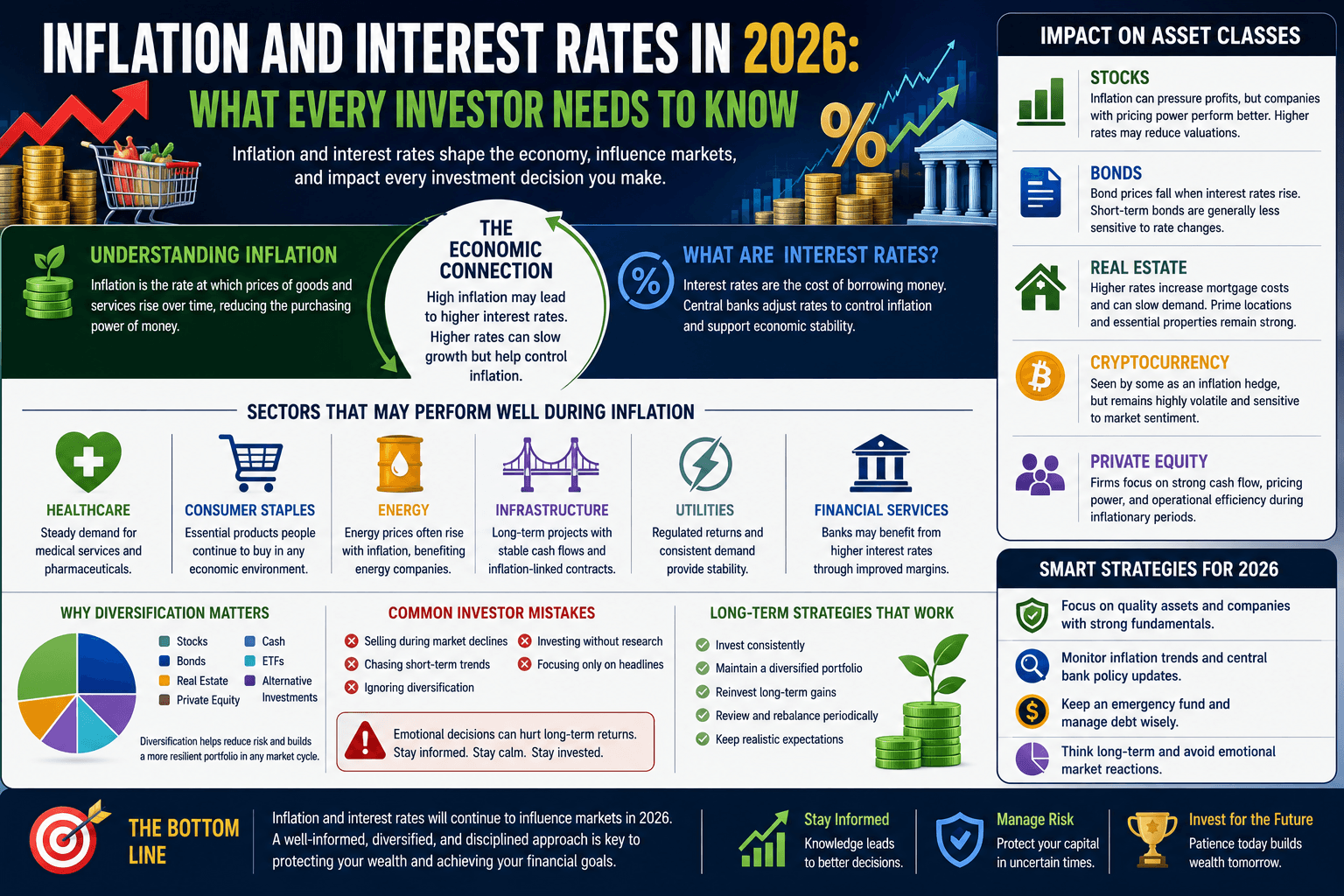
Inflation and interest rates remain two of the most powerful forces influencing the global economy and financial markets. Whether you invest in stocks, bonds, real estate, private equity, or cryptocurrencies, these economic factors can significantly affect returns, borrowing costs, and investment decisions.
In 2026, investors continue monitoring inflation data and central bank policies to better understand market direction. While no one can predict the future with certainty, understanding how inflation and interest rates interact provides valuable insight for building stronger investment strategies.
This guide explains how inflation and interest rates affect different asset classes and how investors can position themselves for long-term financial success.
Understanding Inflation
Inflation refers to the rate at which the prices of goods and services increase over time.
When inflation rises, the purchasing power of money declines. Consumers pay more for food, housing, transportation, healthcare, and other everyday expenses.
Moderate inflation is generally considered a normal part of a healthy economy. However, persistently high inflation can reduce consumer spending, increase business costs, and create uncertainty in financial markets.
What Are Interest Rates?
Interest rates represent the cost of borrowing money.
Central banks use interest rate policies to influence inflation and economic activity.
Lower interest rates often encourage borrowing, business investment, and consumer spending.
Higher interest rates generally slow borrowing and spending while helping reduce inflationary pressure.
Because interest rates affect businesses, consumers, and governments, they have a significant influence on global financial markets.
How Inflation Affects the Stock Market
Inflation influences corporate profitability in several ways.
Companies facing rising labor costs, transportation expenses, and raw material prices may experience lower profit margins if they cannot pass those costs on to customers.
However, businesses with strong pricing power often perform better during inflationary periods because they can adjust prices while maintaining demand.
Investors frequently favor companies with stable earnings, healthy cash flow, and resilient business models during periods of elevated inflation.
The Relationship Between Interest Rates and Stocks
Interest rates directly influence stock valuations.
When borrowing costs increase, businesses may delay expansion projects, reducing future earnings growth.
Higher rates can also make fixed-income investments more attractive relative to stocks.
Conversely, lower interest rates often support higher stock valuations by encouraging investment and economic growth.
Technology companies and high-growth businesses are particularly sensitive to changes in interest rate expectations.
Bonds and Rising Interest Rates
Bond prices and interest rates generally move in opposite directions.
When interest rates rise, existing bonds with lower yields often decline in value.
Investors holding long-term bonds may experience greater price fluctuations than those invested in shorter-term securities.
Many investors adjust bond portfolios based on changing interest rate expectations.
Real Estate Under Changing Interest Rates
Property markets are closely connected to borrowing costs.
Higher mortgage rates may reduce housing affordability, slowing demand for residential property.
Commercial real estate can also be affected as financing becomes more expensive.
However, certain property sectors, including logistics facilities and data centers, may continue benefiting from long-term structural demand despite changing interest rates.
Inflation and Cryptocurrency
Cryptocurrency has become an increasingly discussed asset during inflationary periods.
Some investors view digital assets as an alternative investment due to their limited supply or technological potential.
However, cryptocurrencies remain highly volatile and often respond to broader market sentiment, liquidity conditions, and regulatory developments.
As a result, crypto should generally be considered part of a diversified portfolio rather than a complete inflation hedge.
Private Equity During Economic Change
Private equity firms often adapt investment strategies according to inflation and interest rate trends.
They may prioritize businesses with:
Strong pricing power
Stable cash flow
Essential products or services
Efficient operations
Operational improvements become increasingly important when financing costs rise.
Sectors That May Perform Well During Inflation
Certain industries have historically demonstrated resilience during inflationary periods.
These include:
Healthcare
Consumer Staples
Energy
Infrastructure
Utilities
Financial Services
Companies operating in these sectors often benefit from stable demand or improved pricing flexibility.
Why Diversification Matters
Economic conditions constantly change.
Diversifying investments across multiple asset classes helps reduce dependence on any single market.
A balanced portfolio may include:
Stocks
Exchange-Traded Funds (ETFs)
Bonds
Real Estate
Private Equity
Cash Reserves
Alternative Investments
Diversification remains one of the most effective tools for managing long-term investment risk.
Common Investor Mistakes
Periods of economic uncertainty often lead to emotional investment decisions.
Common mistakes include:
Selling during market declines
Chasing short-term trends
Ignoring diversification
Investing without research
Focusing only on headlines
Successful investors typically maintain disciplined strategies rather than reacting to temporary market volatility.
Long-Term Investment Strategies
Many experienced investors follow principles that remain effective regardless of economic conditions.
These include:
Investing consistently
Maintaining diversified portfolios
Reinvesting long-term gains
Reviewing investments periodically
Keeping realistic expectations
Long-term investing often proves more effective than attempting to predict short-term market movements.
Looking Ahead
The global economy will continue adapting to technological innovation, demographic shifts, and evolving monetary policies.
Artificial intelligence, renewable energy, financial technology, healthcare innovation, and digital infrastructure remain among the sectors expected to attract long-term investment.
Although inflation and interest rates will continue influencing financial markets, disciplined investors who remain diversified and informed are generally better positioned to navigate changing conditions.
Conclusion
Inflation and interest rates will remain central drivers of financial markets throughout 2026. Their influence extends across stocks, bonds, real estate, private equity, and digital assets, making them essential concepts for every investor to understand.
While market uncertainty is inevitable, successful investing depends on long-term planning, diversification, and careful risk management rather than reacting to short-term economic headlines.
By staying informed and maintaining a disciplined investment approach, investors can better position themselves to protect wealth and capitalize on future opportunities.