
PFPersonal Finance in 2026: Smart Ways to Save Money & Build Wealth
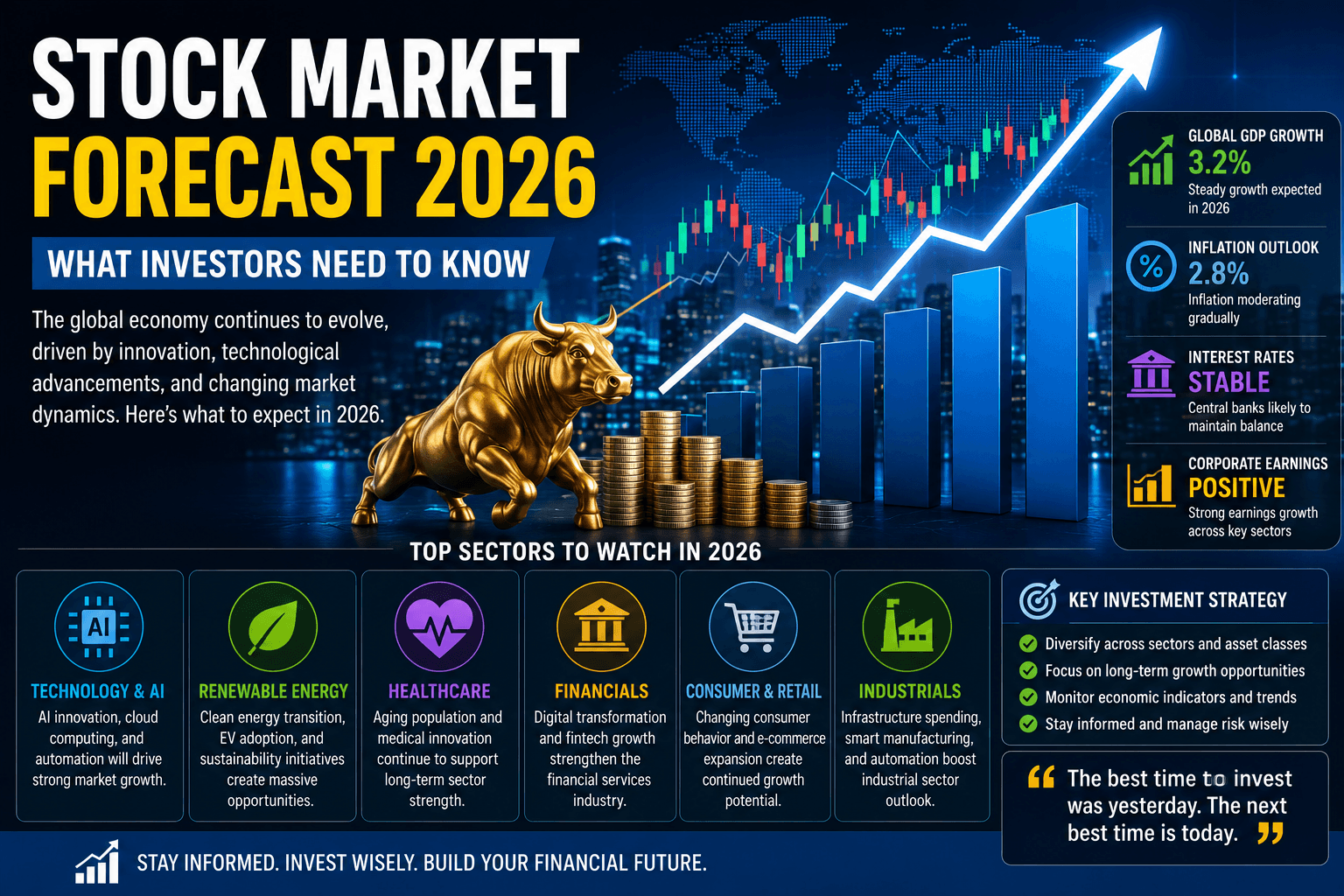
The global stock market continues to evolve as investors navigate changing economic conditions, technological innovation, and shifting geopolitical landscapes. In 2026, financial markets are being influenced by artificial intelligence, interest rate policies, corporate earnings, inflation trends, and the growing role of institutional investment.
Although predicting exact market movements is impossible, understanding the forces driving the economy can help investors make better-informed decisions. Rather than reacting to daily price fluctuations, experienced investors focus on long-term trends, company fundamentals, and portfolio diversification.
This article explores the major factors expected to shape the stock market throughout 2026 and highlights investment opportunities that could influence portfolios in the years ahead.
The Global Economy Remains Resilient
Despite ongoing economic challenges, many analysts expect moderate global growth during 2026.
Businesses continue investing in innovation, governments are expanding infrastructure spending, and consumer demand remains relatively stable across many regions.
Improving productivity through technology and digital transformation continues supporting long-term corporate growth.
These factors contribute to positive long-term expectations for global equity markets.
Artificial Intelligence Continues Driving Market Growth
Artificial intelligence remains one of the strongest investment themes of the decade.
Companies involved in:
AI software
Cloud computing
Semiconductor manufacturing
Data analytics
Robotics
Enterprise automation
continue attracting significant investor attention.
Businesses adopting AI technologies often improve efficiency, reduce costs, and increase profitability, making technology stocks an important sector for long-term investors.
Interest Rates Continue Influencing Markets
Interest rates remain one of the most important factors affecting stock market performance.
Higher borrowing costs may influence business expansion and consumer spending, while lower rates often encourage investment and economic activity.
Investors closely monitor central bank decisions because changes in monetary policy can affect:
Stock valuations
Bond markets
Corporate borrowing
Real estate
Consumer confidence
Understanding interest rate trends helps investors prepare for changing market conditions.
Inflation Remains a Key Market Driver
Inflation continues influencing investment decisions worldwide.
Moderate inflation generally supports healthy economic growth, while persistent inflation can increase business costs and reduce consumer purchasing power.
Companies with strong pricing power and efficient operations often perform better during inflationary periods.
Investors frequently evaluate inflation data when adjusting portfolio allocations.
Corporate Earnings Continue Supporting Markets
Strong corporate earnings remain one of the biggest drivers of long-term stock market performance.
Investors carefully monitor:
Revenue growth
Profit margins
Cash flow
Dividend payments
Future guidance
Companies consistently delivering strong financial results often attract long-term institutional investment.
Quality businesses remain attractive even during periods of market volatility.
Healthcare Continues Offering Stability
Healthcare remains one of the most defensive sectors.
Growing demand for medical services, biotechnology innovation, pharmaceutical research, and digital healthcare supports long-term growth.
Healthcare companies often demonstrate resilience during uncertain economic conditions.
For many investors, healthcare remains an important component of diversified portfolios.
Renewable Energy Investment Continues Expanding
Clean energy continues attracting global investment.
Solar energy, wind power, battery storage, hydrogen technology, and electric vehicle infrastructure remain important long-term growth industries.
Government incentives and corporate sustainability initiatives continue supporting renewable energy investment.
As countries pursue environmental goals, clean energy companies are expected to remain attractive to long-term investors.
Financial Services Continue Modernizing
Banks and financial institutions continue investing in digital transformation.
Financial technology companies are improving:
Mobile banking
Digital payments
Investment platforms
Online lending
Wealth management
Modern financial services continue creating opportunities for both businesses and investors.
Exchange-Traded Funds Gain Popularity
ETFs continue attracting investors because they provide diversified market exposure.
Popular ETF categories include:
Technology
Artificial Intelligence
Healthcare
Dividend Investing
Global Markets
Renewable Energy
For many investors, ETFs offer a simple method of building diversified portfolios while reducing individual company risk.
Private Equity Remains Active
Private equity firms continue investing in innovative companies before they enter public markets.
Popular investment sectors include:
Artificial intelligence
Cybersecurity
Financial technology
Healthcare
Enterprise software
Digital infrastructure
Private equity activity often signals investor confidence in long-term business growth.
Risks Investors Should Watch
Every market presents uncertainty.
Major risks include:
Inflation changes
Interest rate adjustments
Geopolitical events
Supply chain disruptions
Market volatility
Regulatory developments
Successful investors prepare for uncertainty through diversification rather than attempting to predict every market movement.
Building a Strong Investment Portfolio
Experts often recommend portfolios containing multiple asset classes.
Diversification may include:
Large-cap stocks
International equities
ETFs
Dividend-paying companies
Infrastructure investments
Healthcare stocks
Technology leaders
Alternative investments
Balanced portfolios help reduce overall investment risk.
Common Investment Mistakes
Investors should avoid:
Emotional trading
Chasing market hype
Ignoring research
Concentrating investments in one sector
Trying to perfectly time the market
Patience and discipline remain among the most valuable investment skills.
Long-Term Outlook
Although short-term volatility is inevitable, long-term market fundamentals remain encouraging.
Artificial intelligence, digital transformation, infrastructure investment, renewable energy, healthcare innovation, and global economic development continue supporting future corporate growth.
Investors who maintain diversified portfolios and focus on quality businesses are often better positioned to benefit from long-term market appreciation.
Conclusion
The stock market forecast for 2026 reflects a rapidly evolving investment landscape shaped by technology, innovation, and global economic transformation. While uncertainty will always exist, opportunities continue emerging across artificial intelligence, healthcare, financial technology, renewable energy, and infrastructure.
Rather than attempting to predict every market movement, successful investors focus on research, diversification, risk management, and long-term financial goals.
As businesses continue innovating and economies adapt to technological change, disciplined investors who stay informed are likely to remain well-positioned for future success.