
Introduction
Artificial intelligence has moved beyond being a supporting technology—it is now becoming the foundation of many modern businesses. Around the world, startups are embracing AI-first business models to build smarter products, streamline operations, and deliver highly personalized customer experiences from day one.
Unlike traditional companies that add AI features after launch, AI-first startups design their products, services, and operations around artificial intelligence from the beginning. This approach allows them to automate routine tasks, analyze large amounts of data, improve decision-making, and scale rapidly with fewer resources.
As AI technologies continue to mature in 2026, entrepreneurs across industries are recognizing that building an AI-first company can provide a significant competitive advantage. Here's why more startups are making AI the core of their business strategy.
What Is an AI-First Business Model?
An AI-first business model places artificial intelligence at the center of business operations rather than treating it as an additional feature.
In an AI-first startup, machine learning, automation, predictive analytics, natural language processing, and intelligent decision-making systems are integrated into products, customer service, marketing, and internal workflows from the very beginning.
This enables companies to operate more efficiently while continuously learning from customer interactions and business data.
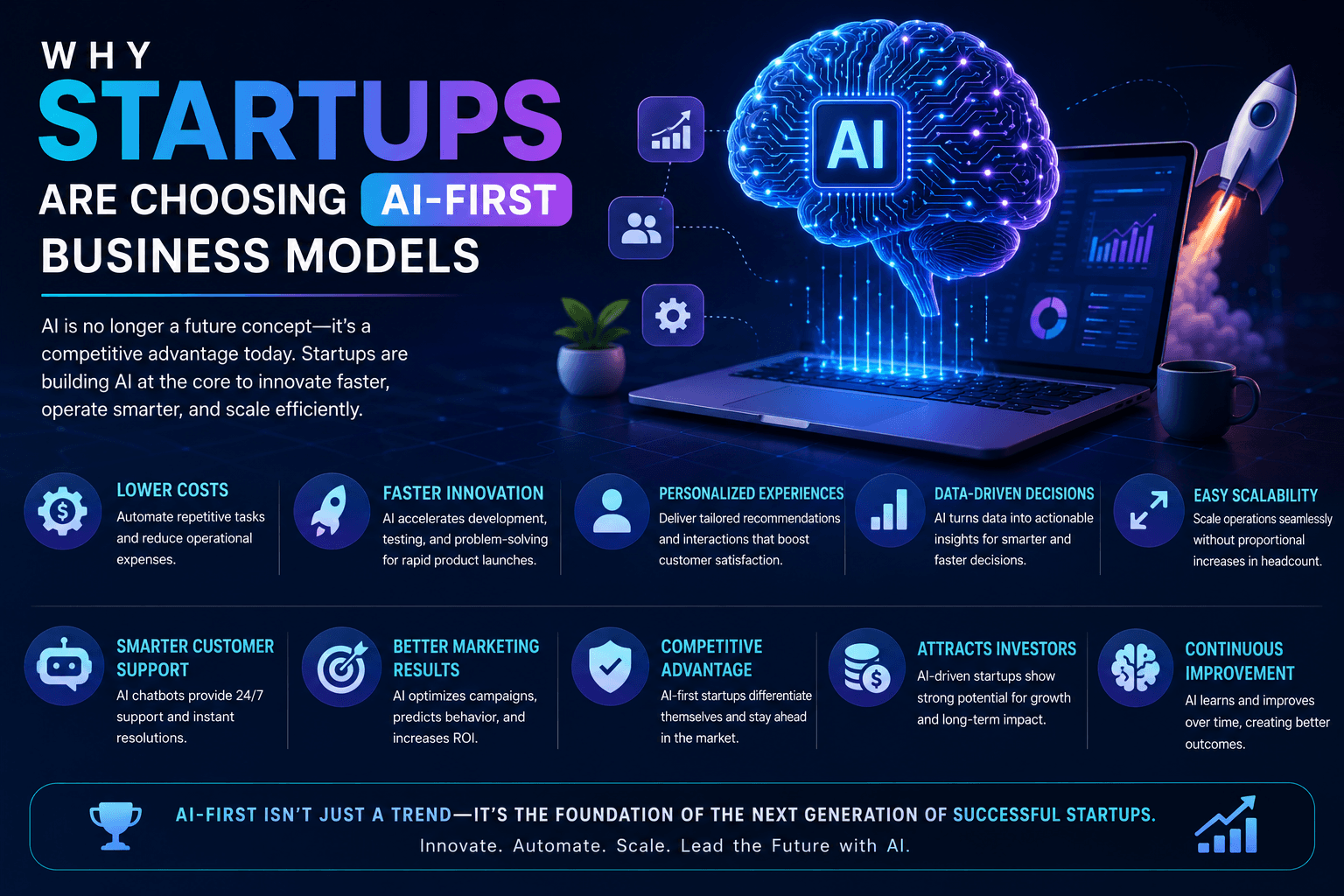
1. Lower Operating Costs
One of the biggest advantages of AI-first businesses is operational efficiency.
Artificial intelligence automates repetitive tasks such as:
Customer support
Data entry
Appointment scheduling
Invoice processing
Inventory management
Marketing automation
Report generation
Automation allows startups to accomplish more with smaller teams, reducing labor costs while improving productivity.
For early-stage companies operating with limited budgets, this efficiency can be critical to long-term success.
2. Faster Product Development
Startups often compete by moving quickly.
AI tools accelerate product development by assisting with:
Software coding
Testing
Bug detection
Design recommendations
Market research
Content generation
Documentation
Developers can build products faster while focusing more on innovation and solving customer problems.
Shorter development cycles also allow startups to launch, gather feedback, and improve products more rapidly.
3. Personalized Customer Experiences
Modern consumers expect personalized experiences.
AI helps startups analyze customer behavior and deliver:
Personalized recommendations
Customized content
Individual pricing strategies
Targeted promotions
Intelligent product suggestions
Tailored customer journeys
These personalized interactions increase customer satisfaction, improve engagement, and encourage repeat purchases.
Instead of offering identical experiences to every customer, AI enables businesses to meet individual needs at scale.
4. Better Decision-Making Through Data
Every startup generates valuable business data.
AI systems analyze large datasets far more quickly than humans, identifying trends and patterns that support better decisions.
Startups use AI to understand:
Customer preferences
Market demand
Sales performance
Advertising effectiveness
Pricing opportunities
Operational efficiency
These insights allow founders to make faster, more informed strategic decisions while reducing uncertainty.
5. Scalability Without Large Teams
Traditional businesses often need to hire more employees as they grow.
AI-first startups can scale much more efficiently.
Automated systems handle growing workloads without requiring proportional increases in staffing.
Whether serving hundreds or millions of customers, AI-powered platforms maintain consistent service quality while controlling operational costs.
This scalability makes AI especially attractive for software-as-a-service (SaaS), e-commerce, fintech, healthcare, and education startups.
6. Enhanced Customer Support
Customer service is one of the first areas where startups implement AI.
Modern AI chatbots provide:
24/7 customer support
Instant responses
Order tracking
Frequently asked questions
Appointment scheduling
Product guidance
Human agents can then focus on more complex customer issues, improving efficiency while maintaining high service quality.
This combination reduces costs while increasing customer satisfaction.
7. Competitive Advantage in Crowded Markets
Many industries have become increasingly competitive.
AI helps startups differentiate themselves through:
Faster service
Smarter recommendations
Predictive insights
Personalized experiences
Automated workflows
Continuous product improvements
Companies that effectively use AI often innovate faster than competitors relying on traditional processes.
This competitive advantage becomes especially valuable during periods of rapid technological change.
8. AI Improves Marketing Performance
Marketing has become increasingly data-driven.
AI enables startups to optimize campaigns by:
Identifying target audiences
Predicting customer behavior
Creating personalized email campaigns
Optimizing advertising budgets
Generating content ideas
Measuring campaign performance
AI-powered analytics help businesses maximize return on investment while reducing wasted marketing spend.
9. Investors Are Supporting AI Innovation
Investment interest in AI continues to grow.
Many venture capital firms actively seek startups that use artificial intelligence to solve real-world business challenges.
AI-first companies often attract investor attention because they demonstrate:
Strong scalability
High automation potential
Data-driven growth
Market differentiation
Long-term innovation opportunities
Although funding is never guaranteed, a well-executed AI strategy can strengthen a startup's value proposition.
10. Continuous Learning and Improvement
Unlike traditional software, AI systems improve over time.
As more users interact with products, AI models learn from new data, helping businesses:
Improve recommendations
Detect fraud
Predict demand
Enhance customer experiences
Optimize pricing
Increase operational efficiency
This continuous improvement enables startups to adapt quickly as customer expectations and market conditions evolve.
Challenges of Building an AI-First Startup
Despite its many advantages, adopting an AI-first approach also presents challenges.
Startups must address issues such as:
Data privacy and security
AI bias and fairness
Regulatory compliance
Model accuracy
Infrastructure costs
Talent shortages
Responsible AI governance
Successful founders balance innovation with transparency, ethical practices, and strong cybersecurity.
Best Practices for AI-First Startups
Businesses considering an AI-first strategy should focus on several key principles:
Solve genuine customer problems rather than using AI simply because it is popular.
Build high-quality data pipelines to support accurate AI models.
Prioritize transparency and responsible AI use.
Protect customer information with strong cybersecurity practices.
Continuously monitor AI performance and update models as needed.
Keep human oversight in critical decision-making processes.
Invest in employee training so teams can effectively work alongside AI technologies.
Conclusion
Artificial intelligence is transforming entrepreneurship by giving startups powerful tools to innovate faster, operate more efficiently, and deliver exceptional customer experiences. AI-first business models allow companies to automate operations, personalize services, make smarter decisions, and scale with remarkable speed.
While adopting AI requires thoughtful planning and responsible implementation, its potential benefits are significant. Startups that integrate artificial intelligence into the core of their business strategy are better positioned to compete in an increasingly digital economy.
As technology continues to evolve, AI-first startups will play a major role in shaping the future of business, creating smarter solutions, unlocking new opportunities, and redefining how companies grow in the years ahead.
FAQs: Why Startups Are Choosing AI-First Business Models
1. What is an AI-first business model?
An AI-first business model is a strategy where artificial intelligence is integrated into the core products, services, and operations from the beginning. Instead of adding AI later, startups build their business around AI to improve efficiency, automate processes, and deliver personalized customer experiences.
2. Why are startups adopting AI-first business models?
Startups are embracing AI-first models to reduce operational costs, automate repetitive tasks, improve decision-making, accelerate product development, and scale their businesses faster while maintaining a competitive edge.
3. How does AI help startups grow faster?
AI enables startups to automate customer support, analyze market trends, optimize marketing campaigns, personalize user experiences, and streamline internal operations, allowing small teams to achieve more with fewer resources.
4. Which industries are seeing the biggest rise in AI-first startups?
AI-first startups are rapidly emerging in healthcare, fintech, e-commerce, cybersecurity, education, logistics, real estate, marketing technology, customer service, and software-as-a-service (SaaS).
5. What are the main benefits of an AI-first business model?
Key benefits include increased productivity, lower operating costs, faster innovation, improved customer experiences, data-driven decision-making, scalability, and the ability to adapt quickly to changing market demands.
6. What challenges do AI-first startups face?
Common challenges include high-quality data requirements, AI development costs, regulatory compliance, cybersecurity risks, talent shortages, ethical concerns, and maintaining transparency in AI-driven decisions.
7. Can small startups afford AI technologies?
Yes. Many cloud-based AI platforms and software-as-a-service (SaaS) solutions offer affordable pricing, enabling startups to access AI tools without investing heavily in infrastructure or large development teams.
8. How does AI improve customer experience?
AI enhances customer experiences through personalized recommendations, intelligent chatbots, predictive analytics, faster response times, automated support, and customized product or service offerings.
9. Why are investors interested in AI-first startups?
Investors are attracted to AI-first startups because they often have scalable business models, strong growth potential, lower operating costs, and the ability to innovate quickly in competitive markets.
10. What is the future of AI-first business models?
The future of AI-first businesses is expected to include autonomous workflows, advanced generative AI, intelligent automation, predictive decision-making, and AI-powered products that transform industries while creating new business opportunities.