
Artificial intelligence is changing the way businesses automate work in 2026. For years, companies relied on traditional automation to handle repetitive tasks. Today, a new generation of AI agents can understand instructions, make decisions, use software tools, and complete multi-step workflows.
This raises an important question for businesses: Should you continue using traditional automation, or is it time to adopt AI agents?
The answer depends on the type of work you want to automate. Traditional automation remains extremely useful for predictable processes, while AI agents can be more suitable for workflows that require flexibility, reasoning, and interaction with different systems.
Let's compare the two approaches and explore which can be better for modern businesses.
What Is Traditional Automation?
Traditional automation uses predefined rules to perform specific tasks.
For example, a business might create a workflow that automatically sends an email whenever a customer submits a form.
A simple process could look like this:
Customer submits form → Information is saved → Email is sent → Sales team receives notification
The system follows predetermined instructions.
Traditional automation is highly effective when the process is predictable and the rules are clear.
Common Examples of Traditional Automation
Businesses use traditional automation for:
Sending scheduled emails
Moving data between applications
Creating recurring reports
Processing simple forms
Updating spreadsheets
Scheduling appointments
Sending notifications
Managing basic workflows
Because the rules are clearly defined, traditional automation can be reliable and relatively easy to monitor.
What Are AI Agents?
AI agents take automation a step further.
Instead of following only fixed instructions, an AI agent can interpret a goal, analyze information, decide what actions may be necessary, and use available tools to complete a task.
For example, instead of simply sending an automated email after a form submission, an AI agent might:
Read the customer's message.
Determine what the customer needs.
Check relevant information.
Decide which response is appropriate.
Draft a personalized reply.
Update the customer record.
Escalate the conversation if human assistance is required.
This makes AI agents useful for workflows where every situation may be slightly different.
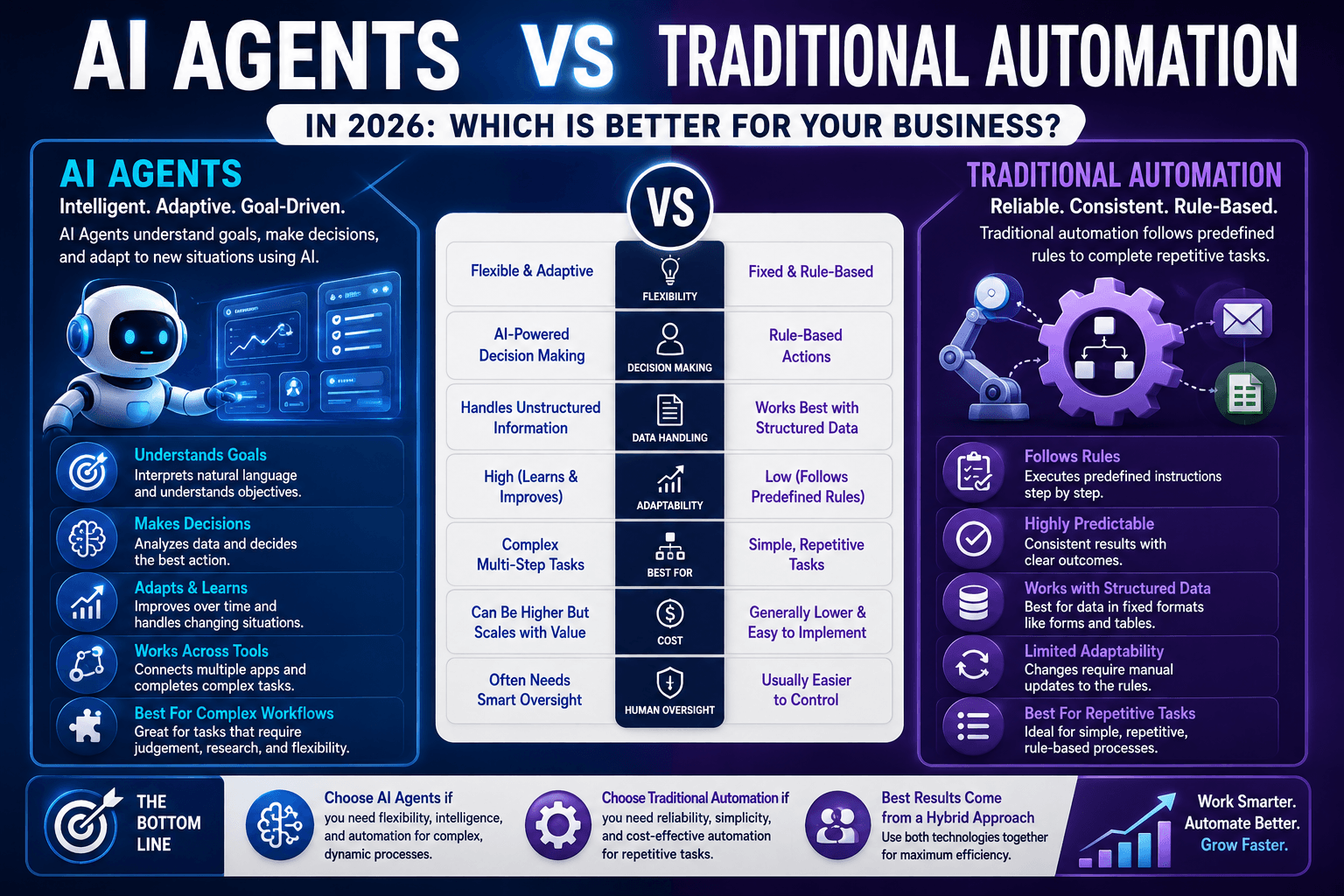
AI Agents vs. Traditional Automation: Key Differences
The biggest difference is flexibility.
Traditional automation generally works according to predefined rules.
AI agents can adapt their actions based on context and information available to them.
Feature | Traditional Automation | AI Agents |
|---|---|---|
Rules | Predefined | Can interpret goals and context |
Flexibility | Limited | Higher |
Decision-making | Rule-based | AI-assisted |
Best for | Predictable tasks | Complex workflows |
Adaptability | Lower | Higher |
Human oversight | Usually straightforward | Often more important |
Setup | Often simpler | Can be more complex |
Predictability | Very high for fixed workflows | Can vary |
Neither technology is automatically better. The right choice depends on the business problem.
1. AI Agents Are Better for Complex Workflows
Some business processes involve many variables.
For example, customer support representatives may receive thousands of different questions. A fixed automation system can handle common questions, but unusual requests may require additional logic.
An AI agent can analyze the customer's message and determine which workflow is most appropriate.
This flexibility can make AI agents useful for customer service, research, sales, operations, and other complex tasks.
2. Traditional Automation Is Better for Repetitive Tasks
If a task is extremely predictable, traditional automation may still be the better option.
Imagine a company needs to transfer information from an online form into a database every time someone submits it.
There is little reason to use an advanced AI agent for this process.
A simple rule-based automation can perform the task quickly, consistently, and with minimal complexity.
Businesses should not use AI simply because it is newer.
Simple problems often need simple solutions.
3. AI Agents Can Handle Unstructured Information
Traditional automation works best when information follows a consistent format.
AI agents can work with more unstructured information, including:
Emails
Customer messages
Documents
Reports
Notes
Conversations
Natural-language instructions
For example, an AI agent could read an incoming customer email and determine whether it relates to billing, technical support, product information, or another issue.
This would be much harder to accomplish using only fixed rules.
4. Traditional Automation Can Be Easier to Control
Businesses often need predictable results.
Traditional automation follows explicit rules, making it easier to understand why a particular action occurred.
This can be particularly useful for sensitive processes where businesses require strict control.
AI agents, on the other hand, can introduce additional uncertainty because their decisions may depend on the information they interpret.
For important workflows, businesses should establish appropriate testing, monitoring, permissions, and human approval.
5. AI Agents Can Work Across Multiple Tools
Modern businesses use many software applications.
An AI agent can potentially work across different systems to complete a broader objective.
For example, a sales-related AI agent might:
Research a potential customer
Update a CRM
Prepare a personalized email
Schedule a follow-up
Summarize previous interactions
This ability to coordinate multiple steps can make AI agents particularly valuable for complex business operations.
6. Traditional Automation Can Be More Cost-Effective
AI agents can require more advanced infrastructure, integration, monitoring, and ongoing management.
For a small, repetitive workflow, traditional automation may therefore be more economical.
Businesses should calculate the total cost of implementation rather than assuming that the most advanced technology will automatically provide the greatest return.
The key question should be:
How much business value will this automation create?
7. AI Agents Can Support Employees
AI agents do not necessarily need to replace employees.
Instead, they can act as digital assistants.
For example, an employee could ask an AI agent to gather information from several systems and prepare a summary.
The employee can then review the result and make the final decision.
This combination of AI speed and human judgment can be particularly useful for knowledge-intensive work.
8. Traditional Automation Remains Important
The rise of AI agents does not mean traditional automation is disappearing.
In many businesses, the best strategy may be to combine both technologies.
A workflow could use traditional automation for predictable steps while an AI agent handles tasks requiring interpretation.
For example:
Customer inquiry → Traditional automation captures data → AI agent analyzes request → Traditional automation updates CRM → Human reviews complex cases
This hybrid approach can provide both reliability and flexibility.
Which Is Better for Small Businesses?
Small businesses should focus on their actual needs rather than technology trends.
Traditional automation may be ideal if the business has:
Simple repetitive workflows
Clear rules
Structured data
Limited automation requirements
A need for highly predictable outcomes
AI agents may be worth considering if the business has:
Complex customer interactions
Large amounts of unstructured information
Multi-step workflows
Research-heavy processes
Multiple systems that need coordination
A need for flexible decision support
Many small businesses can start with simple automation and gradually introduce AI agents as their needs become more advanced.
How to Decide Which Technology to Use
Before implementing automation, ask these questions:
Is the process predictable?
If the answer is yes, traditional automation may be sufficient.
Does the process require interpretation?
If employees regularly need to understand different situations before taking action, an AI agent may be more useful.
Does the workflow involve multiple systems?
If several applications need to be coordinated, an AI agent could potentially simplify the process.
What happens if the system makes a mistake?
For high-impact tasks, businesses should consider human review and appropriate safeguards.
What is the expected return?
Automation should save time, reduce costs, improve service, increase revenue, or provide another measurable benefit.
The Future: Hybrid Automation
The future of business automation is unlikely to be purely AI-driven or purely rule-based.
Instead, businesses may increasingly use hybrid automation, combining traditional workflows with AI agents.
Traditional automation can handle predictable tasks efficiently, while AI agents can manage situations requiring interpretation and flexibility.
Humans can remain responsible for important decisions, oversight, and exceptions.
This creates a three-part model:
Traditional Automation + AI Agents + Human Expertise
Together, these technologies can create more efficient and adaptable business operations.
Conclusion
AI agents and traditional automation both have important roles in business in 2026.
Traditional automation remains an excellent choice for predictable, repetitive processes where reliability and control are priorities. AI agents can provide greater flexibility when workflows involve complex information, multiple steps, or changing circumstances.
The best approach is not to replace every existing automation system with AI. Instead, businesses should identify which tasks genuinely benefit from AI and use the simplest technology that solves the problem effectively.
The future of business automation is not AI versus traditional automation—it is choosing the right combination of both.
FAQs
1. What is the difference between AI agents and traditional automation?
Traditional automation follows predefined rules, while AI agents can interpret goals, analyze information, and perform multi-step tasks with greater flexibility.
2. Are AI agents better than traditional automation?
Not always. Traditional automation can be better for simple, predictable, repetitive tasks, while AI agents are more useful for complex and variable workflows.
3. Can small businesses use AI agents?
Yes. Small businesses can use AI agents for customer service, sales research, administrative tasks, content workflows, data analysis, and other suitable processes.
4. Is traditional automation still useful in 2026?
Absolutely. Rule-based automation remains valuable for predictable processes where businesses need reliable and consistent results.
5. Can AI agents replace employees?
AI agents can automate certain tasks, but businesses still need people for judgment, creativity, relationship management, oversight, and complex decisions.
6. Are AI agents expensive?
Costs vary depending on the technology, integrations, usage, and complexity. Businesses should compare implementation and operating costs with the expected benefits.
7. What businesses can benefit most from AI agents?
Businesses with complex customer interactions, research-heavy workflows, large amounts of unstructured data, or multi-step operations may benefit significantly.
8. Should businesses use AI agents for every workflow?
No. Businesses should use AI where it provides meaningful value. Simple rule-based automation may be more efficient for straightforward tasks.
9. What is hybrid automation?
Hybrid automation combines traditional rule-based automation with AI agents and human oversight to create flexible but controlled workflows.
10. How should a business start with AI agents?
Start with a clearly defined, relatively low-risk workflow. Test the AI agent, measure its performance, establish safeguards, and expand gradually based on results.