
PFPersonal Finance in 2026: Smart Ways to Save Money & Build Wealth
Exchange-Traded Funds (ETFs) have become one of the fastest-growing investment products in global financial markets. Whether you're a beginner building your first portfolio or an experienced investor looking for diversification, ETFs offer an accessible and cost-effective way to invest across multiple industries, regions, and asset classes.
In 2026, growing interest in artificial intelligence, clean energy, healthcare, and global technology has driven even more investors toward ETFs. Their flexibility, transparency, and relatively low costs make them an attractive choice during both rising and volatile markets.
This guide explains how ETFs work, why they continue gaining popularity, and how investors can use them as part of a long-term investment strategy.
What Is an ETF?
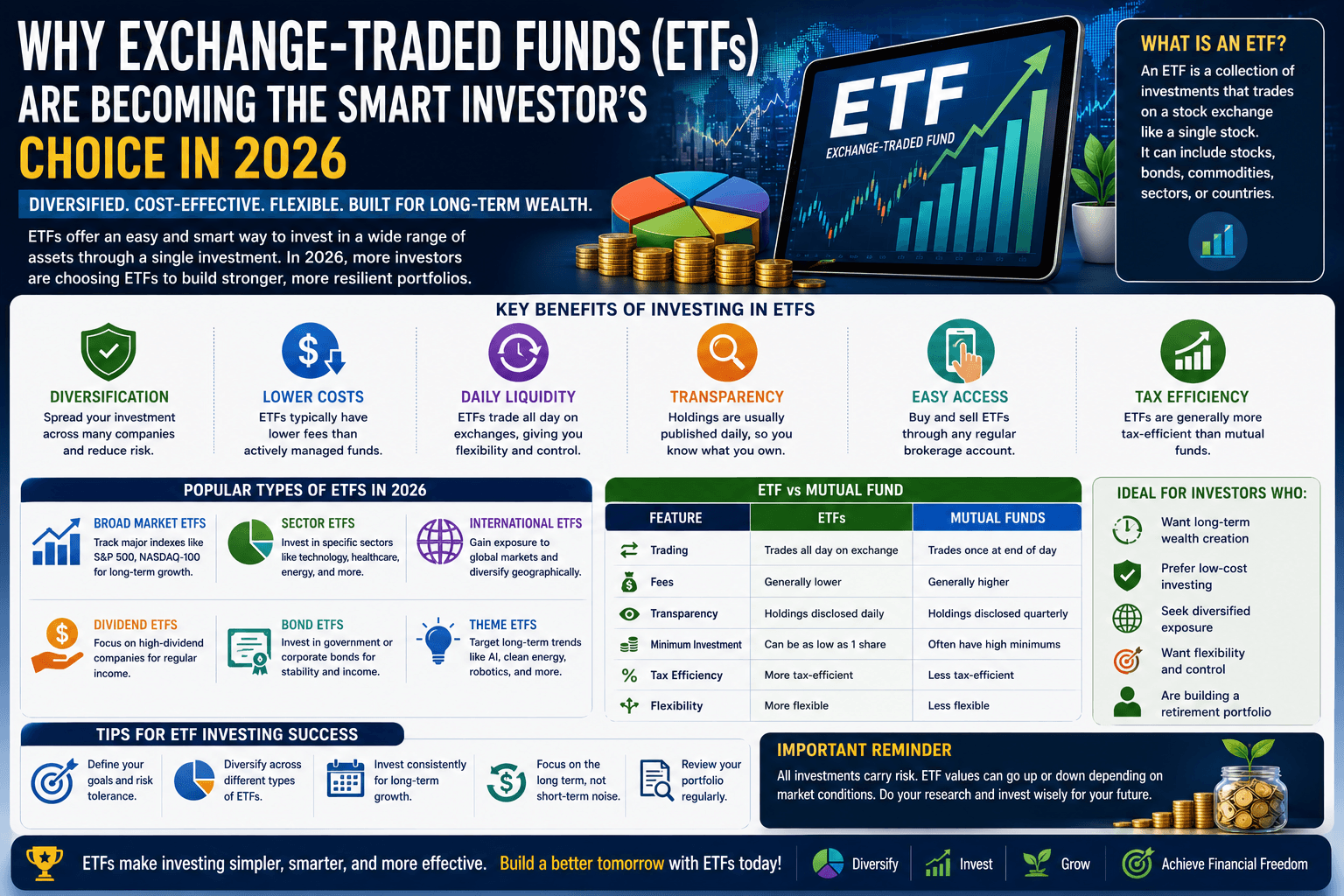
An Exchange-Traded Fund (ETF) is a collection of investments packaged into a single fund that trades on a stock exchange like an individual stock.
Instead of buying shares in one company, an ETF can provide exposure to dozens, hundreds, or even thousands of securities through a single investment.
ETFs can include:
Stocks
Bonds
Commodities
Real Estate Investment Trusts (REITs)
International Markets
Technology Companies
This built-in diversification helps reduce investment risk.
Why ETFs Continue Growing
ETFs have become increasingly popular because they combine many of the benefits of traditional mutual funds with the flexibility of stock trading.
Key advantages include:
Broad diversification
Lower management fees
Daily liquidity
Portfolio transparency
Easy accessibility
Investors appreciate the ability to gain exposure to entire sectors without selecting individual companies.
Diversification Reduces Risk
Diversification remains one of the most important principles of successful investing.
Rather than relying on one stock, ETFs spread investments across multiple companies and industries.
If one company performs poorly, stronger performance from others may help reduce the overall impact on the portfolio.
This balanced approach can improve long-term investment stability.
Lower Investment Costs
Many ETFs have lower expense ratios than actively managed investment funds.
Lower fees allow investors to keep more of their long-term investment returns.
Over several decades, even small differences in annual costs can significantly affect overall portfolio performance.
Cost efficiency is one reason ETFs remain attractive for long-term investors.
AI and Technology ETFs
Artificial intelligence has become one of the strongest investment themes of 2026.
Technology-focused ETFs provide exposure to companies involved in:
Artificial Intelligence
Cloud Computing
Semiconductor Manufacturing
Robotics
Cybersecurity
Data Analytics
Instead of choosing individual technology companies, investors can access an entire sector through a single ETF.
Healthcare ETFs
Healthcare continues benefiting from demographic growth and medical innovation.
Healthcare ETFs often include companies involved in:
Biotechnology
Pharmaceuticals
Medical Devices
Healthcare Equipment
Digital Health
These funds provide diversified exposure to one of the world's most resilient industries.
Global ETFs
International diversification has become increasingly important.
Global ETFs allow investors to access companies across:
North America
Europe
Asia-Pacific
Emerging Markets
Global exposure helps reduce dependence on a single country's economy while creating additional investment opportunities.
Dividend ETFs
Many investors seek regular income alongside capital appreciation.
Dividend-focused ETFs invest in companies with strong histories of paying dividends.
Benefits include:
Regular income
Long-term growth potential
Diversification
Lower individual company risk
Dividend ETFs remain popular among income-focused investors.
ETFs and Retirement Planning
Long-term retirement investors frequently include ETFs within their portfolios.
Advantages include:
Consistent diversification
Lower costs
Easy portfolio management
Long-term growth potential
Regular investing through ETFs can benefit from compounding over many years.
Common ETF Investment Mistakes
Although ETFs simplify investing, mistakes remain possible.
Investors should avoid:
Chasing short-term trends
Ignoring diversification
Buying without research
Frequently trading
Concentrating only on one sector
Long-term investing generally produces better outcomes than attempting to time the market.
Building a Balanced ETF Portfolio
Many investors combine several ETF categories.
A diversified ETF portfolio may include:
Broad Market ETFs
Technology ETFs
Healthcare ETFs
Dividend ETFs
International ETFs
Bond ETFs
Clean Energy ETFs
This balanced approach provides exposure to multiple sectors and economic trends.
The Future of ETFs
The ETF industry continues expanding rapidly.
Emerging areas include:
Artificial Intelligence
Climate Technology
Sustainable Investing
Digital Infrastructure
Robotics
Blockchain Technology
As innovation continues, ETFs are expected to remain among the most widely used investment products globally.
Conclusion
Exchange-Traded Funds have transformed modern investing by making diversification, cost efficiency, and broad market access available to millions of investors.
Whether the goal is long-term wealth creation, retirement planning, or building a balanced portfolio, ETFs offer flexibility and simplicity that appeal to both beginners and experienced investors.
While every investment carries risk, disciplined investing through diversified ETFs can help investors navigate changing market conditions while participating in long-term economic growth.
As financial markets continue evolving in 2026, ETFs remain one of the smartest tools for building sustainable wealth.