
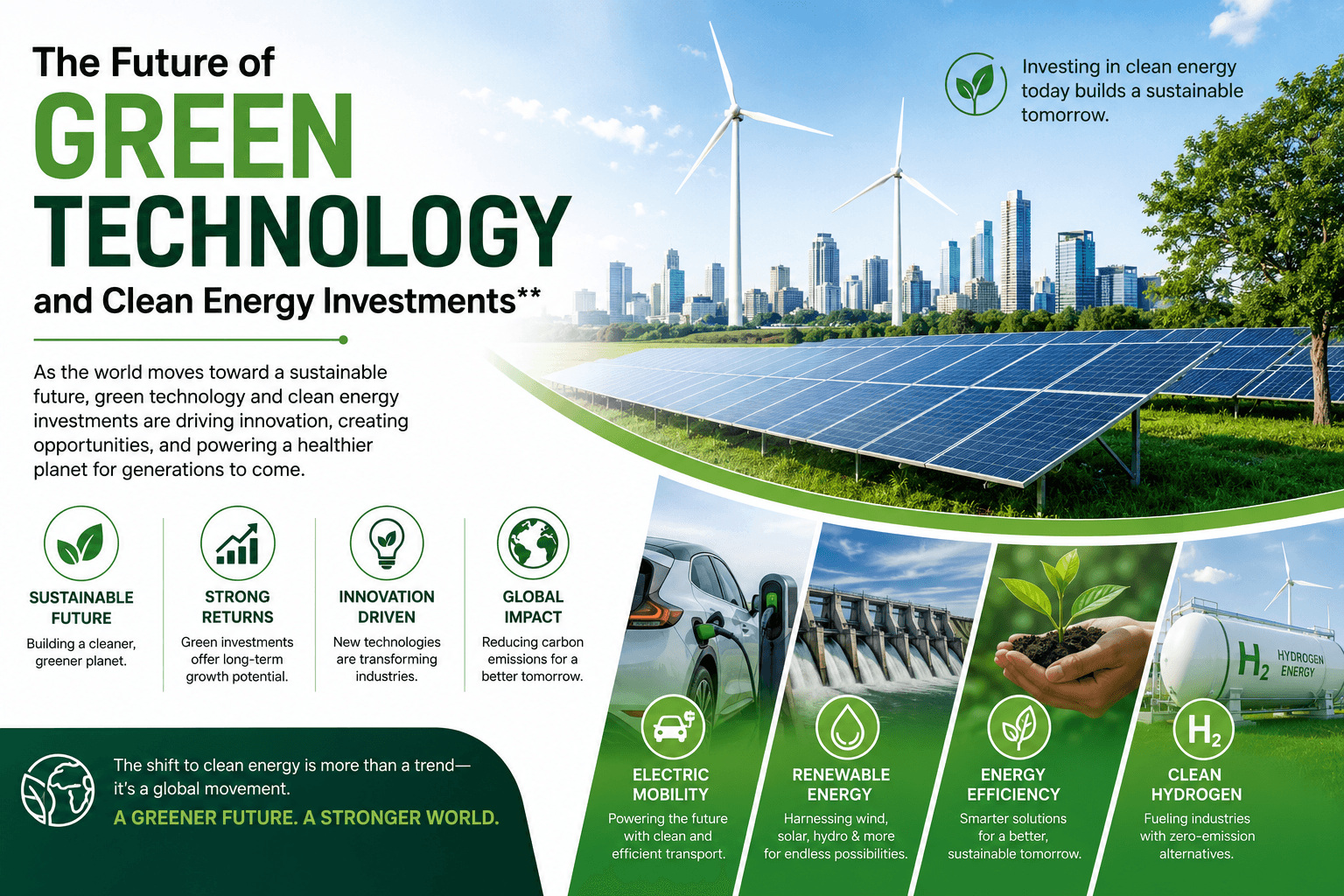

As climate change, energy security, and environmental sustainability continue to dominate global discussions, green technology and clean energy investments have become some of the most influential forces driving economic transformation. Governments, corporations, and investors are increasingly prioritizing renewable energy, carbon reduction, and sustainable infrastructure to create a cleaner and more resilient future.
The transition toward green technology is no longer simply an environmental initiative—it has become a major business opportunity. From solar farms and offshore wind projects to electric vehicles and hydrogen fuel technologies, companies are investing billions of dollars in innovations that promise long-term growth while reducing environmental impact.
The Global Shift Toward Clean Energy
The global energy landscape is undergoing one of the biggest transformations in history. Countries are setting ambitious net-zero emissions targets while encouraging businesses to adopt cleaner production methods and renewable energy sources.
This shift is fueled by several key factors:
Rising demand for sustainable energy
Government incentives for renewable projects
Declining costs of solar and wind technology
Increasing corporate sustainability commitments
Growing investor interest in Environmental, Social, and Governance (ESG) strategies
As renewable energy becomes more affordable and efficient, businesses are accelerating investments to remain competitive in an evolving marketplace.
Solar and Wind Energy Continue to Lead
Solar and wind power remain the fastest-growing renewable energy sectors worldwide. Advances in photovoltaic technology, battery storage, and smart grid infrastructure have significantly improved efficiency while reducing installation costs.
Large-scale solar farms now generate electricity at prices that rival or outperform traditional fossil fuels in many regions. Offshore wind projects are also expanding rapidly, providing stable energy production with minimal environmental impact.
These technologies are expected to remain major investment opportunities throughout the coming decade.
Energy Storage Is Becoming a Critical Investment
Renewable energy production depends heavily on weather conditions, making energy storage one of the industry's most important priorities.
Modern battery technologies are helping stabilize electricity grids by storing excess renewable energy for later use. Lithium-ion batteries currently dominate the market, while researchers continue developing solid-state batteries, sodium-ion batteries, and other next-generation storage solutions.
As storage technology improves, renewable energy becomes more reliable and scalable, opening new investment opportunities across global markets.
Electric Vehicles Are Accelerating the Green Economy
Electric vehicles (EVs) have become a cornerstone of the clean energy transition. Major automobile manufacturers are investing heavily in EV production while governments expand charging infrastructure and introduce incentives for consumers.
The growth of electric transportation is creating opportunities across multiple industries, including:
Battery manufacturing
Charging infrastructure
Software development
Renewable electricity generation
Recycling technologies
Smart mobility solutions
As battery costs continue to decline, electric vehicles are becoming increasingly accessible to consumers worldwide.
Green Hydrogen Shows Long-Term Potential
Hydrogen produced using renewable electricity—commonly known as green hydrogen—is attracting substantial global investment.
Unlike traditional hydrogen production, green hydrogen generates little to no carbon emissions and offers promising solutions for industries that are difficult to electrify, including steel manufacturing, aviation, shipping, and heavy transportation.
Although still in its early stages, green hydrogen could become a vital component of future clean energy systems.
Artificial Intelligence Is Improving Energy Efficiency
Artificial intelligence is helping businesses optimize energy consumption, predict equipment maintenance, and improve renewable energy forecasting.
AI-powered systems can analyze weather patterns, monitor electricity demand, and automatically balance energy distribution across smart grids.
Companies are also using machine learning to improve building efficiency, reduce industrial emissions, and optimize manufacturing operations.
The combination of AI and clean energy is expected to drive significant productivity gains while lowering operational costs.
Sustainable Investing Is Becoming Mainstream
Institutional investors increasingly recognize that sustainable companies often demonstrate stronger long-term resilience.
Environmental, Social, and Governance (ESG) investing has evolved from a niche strategy into a mainstream investment approach. Asset managers are evaluating businesses not only by financial performance but also by environmental responsibility, governance standards, and social impact.
Companies with credible sustainability strategies often attract greater investor confidence and improved access to capital.
Governments Are Driving Market Growth
Public policy continues to play a crucial role in accelerating clean energy adoption.
Many governments now provide:
Renewable energy tax incentives
Carbon reduction programs
Clean technology grants
Green infrastructure funding
Electric vehicle subsidies
Research and development support
These policies encourage private investment while helping businesses transition toward more sustainable operations.
Challenges Remain
Despite remarkable progress, several challenges continue to influence the pace of green technology adoption.
Supply chain disruptions, critical mineral shortages, permitting delays, and grid modernization remain significant obstacles in many countries.
Additionally, large-scale renewable projects require substantial upfront investment, making financing an important consideration for both governments and private investors.
Continued technological innovation and international collaboration will be essential to overcoming these barriers.
Business Opportunities Across Industries
Green technology is creating opportunities far beyond the energy sector.
Industries benefiting from sustainable innovation include:
Construction
Manufacturing
Agriculture
Transportation
Financial services
Information technology
Healthcare
Real estate
Businesses that embrace sustainability are improving operational efficiency while strengthening their brand reputation among environmentally conscious consumers.
The Future of Clean Energy Investments
Experts expect global investment in renewable energy, sustainable infrastructure, and climate technology to continue growing throughout the next decade.
Emerging technologies such as carbon capture, advanced nuclear energy, smart grids, sustainable aviation fuels, and circular economy solutions are likely to reshape future investment strategies.
Companies that invest early in green innovation may gain competitive advantages through lower operating costs, regulatory compliance, and stronger customer loyalty.
Conclusion
The future of green technology represents one of the most significant economic opportunities of the twenty-first century. As governments strengthen climate policies, businesses accelerate sustainability initiatives, and investors prioritize long-term resilience, clean energy investments are becoming central to global economic growth.
Organizations that embrace renewable energy, energy efficiency, and sustainable innovation today will be better positioned to thrive in tomorrow's competitive business environment. The transition toward a cleaner economy is no longer a distant vision—it is already reshaping industries, creating new markets, and defining the future of global business.
FAQs: The Future of Green Technology and Clean Energy Investments
1. What is green technology?
Green technology refers to environmentally friendly innovations that reduce pollution, improve energy efficiency, conserve natural resources, and support sustainable economic development. Examples include renewable energy, electric vehicles, smart grids, and energy-efficient manufacturing.
2. What is clean energy?
Clean energy is energy generated from sources that produce little or no greenhouse gas emissions. Common clean energy sources include solar, wind, hydroelectric, geothermal, nuclear, and certain forms of sustainable bioenergy.
3. Why are green technology investments growing rapidly?
Governments, businesses, and investors are increasing investments due to rising energy demand, climate goals, supportive regulations, declining renewable energy costs, and growing consumer demand for sustainable products and services.
4. Which sectors are leading green technology innovation?
Major sectors include renewable energy, electric vehicles (EVs), battery storage, hydrogen technology, carbon capture, smart grids, sustainable construction, recycling, water treatment, and energy-efficient manufacturing.
5. Why is renewable energy becoming more attractive to investors?
Renewable energy projects often provide long-term revenue, lower operating costs, government incentives, and growing global demand, making them attractive investments for institutional and retail investors.
6. What role do solar and wind power play in the clean energy transition?
Solar and wind are among the fastest-growing renewable energy sources because they generate electricity without burning fossil fuels, helping countries reduce carbon emissions while improving energy security.
7. How do battery storage systems support clean energy?
Battery storage allows excess electricity generated by renewable sources to be stored and used later, improving grid stability, reducing energy waste, and supporting reliable electricity supply.
8. What is green hydrogen, and why is it important?
Green hydrogen is produced using renewable electricity through electrolysis. It has the potential to decarbonize industries such as steel, shipping, aviation, and heavy manufacturing where direct electrification is difficult.
9. How are governments encouraging clean energy investments?
Many governments provide tax credits, grants, subsidies, low-interest financing, renewable energy targets, and infrastructure investments to accelerate the adoption of green technologies.
10. What industries benefit from green technology besides energy?
Industries including transportation, construction, agriculture, manufacturing, finance, real estate, logistics, and information technology are increasingly adopting green solutions to improve sustainability and reduce costs.
11. What are the biggest investment opportunities in green technology?
Key opportunities include solar power, wind energy, battery manufacturing, EV charging infrastructure, hydrogen production, energy-efficient buildings, carbon capture technologies, and smart electricity grids.
12. How does clean energy contribute to economic growth?
Clean energy creates new industries, attracts private investment, generates skilled jobs, reduces fuel imports, improves energy independence, and encourages technological innovation across multiple sectors.
13. What risks should investors consider before investing in green technology?
Investors should evaluate regulatory changes, technology adoption rates, project financing, supply chain disruptions, commodity price fluctuations, competition, and company financial performance before making investment decisions.
14. Why are ESG investing and green technology closely connected?
Environmental, Social, and Governance (ESG) investing often prioritizes companies that reduce environmental impact, improve sustainability, and adopt clean technologies, making green technology an important part of many ESG portfolios.
15. How is artificial intelligence supporting clean energy development?
AI helps optimize renewable energy generation, predict electricity demand, improve grid management, monitor equipment, reduce maintenance costs, and increase the efficiency of energy storage systems.
16. What role do electric vehicles play in green technology?
Electric vehicles reduce dependence on fossil fuels, lower transportation emissions, improve air quality, and stimulate investment in battery technology, charging infrastructure, and renewable electricity.
17. How can businesses benefit from investing in green technology?
Businesses can reduce energy costs, improve operational efficiency, strengthen regulatory compliance, attract environmentally conscious customers, enhance brand reputation, and access new sources of financing.
18. Is clean energy expected to outperform traditional energy investments over the long term?
Many analysts believe clean energy will continue growing due to increasing global electricity demand, technological improvements, supportive government policies, and the transition toward lower-carbon economies. However, performance depends on market conditions and individual investments.
19. How can individual investors gain exposure to green technology?
Investors can participate through renewable energy companies, clean energy ETFs, green infrastructure funds, sustainable mutual funds, battery manufacturers, EV companies, and businesses developing environmental technologies.
20. What is the future outlook for green technology and clean energy investments?
The long-term outlook remains positive as governments, corporations, and financial institutions continue investing in renewable energy, sustainable infrastructure, advanced battery technologies, hydrogen, smart grids, and climate-focused innovation. Green technology is expected to play a central role in global economic growth and the transition to a lower-carbon future.