
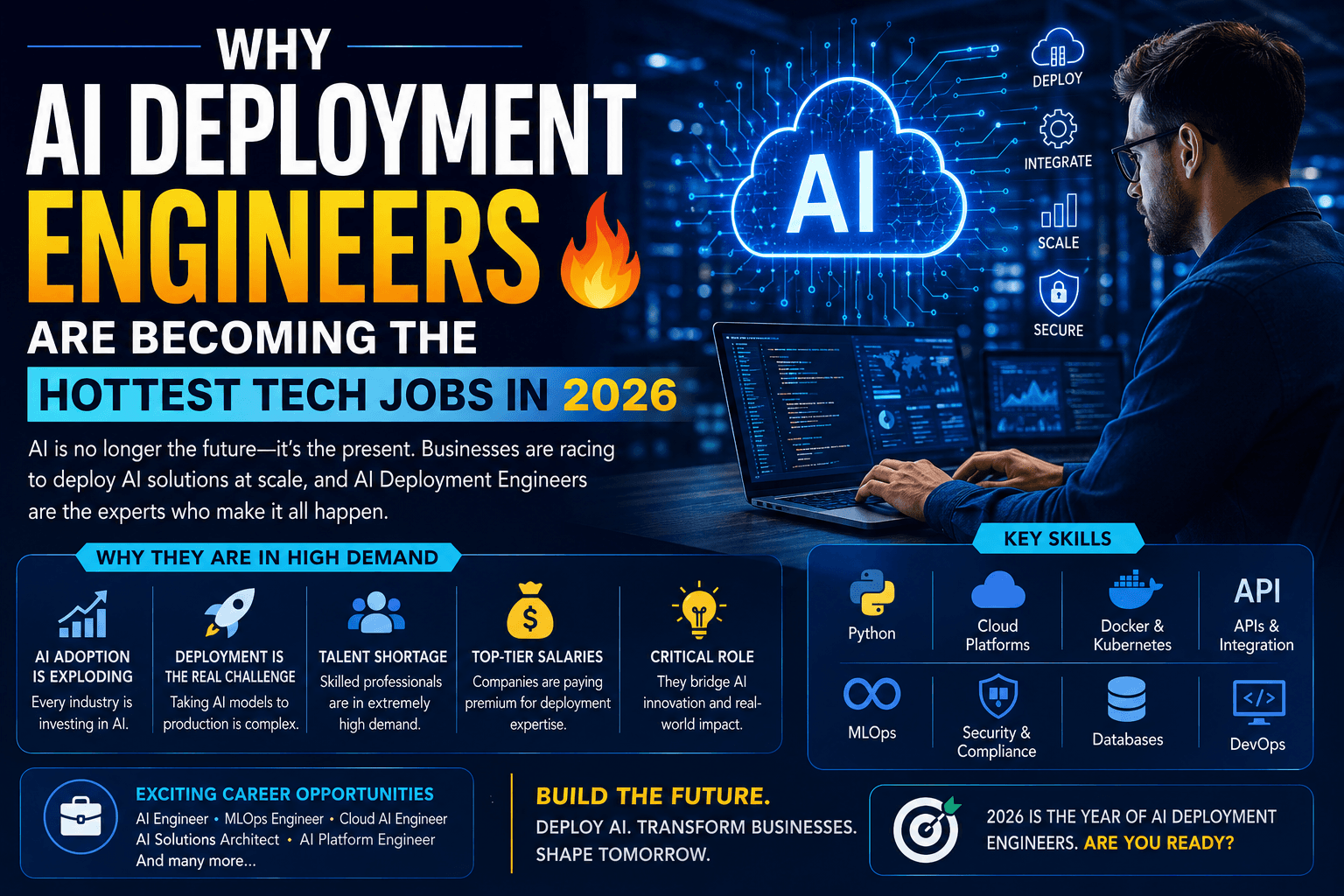

Artificial intelligence has moved rapidly from experimentation into real-world business operations. Companies are no longer focused only on building AI models—they also need people who can deploy, integrate, monitor, secure, and maintain AI systems in production.
This is driving growing demand for AI deployment engineers, professionals who bridge the gap between AI development and reliable business implementation.
What Is an AI Deployment Engineer?
An AI deployment engineer helps move AI models and applications from development environments into real-world production systems.
Their responsibilities can include:
Deploying machine-learning models
Integrating AI APIs and models into applications
Managing inference infrastructure
Monitoring model performance
Optimizing AI workloads
Managing cloud and GPU infrastructure
Automating deployment pipelines
Implementing security controls
Troubleshooting production AI systems
The role sits at the intersection of AI, software engineering, cloud infrastructure, and DevOps.
Why Demand Is Increasing
Businesses are investing heavily in generative AI, machine learning, AI agents, and automation.
But building an AI prototype is very different from operating one reliably at scale.
Companies need engineers who can answer practical questions such as:
How do we deploy this model?
How do we reduce inference costs?
How do we scale it when usage increases?
How do we monitor its performance?
How do we protect sensitive data?
How do we integrate it with existing systems?
This is creating a growing need for deployment-focused AI expertise.
The Shift From AI Experiments to Production
Many organizations have spent the past few years experimenting with AI.
In 2026, the focus is increasingly shifting toward production AI.
Businesses want AI systems that can operate reliably for employees and customers.
That means organizations need infrastructure capable of handling:
High request volumes
Large models
Real-time inference
Data pipelines
Model updates
Security requirements
Reliability and uptime
AI deployment engineers play a central role in making this transition possible.
The Connection Between AI and DevOps
AI deployment has created a specialized area often associated with MLOps and AI infrastructure.
Traditional DevOps focuses on deploying and maintaining software applications.
AI systems introduce additional requirements, including:
Model versioning
Dataset management
Model monitoring
Inference optimization
GPU utilization
Model evaluation
Data drift detection
AI deployment engineers need to understand both software delivery and machine-learning workflows.
Generative AI Is Creating New Opportunities
The growth of generative AI is accelerating demand for deployment expertise.
Organizations are deploying:
Large language models
AI assistants
Retrieval-augmented generation systems
AI coding tools
Document-processing systems
Multimodal AI applications
AI agents
These applications often require complex architectures involving models, databases, APIs, vector stores, security systems, and cloud infrastructure.
Deployment engineers help bring these components together.
AI Agents Increase Deployment Complexity
The rise of agentic AI is creating another layer of demand.
AI agents may interact with enterprise applications, databases, APIs, and business workflows.
This means engineers need to manage not just a model, but an entire AI application ecosystem.
Deployment teams may need to implement:
Tool permissions
Authentication
Monitoring
Logging
Guardrails
Human approval workflows
Cost controls
As agents become more autonomous, reliable deployment becomes even more important.
Cloud and GPU Skills Are Valuable
AI deployment often requires specialized computing infrastructure.
Engineers may work with:
GPUs
Cloud platforms
Containers
Kubernetes
Serverless infrastructure
APIs
Distributed systems
Understanding how to allocate computing resources efficiently can have a major impact on AI application performance and operating costs.
Model Optimization Is a Critical Skill
Large AI models can be expensive to operate.
Deployment engineers therefore focus on improving inference efficiency.
Techniques may include:
Quantization
Model compression
Caching
Batching
Efficient serving
Hardware optimization
Selecting smaller models where appropriate
The goal is to deliver the required performance without unnecessarily increasing infrastructure costs.
Monitoring AI in Production
Traditional application monitoring is not enough for AI systems.
Teams may need to monitor:
Latency
Throughput
Error rates
Token usage
Model quality
Cost per request
Data drift
Safety issues
AI deployment engineers help build systems that identify problems quickly and provide visibility into how models are performing.
Security Is Becoming Essential
AI deployment introduces new security considerations.
Production AI systems may process sensitive customer or business information.
Engineers need to understand:
Identity and access management
Data encryption
API security
Prompt injection
Data leakage
Model access controls
Secure infrastructure
Third-party AI risks
Security must be integrated into the deployment process rather than added after an AI application is already in production.
AI Deployment Engineers Help Control Costs
AI infrastructure can become expensive quickly.
Poorly optimized models, inefficient GPU utilization, unnecessary API calls, and uncontrolled workloads can significantly increase operating expenses.
Deployment engineers can help businesses optimize:
Compute resources
Model selection
Inference workloads
Cloud spending
Storage
Network usage
This makes the role directly relevant to business performance.
What Skills Do AI Deployment Engineers Need?
A strong AI deployment engineer typically combines several technical skill sets.
Software Engineering
Knowledge of programming languages such as Python, Java, Go, or similar technologies is useful.
Cloud Computing
Experience with major cloud platforms and cloud-native architectures is increasingly valuable.
DevOps
CI/CD, containers, infrastructure automation, and monitoring are important foundations.
Machine Learning
Engineers should understand how models are trained, evaluated, deployed, and monitored.
AI Infrastructure
Knowledge of GPUs, model-serving systems, vector databases, and inference optimization can be highly valuable.
Security
Understanding AI-specific and traditional application-security principles is essential.
AI Deployment vs. AI Research
AI research engineers focus primarily on developing new models and algorithms.
AI deployment engineers focus on making AI systems work reliably in production.
The two roles complement each other.
A company may develop an excellent model, but without effective deployment infrastructure, it may be difficult or expensive to use at scale.
Career Opportunities
The demand for AI deployment skills is creating opportunities across many industries, including:
Financial services
Healthcare
Retail
Manufacturing
Telecommunications
Software
Logistics
Cybersecurity
Government
Professional services
Organizations of different sizes need people who can turn AI capabilities into reliable business applications.
Why the Role Could Become Even More Important
The AI industry is moving from model development toward AI implementation.
As more businesses adopt AI, the bottleneck may increasingly shift from discovering what AI can do to determining how to deploy it effectively.
This creates a valuable combination:
AI knowledge + software engineering + cloud infrastructure + operational expertise.
Professionals who can connect these disciplines are likely to remain highly valuable.
How to Become an AI Deployment Engineer
Someone entering the field can build skills progressively.
Step 1: Learn Software Engineering
Build strong foundations in programming, APIs, databases, and application architecture.
Step 2: Learn Cloud and DevOps
Study containers, CI/CD, cloud platforms, infrastructure-as-code, and monitoring.
Step 3: Learn Machine Learning Fundamentals
Understand model training, inference, evaluation, and common ML workflows.
Step 4: Build AI Applications
Create projects using LLMs, APIs, RAG systems, or AI agents.
Step 5: Practice Production Deployment
Deploy applications with authentication, monitoring, logging, testing, and cost controls.
Step 6: Learn AI Security
Understand common risks associated with AI applications and model integrations.
Conclusion
AI deployment engineers are becoming increasingly important because businesses need more than AI prototypes.
They need reliable, scalable, secure, and cost-effective AI systems operating in production.
As generative AI, AI agents, and machine-learning applications become embedded in everyday business processes, the ability to deploy and operate these technologies will become a critical competitive capability.
For technology professionals, this makes AI deployment engineering an attractive career path—particularly for those who can combine AI expertise with cloud, software engineering, DevOps, security, and infrastructure skills.
In 2026, the AI opportunity is not only about building smarter models. It is also about turning those models into dependable products that businesses can actually use.