PFPersonal Finance in 2026: Smart Ways to Save Money & Build Wealth
Introduction
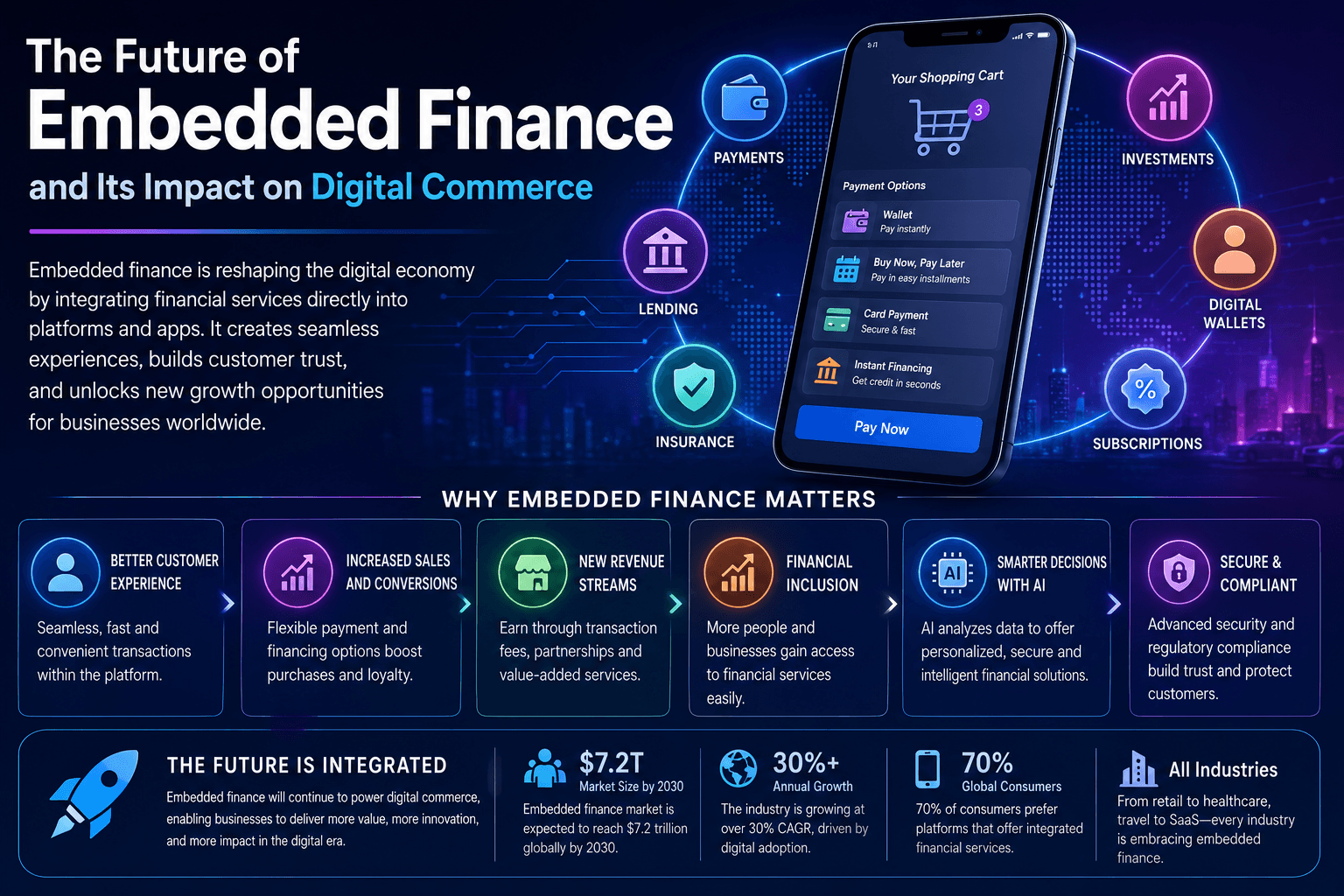
The lines between financial services and digital commerce are disappearing. Consumers no longer need to visit a bank or switch to a separate financial application to access payments, financing, insurance, or investment products. Instead, these services are being integrated directly into the digital platforms they use every day.
This transformation, known as embedded finance, is reshaping how businesses interact with customers and generate revenue. From e-commerce marketplaces to travel apps and SaaS platforms, companies are embedding financial products into the customer journey to deliver faster, more personalized, and frictionless experiences.
As digital commerce continues to evolve in 2026, embedded finance is becoming a strategic advantage rather than an optional feature.
What Is Embedded Finance?
Embedded finance is the integration of financial services into non-financial digital platforms, allowing customers to complete financial transactions without leaving the website or application they are already using.
Common examples include:
Buy Now, Pay Later (BNPL) at checkout
Integrated digital wallets
Embedded insurance during purchases
Merchant financing for small businesses
Subscription billing and payment management
In-app savings and investment features
By reducing friction in the customer journey, embedded finance helps businesses increase conversions while improving user satisfaction.
Why Embedded Finance Is Growing
Several factors are driving the rapid adoption of embedded finance:
Growing demand for seamless digital experiences
Increased smartphone and digital wallet usage
Advances in API technology
Expansion of cloud-based financial infrastructure
Greater consumer trust in digital payments
These trends are encouraging businesses to integrate financial services directly into their platforms rather than relying on third-party providers.
Improving Customer Experience
Modern consumers value convenience, speed, and personalization.
Embedded finance eliminates unnecessary steps by allowing customers to access payments, financing, or insurance without leaving the platform.
Benefits include:
Faster checkout experiences
Reduced cart abandonment
Flexible payment options
Personalized financial offers
Improved customer satisfaction
Higher customer retention
A seamless payment experience not only improves conversions but also strengthens long-term customer relationships.
Driving Growth in E-Commerce
E-commerce businesses are among the biggest beneficiaries of embedded finance.
Flexible payment methods, instant financing, and integrated wallets encourage shoppers to complete purchases while simplifying cross-border transactions and recurring subscriptions.
Retailers that offer multiple payment options often experience stronger customer engagement and improved sales performance.
Supporting Small and Medium-Sized Businesses
Embedded finance is making financial services more accessible for small businesses.
Many digital commerce platforms now offer merchants:
Instant working capital
Automated invoicing
Cash flow management
Integrated payment processing
Expense tracking
Financial reporting dashboards
These services reduce administrative complexity and help businesses manage growth more efficiently.
Artificial Intelligence Is Making Embedded Finance Smarter
Artificial intelligence is enhancing embedded finance by analyzing customer behavior and financial data in real time.
AI enables businesses to:
Personalize payment recommendations
Detect fraud more accurately
Automate credit assessments
Improve customer support with AI assistants
Strengthen regulatory compliance
Identify unusual transaction patterns
The combination of AI and embedded finance is creating faster, safer, and more intelligent digital financial experiences.
Embedded Finance Is Expanding Beyond Retail
Although embedded finance first gained momentum in e-commerce, adoption is now expanding across multiple industries, including:
Healthcare
Travel and hospitality
Education
Real estate
Transportation
Manufacturing
SaaS platforms
Organizations are integrating payments, financing, insurance, and subscription management into their digital ecosystems to improve customer experiences and create new revenue streams.
Security and Regulatory Compliance
As financial services become more deeply integrated into digital platforms, protecting customer information is becoming increasingly important.
Businesses should invest in:
Secure payment infrastructure
End-to-end encryption
Multi-factor authentication
Fraud prevention systems
Data privacy compliance
Continuous security monitoring
Strong cybersecurity practices help protect sensitive information while strengthening customer confidence.
New Revenue Opportunities
Embedded finance enables businesses to diversify income beyond traditional product sales.
Potential revenue sources include:
Payment processing fees
Revenue-sharing partnerships
Merchant financing
Insurance commissions
Premium subscription services
Financial product referrals
These additional income streams can improve long-term profitability while increasing customer engagement.
Challenges Businesses Should Consider
Despite its benefits, embedded finance presents several challenges:
Compliance with financial regulations
Data privacy requirements
Cybersecurity threats
Integration complexity
Customer trust
Technology costs
Organizations should carefully evaluate these factors when implementing embedded financial services.
The Future of Digital Commerce
Embedded finance is expected to become a standard feature of digital platforms over the coming years.
As artificial intelligence, cloud computing, and open banking continue to evolve, businesses will deliver increasingly personalized financial experiences that are seamlessly integrated into everyday digital interactions.
Companies that invest early in embedded finance can improve customer satisfaction, create new revenue opportunities, and strengthen their competitive position.
Key Takeaways
Embedded finance is transforming digital commerce by integrating financial services into everyday platforms.
AI is making financial experiences more personalized, secure, and efficient.
Businesses across industries are using embedded finance to improve customer engagement and generate new revenue.
Strong cybersecurity and regulatory compliance remain essential for successful implementation.
Organizations that embrace embedded finance today will be better positioned for the future of the digital economy.
Conclusion
Embedded finance is reshaping the relationship between businesses, consumers, and financial services. By embedding payments, lending, insurance, and other financial products directly into digital experiences, companies are reducing friction while creating greater value for their customers.
As digital commerce continues to expand, embedded finance is likely to become a core component of business strategy across industries. Organizations that combine secure technology, artificial intelligence, and customer-centric innovation will be well positioned to compete in the next generation of the digital economy.
FAQs: The Future of Embedded Finance and Its Impact on Digital Commerce
1. What is embedded finance?
Embedded finance is the integration of financial services directly into non-financial platforms, apps, marketplaces, and digital products, allowing customers to access payments, lending, insurance, banking, or other financial services without leaving the platform.
2. Why is embedded finance becoming important in digital commerce?
Embedded finance makes transactions faster and more convenient by integrating financial services directly into the customer journey. It can reduce friction, improve conversion rates, and create new revenue opportunities for digital businesses.
3. How does embedded finance affect online shopping?
It allows customers to access services such as one-click payments, digital wallets, installment plans, financing, and insurance within an online shopping experience.
4. What are examples of embedded finance?
Examples include buy now, pay later services at checkout, digital wallets inside shopping apps, instant merchant financing, integrated payment systems, and insurance offered during online purchases.
5. How can embedded finance increase e-commerce sales?
Flexible payment options and faster checkout experiences can reduce purchasing friction and potentially increase conversion rates, average order values, and customer retention.
6. What role do digital wallets play in embedded finance?
Digital wallets allow customers to store payment information and complete transactions quickly. When integrated into commerce platforms, they can make payments more seamless and convenient.
7. Can small businesses benefit from embedded finance?
Yes. Small businesses can use embedded payment processing, financing, invoicing, and other financial tools without building financial infrastructure themselves.
8. How does embedded lending work?
Embedded lending allows customers or businesses to access financing directly through a platform they already use. Automated systems may evaluate transaction and other permitted data to determine eligibility and financing options.
9. How can embedded finance benefit marketplaces?
Marketplaces can integrate payments, seller payouts, lending, expense management, and other financial services, creating a more complete ecosystem for buyers and sellers.
10. Does embedded finance create new revenue opportunities?
Yes. Businesses can potentially generate revenue through transaction fees, financial-product partnerships, lending services, subscriptions, or other embedded financial offerings.
11. What impact could embedded finance have on customer experience?
It can make financial interactions more convenient by removing the need to switch between different applications or websites during purchases and other transactions.
12. Is embedded finance secure?
Embedded finance can use technologies such as encryption, authentication, fraud detection, and transaction monitoring. However, businesses must implement strong security controls and comply with applicable financial and data-protection requirements.
13. What are the main challenges of embedded finance?
Major challenges include regulatory compliance, cybersecurity, data privacy, fraud prevention, integration complexity, customer trust, and managing relationships with financial-service providers.
14. How does artificial intelligence support embedded finance?
AI can help detect fraudulent transactions, personalize financial offers, analyze customer behavior, automate support, assess risk, and improve payment and financial decision-making processes.
15. What is the relationship between embedded finance and fintech?
Fintech companies often provide the technology and infrastructure that allow non-financial businesses to integrate financial services into their platforms and customer experiences.
16. How could embedded finance change digital commerce by 2030?
Embedded finance could become increasingly integrated into shopping, marketplaces, social commerce, business platforms, and digital services, making financial services a largely invisible part of everyday transactions.
17. Will embedded finance replace traditional banks?
Not necessarily. Banks are likely to remain important financial institutions, while embedded finance can change how customers access financial products by bringing those services into platforms they already use.
18. What industries can use embedded finance?
E-commerce, transportation, travel, healthcare, marketplaces, retail, software, logistics, real estate, and many other industries can integrate financial services into their digital experiences.
19. Why is customer data important for embedded finance?
Customer and transaction data can help businesses personalize financial experiences, identify fraud, understand purchasing behavior, and provide relevant services. However, data must be collected and used responsibly and in accordance with applicable privacy regulations.
20. What is the future of embedded finance?
The future of embedded finance is likely to involve increasingly seamless payments, lending, insurance, banking, and financial management integrated into digital experiences. As commerce becomes more connected, financial services may become an invisible but essential part of the customer journey.