
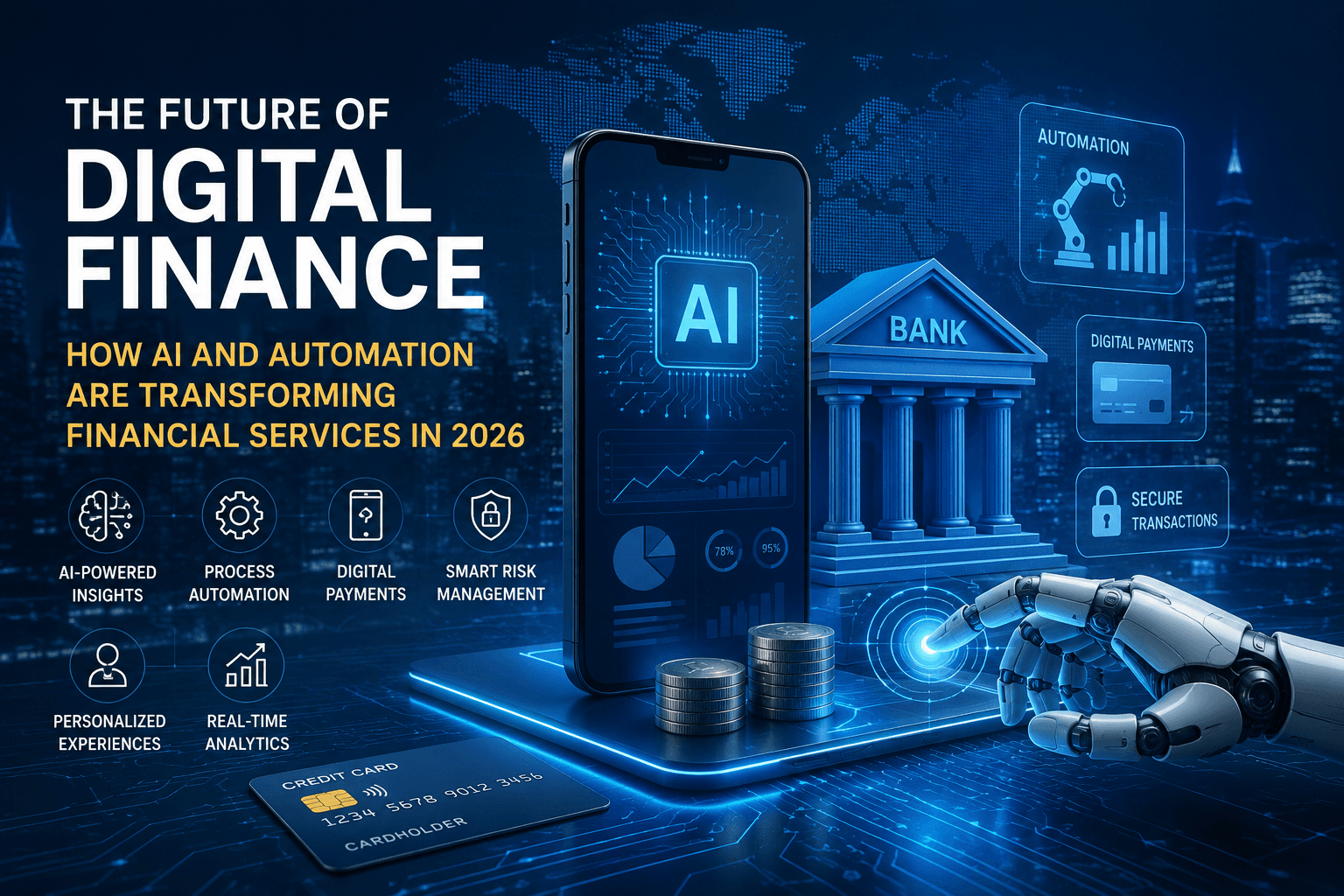

The finance industry is undergoing a major transformation as artificial intelligence, automation, digital payments, and advanced analytics reshape how businesses and consumers manage money. Financial institutions are no longer relying solely on traditional banking systems. They are increasingly using technology to improve efficiency, personalize services, manage risk, and make faster decisions.
In 2026, the focus is shifting from simply digitizing financial services to creating intelligent financial ecosystems that can respond to customers and market conditions in real time.
AI Is Reshaping Financial Decision-Making
Artificial intelligence is becoming an important tool for banks, fintech companies, investment firms, and corporate finance departments.
AI systems can analyze large volumes of financial information and identify patterns that may be difficult to detect manually. Businesses can use these capabilities for forecasting, fraud detection, credit assessment, customer service, and financial planning.
For example, AI-powered forecasting can help companies estimate future cash flow and identify potential financial challenges before they become serious problems.
This allows finance teams to move from reactive reporting toward proactive decision-making.
Automation Is Reducing Financial Workloads
Financial operations often involve repetitive tasks such as invoice processing, expense management, reconciliation, reporting, and data entry.
Automation can handle many of these processes with limited human intervention.
Intelligent automation can also identify unusual transactions, categorize financial information, and route activities to the appropriate employees for approval.
The result can be faster processing, fewer manual errors, and more time for finance professionals to focus on strategic responsibilities.
Digital Payments Continue to Expand
Digital payments have become an essential part of modern commerce.
Consumers increasingly expect fast and convenient payment options, while businesses want payment systems that are secure, efficient, and easy to integrate.
Mobile payments, digital wallets, instant transfers, and embedded payment systems are changing how money moves between consumers and businesses.
For companies, modern payment infrastructure can also provide valuable transaction data that supports financial analysis and customer insights.
Embedded Finance Is Changing Business Models
Finance is increasingly being integrated directly into non-financial products and services.
This concept, known as embedded finance, allows companies to offer financial services as part of their existing customer experiences.
For example, an e-commerce platform might provide payment plans, insurance, credit, or digital wallets without requiring customers to leave the platform.
This creates new revenue opportunities while making financial services more accessible.
Fraud Detection Is Becoming More Intelligent
As financial transactions become increasingly digital, cybersecurity and fraud prevention have become critical priorities.
Traditional fraud detection systems often rely on predefined rules.
AI-powered systems can analyze transaction behavior and identify unusual patterns in real time.
A system may flag activity based on factors such as transaction frequency, unusual spending behavior, account activity, or unexpected locations.
Human experts can then investigate potentially suspicious transactions.
This combination of automation and human oversight can strengthen financial security.
AI Is Transforming Customer Service
Financial institutions are also using AI-powered assistants and chatbots to improve customer support.
AI systems can answer common questions, explain financial products, assist with account-related requests, and route complicated issues to human representatives.
The goal is not necessarily to eliminate human customer service. Instead, automation can handle routine interactions while employees focus on more complex customer needs.
Financial Personalization Is Growing
Customers increasingly expect financial services to reflect their individual circumstances.
AI and data analytics can help institutions provide personalized recommendations and insights.
For example, financial platforms can analyze spending patterns and provide budgeting suggestions, savings recommendations, or alerts about unusual expenses.
Responsible personalization can improve customer experiences while helping people make more informed financial decisions.
Data Is Becoming a Strategic Financial Asset
Modern financial organizations generate enormous amounts of data.
Transaction histories, customer behavior, market information, operational data, and economic indicators can all contribute to better decision-making.
However, data is valuable only when it is accurate, secure, and properly managed.
Financial organizations therefore need strong data governance, cybersecurity, privacy controls, and integration capabilities.
The Rise of Real-Time Finance
Traditional financial reporting often provides information after an event has already occurred.
Modern digital systems are moving toward real-time financial visibility.
Businesses can increasingly monitor revenue, payments, expenses, cash flow, and financial risks as they happen.
Real-time information can help executives respond more quickly to changing market conditions and operational challenges.
Financial Professionals Are Becoming More Strategic
Technology is changing the role of finance professionals.
As routine processes become automated, accountants, analysts, and finance managers can spend more time on activities such as:
Strategic planning
Financial forecasting
Risk management
Business analysis
Investment decisions
Scenario planning
This means technology is not simply changing financial processes. It is also changing the skills that finance professionals need.
Cybersecurity Will Remain a Major Priority
Greater digitalization also creates greater cybersecurity risks.
Financial institutions are attractive targets for cybercriminals because they manage valuable financial and personal information.
Businesses need strong authentication, encryption, access controls, fraud monitoring, and employee security training.
AI can help detect suspicious activity, but organizations must also protect the AI systems themselves from manipulation and unauthorized access.
The Importance of Responsible AI in Finance
AI can improve financial services, but its use requires careful governance.
Financial decisions can significantly affect individuals and businesses. Organizations therefore need to consider issues such as fairness, transparency, privacy, security, and human oversight.
Companies should establish clear policies governing how AI systems are developed, deployed, monitored, and evaluated.
Responsible AI will become increasingly important as financial institutions use AI in more sensitive decision-making processes.
Conclusion
The future of finance is becoming increasingly digital, intelligent, and automated.
AI is improving financial forecasting and fraud detection, automation is reducing repetitive workloads, digital payments are accelerating transactions, and embedded finance is creating new business models.
However, technology alone will not determine success.
Financial organizations will need to combine advanced technology with strong cybersecurity, reliable data, responsible AI governance, and skilled professionals.
In 2026 and beyond, the most successful finance businesses will likely be those that use technology not simply to reduce costs, but to create faster decisions, better customer experiences, stronger financial resilience, and sustainable growth.
FAQs: The Future of Digital Finance
1. What is digital finance?
Digital finance refers to financial services delivered through digital technologies, including online banking, mobile payments, digital wallets, fintech platforms, AI-powered financial tools, and automated financial services.
2. How is AI transforming the finance industry?
AI is helping financial organizations analyze large amounts of data, detect fraud, automate processes, improve forecasting, personalize customer experiences, and support faster financial decision-making.
3. What is financial automation?
Financial automation uses software, AI, and other technologies to perform repetitive financial tasks such as invoice processing, reconciliation, expense management, reporting, and transaction monitoring with less manual intervention.
4. How are digital payments changing financial services?
Digital payments allow customers and businesses to transfer money quickly through mobile apps, digital wallets, online banking, and other electronic payment systems. They can make transactions faster and more convenient.
5. What is embedded finance?
Embedded finance involves integrating financial services directly into non-financial platforms. For example, an online marketplace may offer payments, lending, insurance, or financial accounts within its existing customer experience.
6. How does AI help detect financial fraud?
AI can analyze transaction patterns and identify unusual activity in real time. It can flag potentially suspicious transactions based on factors such as abnormal spending behavior, transaction frequency, or unexpected account activity.
7. Can AI improve financial forecasting?
Yes. AI-powered forecasting can analyze historical and real-time data to identify patterns and estimate potential future revenue, expenses, cash flow, demand, and financial risks.
8. How is digital finance improving customer experiences?
Digital finance enables faster services, personalized recommendations, automated support, convenient payments, and real-time financial information. AI assistants can also handle routine customer questions around the clock.
9. What are the biggest risks of digital finance?
Major risks include cybersecurity threats, fraud, data breaches, privacy concerns, system failures, and inappropriate use of AI. Financial organizations need strong security and governance measures to manage these risks.
10. What is the future of finance in 2026 and beyond?
Finance is expected to become increasingly automated, AI-powered, personalized, and real-time. Businesses that combine digital technologies with strong security, responsible AI governance, quality data, and human expertise can be better positioned for long-term growth.